In today’s digital age, we have access to more information than ever before. From news articles to social media posts, we are constantly bombarded with information from a wide range of sources. However, with so much information available, it’s becoming increasingly difficult to separate fact from fiction. This is where the concept of the “Information Cocoon Room” comes into play.
In today’s digital age, we have access to more information than ever before because of the rapid development of technology and the widespread use of the internet.
The internet has enabled us to access an enormous amount of information from across the globe, at any time, and from virtually any location with an internet connection. This has been made possible by the development of search engines, which can quickly and efficiently scan through millions of web pages to find the information that we are looking for.
Furthermore, the rise of social media and other online platforms has made it easier to share and disseminate information. This has led to the democratization of information, where individuals and organizations can share their ideas and perspectives with a global audience.
Finally, advances in technology have made it possible to store and process large amounts of data. This has led to the creation of massive databases and repositories of information, which can be analyzed and used to gain insights and understanding into a wide range of topics.
In summary, the digital age has given us access to more information than ever before thanks to the development of technology, the rise of the internet and search engines, the democratization of information through social media, and the ability to store and process vast amounts of data.
With so much information available, it’s becoming increasingly difficult to separate fact from fiction because of several reasons.

Firstly, the sheer volume of information available can be overwhelming, making it difficult to identify trustworthy sources. With so many different sources of information, it can be challenging to evaluate their reliability and accuracy.
Secondly, the rise of social media has made it easier for false information to spread quickly and widely. In some cases, misinformation and disinformation can be deliberately spread for political or financial gain, or to influence public opinion.
Thirdly, our own biases and preconceptions can make it difficult to objectively evaluate information. We may be more likely to believe information that confirms our existing beliefs, and less likely to accept information that challenges them.
Finally, the speed at which information is disseminated can make it difficult to separate fact from fiction. In the rush to be the first to report on a story, journalists and media outlets may not have had enough time to verify the information they are sharing.
In summary, the volume and speed of information available, the rise of social media, our own biases and preconceptions, and the pressure to be the first to report on a story can all make it difficult to separate fact from fiction in today’s information-rich environment.
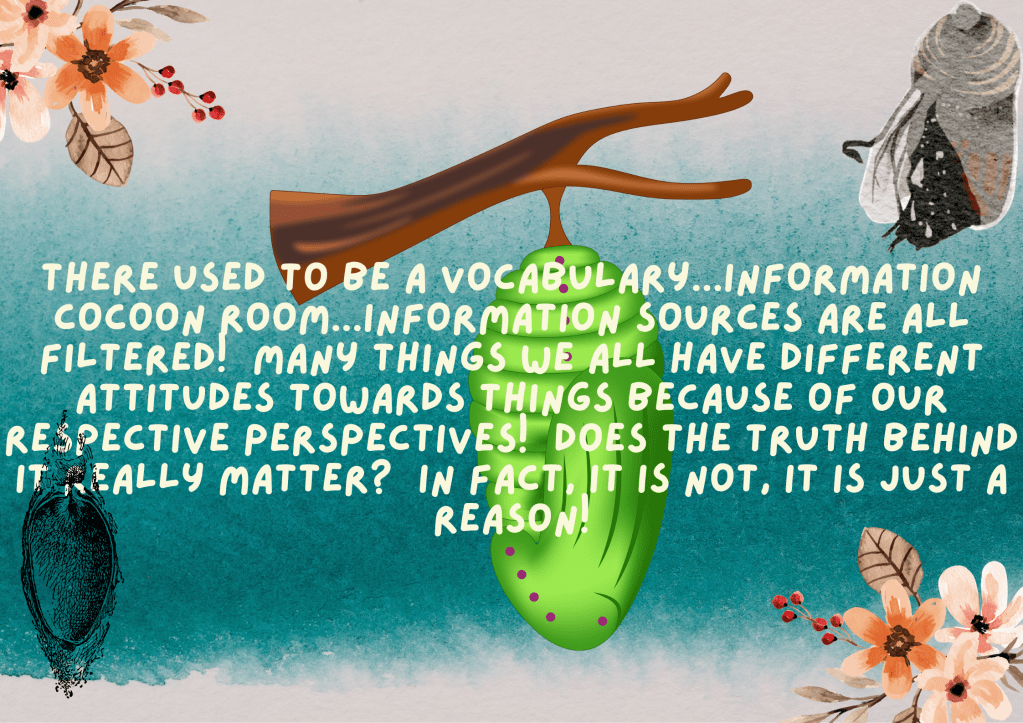
The Information Cocoon Room refers to the idea that we are all living in our own bubbles, where our information sources are filtered according to our individual preferences and biases. In other words, we are only exposed to information that confirms our existing beliefs and viewpoints, while information that challenges our beliefs is filtered out.
This can be problematic because it means that we are not getting a full picture of the world around us. We are only seeing a small slice of reality, which can lead to narrow-mindedness, intolerance, and an inability to empathize with others who have different perspectives.
One of the key factors that contribute to the Information Cocoon Room is the rise of social media. Social media algorithms are designed to show us content that is most likely to engage us, based on our past behavior. This means that we are more likely to see content that confirms our existing beliefs, rather than content that challenges them.
Another factor that contributes to the Information Cocoon Room is the rise of echo chambers. Echo chambers are groups of people who share similar beliefs and viewpoints, and who only engage with information that confirms their existing beliefs. This can lead to a reinforcement of beliefs and an inability to consider alternative viewpoints.
So, does the truth behind information really matter? In fact, it does. The truth is what allows us to make informed decisions and engage with the world around us in a meaningful way. When we only see a small slice of reality, we are not getting the full picture, which can lead to misunderstandings, intolerance, and a lack of empathy.
So, how can we break out of the Information Cocoon Room? Here are a few tips:
- Diversify your information sources: Make an effort to seek out information from a variety of sources, including sources that may challenge your existing beliefs.
- Engage with people who have different perspectives: Have conversations with people who have different beliefs and viewpoints than your own. This can help you to see the world from a different perspective and gain a deeper understanding of the issues at hand.
- Be open-minded: Be willing to consider alternative viewpoints and perspectives, even if they challenge your existing beliefs.
- Practice critical thinking: When consuming information, be sure to evaluate the source of the information, the credibility of the information, and the biases that may be present.
In conclusion, the Information Cocoon Room is a real phenomenon that is becoming increasingly prevalent in today’s digital age. By diversifying our information sources, engaging with people who have different perspectives, being open-minded, and practicing critical thinking, we can break out of our bubbles and gain a more nuanced understanding of the world around us. It’s important to remember that while it can be uncomfortable to engage with information that challenges our existing beliefs, it’s essential for personal growth, empathy, and a deeper understanding of complex issues.
Furthermore, it’s important to recognize that the Information Cocoon Room is not just a personal issue but also a societal issue. The spread of misinformation and the polarization of society are just some of the consequences of living in a world where our information sources are filtered according to our individual biases. As a society, we need to find ways to promote critical thinking, media literacy, and the ability to consider alternative viewpoints.
One way to address the issue is through education. By teaching critical thinking skills and media literacy in schools, we can help future generations to become more discerning consumers of information. Additionally, media outlets and social media platforms can take steps to promote diverse viewpoints and reduce the impact of echo chambers and filter bubbles.
Finally, it’s important to remember that the Information Cocoon Room is not a problem that can be solved overnight. It will require a concerted effort from individuals, organizations, and society as a whole to break down the barriers that prevent us from engaging with a diverse range of viewpoints and information sources.
In conclusion, the Information Cocoon Room is a complex issue that requires a nuanced approach. By diversifying our information sources, engaging with people who have different perspectives, being open-minded, practicing critical thinking, promoting media literacy, and reducing the impact of echo chambers and filter bubbles, we can begin to break down the barriers that prevent us from engaging with a full picture of reality.
It’s interesting to understand the concept of an “Information Cocoon Room” where information sources are filtered. Indeed, in today’s digital age, we often find ourselves surrounded by personalized news feeds, social media algorithms, and search engine rankings that cater to our interests and preferences. This can create a situation where we are exposed primarily to information that aligns with our existing beliefs and perspectives, forming what is often referred to as an “echo chamber.”
This phenomenon can have both positive and negative implications. On the positive side, personalized information filtering can save us time and energy by presenting us with content that is relevant and interesting to us. It allows us to access information that we find valuable, leading to a more efficient consumption of information.
However, on the negative side, this filtering can inadvertently reinforce our existing biases and limit our exposure to alternative viewpoints and perspectives. It can create an environment where conflicting opinions are silenced or downplayed, leading to a lack of critical thinking and a potential polarization of society. And if it is driven by some bigger force, say a government, then the people of that country have to cross those barriers to witness the reality. Otherwise, they see only what is being shown to them.
An important question tat comes to my mind is about the truth behind information and whether it really matters in the context of these filtered information environments. While it’s true that our perspectives and attitudes towards things are shaped by various factors, including our individual experiences, cultural backgrounds, and personal biases, the pursuit of truth remains crucial.
Truth acts as a compass that guides our understanding of the world and helps us make informed decisions. It provides a foundation for constructive dialogue and the exchange of ideas. Without a commitment to truth, discourse can become fragmented, and it becomes challenging to address societal issues or work towards common goals.
While it may be difficult to uncover an absolute and objective truth in many situations, engaging in open-mindedness, critical thinking, and seeking diverse perspectives can help us approach a more comprehensive understanding of complex topics. By actively seeking out different viewpoints, challenging our own assumptions, and considering multiple sources of information, we can strive to break out of our information cocoons and broaden our horizons.
It’s important to recognize that each individual’s perspective is influenced by their unique circumstances and experiences. However, this should not discourage us from seeking truth and striving for a more nuanced understanding of the world. The process of exploring different perspectives and evaluating information critically can enrich our knowledge and contribute to a more informed and empathetic society.
What’s your opinion?
Does it really matter?
In conclusion, while the concept of an “Information Cocoon Room” may highlight the personalized and filtered nature of information consumption today, it is essential to acknowledge the significance of truth in our pursuit of knowledge and understanding. By actively seeking diverse perspectives and engaging in critical thinking, we can transcend the limitations of our own biases and contribute to a more informed and open society.

 Poetry Hub
Hello. Thanks for visiting. I’d love to hear your thoughts! What resonated with you in this piece? Drop a comment below and let’s start a conversation.