Sanatan Nasadiya Sukta is a hymn or poem found in the Rigveda, one of the oldest sacred texts of Hinduism. It is considered a philosophical and contemplative composition that explores the origins of the universe and the nature of existence.
The Nasadiya Sukta is also known by other names, including “Hymn of Creation,” “Creation Hymn,” or “The Hymn of Non-Eternity.” It consists of a series of questions and reflections on the cosmic origins before formulating abstract concepts about the creation and the divine forces behind it.
The hymn presents abstract and speculative ideas about the creation of the universe, questioning its origins and the process through which it came into being. It explores the mysterious nature of existence, contemplating the presence or absence of gods, primordial matter, and the complexities of time and space.
Sanatan Nasadiya Sukta is highly regarded and studied for its philosophical and metaphysical content, as it delves into concepts of creation, existence, and the limitations of human understanding. It is revered as a profound exploration of the mysteries of the universe within the context of ancient Indian philosophy and spirituality.
The Sanatan Nasadiya Sukta is a hymn found in the Rigveda, which is an ancient collection of Sanskrit hymns. The Rigveda is considered to be the product of a collective effort by several ancient seers or sages known as the Rishis. Therefore, it is difficult to attribute authorship of specific hymns within the Rigveda, including the Sanatan Nasadiya Sukta, to any one individual. The hymns were memorized and transmitted orally across generations before eventually being compiled into the Rigveda.
Here are the opening verses of the hymn:
नासदासीन्नो सदासीत्तदानीं नासीद्रजो नो व्योमा परो यत् |
किमावरीवः कुह कस्य शर्मन्नभः किमासीद्गहनं गभीरम् ||
अप्रजो नेष्टा वियति प्रतश्था गभीष्णं नाम नृत्यति पृथिव्याम् |
धर्माणि पृथिव्या धर्मेण जायन्ते नित्यं महीं देवैः पर्यणानि ||
Please note that these are just the initial verses, and the complete hymn consists of more verses.
The Sanatan Nasadiya Sukta is composed in ancient Sanskrit, and I am providing here with an English translation of its key verses. Here is an approximate (and best possible) translation of some of the verses:
- In the primal void, neither nothingness nor existence prevailed. Air had not yet formed, nor the expansive heavens. Questions arose: What enveloped this state? Where did it reside? Whose guardianship held it? Did an enigmatic cosmic water exist, concealed in immeasurable depths?
- In that timeless realm, the boundaries between mortality and immortality were non-existent. The distinction between day and night had yet to be illuminated. The eternal One existed, breathing without the stir of wind, self-sufficient and unyielding. In that moment, there was only that One, with no other entity to be found.
- In the beginning, darkness shrouded everything, a boundless cloak enveloping the unknown. The vast expanse existed as unilluminated water, a realm untouched by light. Then, from the void, emerged a singular entity, enclosed within the void itself. Finally, like a phoenix rising from ashes, it was born, ignited by the magnificent power of heat. In this majestic act, life sprang forth, destined to shine brightly amidst the darkness.
- At the dawn of existence, a profound yearning embraced the void, seeding creation itself. Desire, the primal force, emerged from the depths of the mind, birthing the essence of life. The wise sages, delving into the depths of their enlightened hearts, have discovered a profound truth: that which exists is shaped by the absence of what it is not. In this paradoxical dance, the interplay of presence and absence, lies the essence of existence, known only to those who seek wisdom’s path.
Please note that this is just a partial translation, and the complete hymn is longer. The precise interpretation may vary depending on different translations and commentaries.
The Sanatan Nasadiya Sukta, being a philosophical and metaphorical hymn, has been subject to various interpretations and commentaries by scholars and philosophers over the centuries. Here are a few interpretations that have been derived from the hymn:
- Creation and Cosmology: One interpretation focuses on the hymn’s exploration of the origin and nature of the universe. It contemplates the existence or non-existence of the universe before its creation, questions the role of divine forces or cosmic elements in the process, and reflects on the mysteries surrounding creation.
- Existence and Non-Existence: The hymn raises questions about the concepts of existence and non-existence. It ponders the state of the universe before its manifestation and explores the interplay between being and non-being, suggesting a cyclical view of creation and dissolution.
- The Limitations of Human Understanding: Another interpretation highlights the hymn’s philosophical inquiry into the limits of human comprehension. It suggests that knowledge and perception are constrained by human faculties, and there may be fundamental aspects of reality that transcend human understanding.
- Primordial Substance and Consciousness: Some interpretations delve into the concept of a primordial substance or primal matter from which the universe emerges. It explores the connection between the metaphysical and material aspects of existence and the role of consciousness in the creative process.
- Metaphysical Speculation: The Sanatan Nasadiya Sukta is seen as an expression of deep philosophical reflection and metaphysical speculation. It invites contemplation on the nature of the divine, the complexities of time and space, and the mysteries of existence.
These interpretations may vary depending on the perspective and philosophical framework of the commentators. The Sanatan Nasadiya Sukta continues to inspire profound discussions and reflections on the nature of reality, cosmology, and human existence.
The verses of the Sanatan Nasadiya Sukta have been highly regarded for their contemplation on the creation of the universe. While interpretations may vary, these verses touch upon fundamental questions about the origin and nature of existence. They evoke a sense of wonder and curiosity about the mysteries surrounding the creation of the universe.
The hymn explores the concept of the universe emerging from a state of non-existence and raises inquiries about the cosmic elements, the role of divine forces, and the nature of primal matter. It invites deep philosophical contemplation on the interplay of existence and non-existence, the limitations of human understanding, and the complexities of cosmology.
These verses resonate with the quest for knowledge and understanding of the universe’s origins, and they provide a thought-provoking framework for philosophical and metaphysical discussions. However, it is important to note that the interpretation and resonance of these verses may vary depending on individual perspectives and philosophical frameworks.
Overall, the Sanatan Nasadiya Sukta’s verses offer a poetic and profound exploration of the creation of the universe, stimulating contemplation and inspiring seekers of truth to ponder the mysteries of existence.
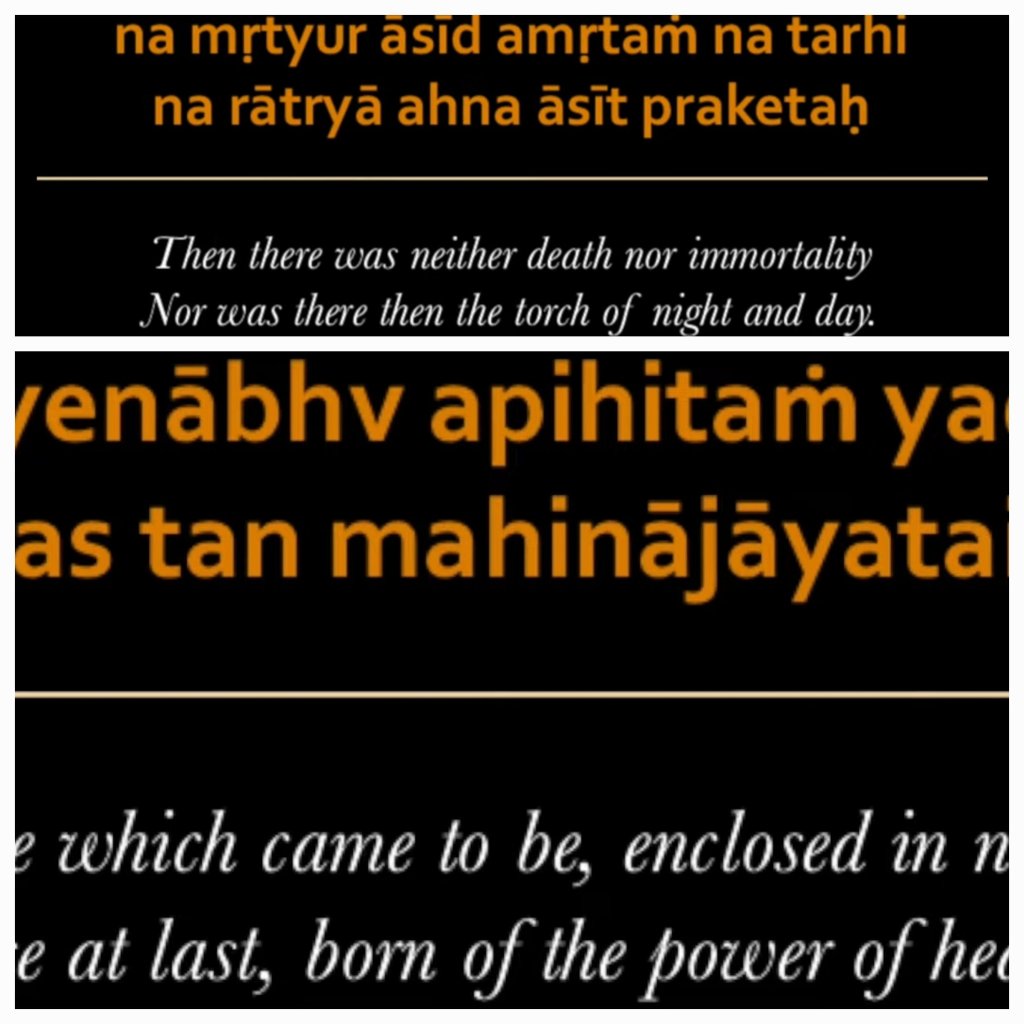
The verses of the Sanatan Nasadiya Sukta can indeed resonate with the notion of the life and death cycle. The hymn’s exploration of existence and non-existence, creation and dissolution, and the interplay between being and non-being reflects profound philosophical and metaphysical themes that can be related to the cycles of life and death.
The hymn contemplates the state of the universe before its manifestation, questioning the nature of existence and the processes that lead to creation. It raises inquiries about the cyclical nature of the cosmos, suggesting that the universe undergoes periods of manifestation and dissolution, mirroring the cycles of life and death that are observed in the natural world.
Furthermore, the questioning and introspective nature of the hymn can be seen as a reflection of the human quest for understanding the mysteries of life and death. It invites contemplation on the limitations of human understanding and the deeper realities beyond our comprehension, acknowledging that life and death are interconnected aspects of the broader cosmic order.
While the primary focus of the Sanatan Nasadiya Sukta is on the nature of creation, its themes and philosophical inquiries can be interpreted in ways that resonate with the cycles of life and death. It offers a perspective that encourages reflection on the transient nature of existence and the enduring mysteries of the universe.
It’s important to note, however, that the interpretation and resonance of these verses can vary depending on individual perspectives and philosophical frameworks. Different individuals and cultures may find different meanings and connections within the hymn when contemplating the cycles of life and death.

 Poetry Hub
Hello. Thanks for visiting. I’d love to hear your thoughts! What resonated with you in this piece? Drop a comment below and let’s start a conversation.