The Economy Class Founder by Manasij Ganguli is a candid and captivating memoir of a first-time entrepreneur who dared to pursue his dream of building a successful startup. Manasij Ganguli, the co-founder and CEO of ThreadSol, a software company that provides solutions for the apparel industry, shares his journey of overcoming multiple challenges, failures, and near-bankruptcies, as well as celebrating the joys, learnings, and achievements of his venture.
The book is divided into three parts, each corresponding to a different phase of ThreadSol’s evolution: the inception, the growth, and the exit. The author narrates his story in a conversational and humorous tone, often breaking the fourth wall and addressing the reader directly. He does not shy away from revealing his mistakes, doubts, fears, and emotions, making the reader feel like a confidant and a witness to his roller-coaster ride.
The book is full of anecdotes and insights that illustrate the realities and complexities of the startup world. The author describes the various aspects of building a startup, such as finding the right co-founders, validating the idea, raising funds, hiring talent, developing the product, acquiring customers, expanding globally, and negotiating the exit. He also reflects on the personal and professional sacrifices, trade-offs, and dilemmas that he faced along the way.
The book is not a typical success story that glorifies the founder or the startup. Rather, it is a realistic and relatable account of the struggles, failures, and learnings that are inevitable in any entrepreneurial journey. The author does not offer any prescriptive advice or formulaic solutions, but instead lets the reader draw their own conclusions and lessons from his experiences. The book is a valuable and inspiring read for anyone who is interested in entrepreneurship, especially in the Indian context. It is also a compelling and entertaining story of a man who followed his passion and vision, and achieved his dream of creating a positive impact in the world.
The target audience for this book are people who are interested in entrepreneurship, especially in the Indian context. The book is suitable for anyone who wants to learn from the experiences of a first-time founder who built a successful startup from scratch. The book is also appealing for anyone who enjoys reading a realistic and relatable story of passion, vision, and impact.
This book is not a typical success story that glorifies the founder or the startup. Rather, it is a realistic and relatable account of the struggles, failures, and learnings that are inevitable in any entrepreneurial journey. Therefore, you should not expect from this book:
A prescriptive advice or formulaic solution for building a successful startup. The book does not offer any generic tips or tricks, but instead lets the reader draw their own conclusions and lessons from the author’s experiences.
A comprehensive or technical guide for developing a software product or a solution for the apparel industry. The book does not go into the details of the product development or the domain knowledge, but focuses more on the business and personal aspects of the startup journey.
A glamorous or romanticized portrayal of the startup life. The book does not hide the challenges, sacrifices, trade-offs, and dilemmas that the author faced along the way. The book shows the reality and complexity of the startup world, especially in the Indian context.
Some of the key turning points in the book are:
The moment when the author and his co-founders decided to quit their jobs and start ThreadSol, a software company that provides solutions for the apparel industry.
The moment when they got their first customer, a garment factory in Sri Lanka, after months of cold calling and pitching.
The moment when they faced a near-bankruptcy situation and had to cut down their expenses drastically, living in cheap hotels and taking long bus rides.
The moment when they received their first funding from Blume Ventures, a venture capital firm that believed in their vision and potential.
The moment when they expanded their business to China, the largest apparel market in the world, and faced various challenges and opportunities there1.
The moment when they achieved a net positive cash flow and became profitable, proving their business model and value proposition.
The moment when they decided to sell their company to Coats, a global leader in industrial thread manufacturing, and negotiated the exit deal.
The flow of the story is smooth and engaging. The author uses a chronological order to narrate his startup journey, starting from the inception, to the growth, and to the exit. He also uses flashbacks and foreshadowing to create suspense and interest. The author switches between different scenes and locations, such as India, Sri Lanka, China, and the UK, to show the diversity and scale of his business. He also balances the story with humor, emotions, and reflections, making the reader feel connected and involved. The book is well-structured and well-paced, keeping the reader hooked till the end.
The character building is one of the strengths of the book. The author portrays himself and his co-founders as realistic and relatable characters, who have their own strengths, weaknesses, personalities, and motivations. The author also introduces and describes the various people who influenced and supported his startup journey, such as his mentors, investors, customers, employees, and family members. He shows how each character contributed to the success or failure of his venture, and how they interacted and communicated with each other. He also reveals the emotions, thoughts, and conflicts that each character experienced, making them more human and complex. The book makes the reader feel like they know the characters personally, and care about their outcomes.
Here are several notable insights gleaned from the book:
Entrepreneurship is not a glamorous or easy path, but a challenging and rewarding one. It requires passion, vision, perseverance, and resilience to overcome the obstacles and failures that are inevitable in any startup journey.
Entrepreneurship is not a solo or linear journey, but a collaborative and iterative one. It involves finding the right co-founders, mentors, investors, customers, and employees who share your vision and values, and who can help you grow and improve your product and business.
Entrepreneurship is not a static or predictable journey, but a dynamic and uncertain one. It involves adapting to the changing market needs, customer preferences, and competitive landscape, and constantly innovating and experimenting with new ideas and solutions.
Entrepreneurship is not a selfish or isolated journey, but a social and impactful one. It involves creating a positive change in the world, solving real problems, and making a difference in the lives of others.
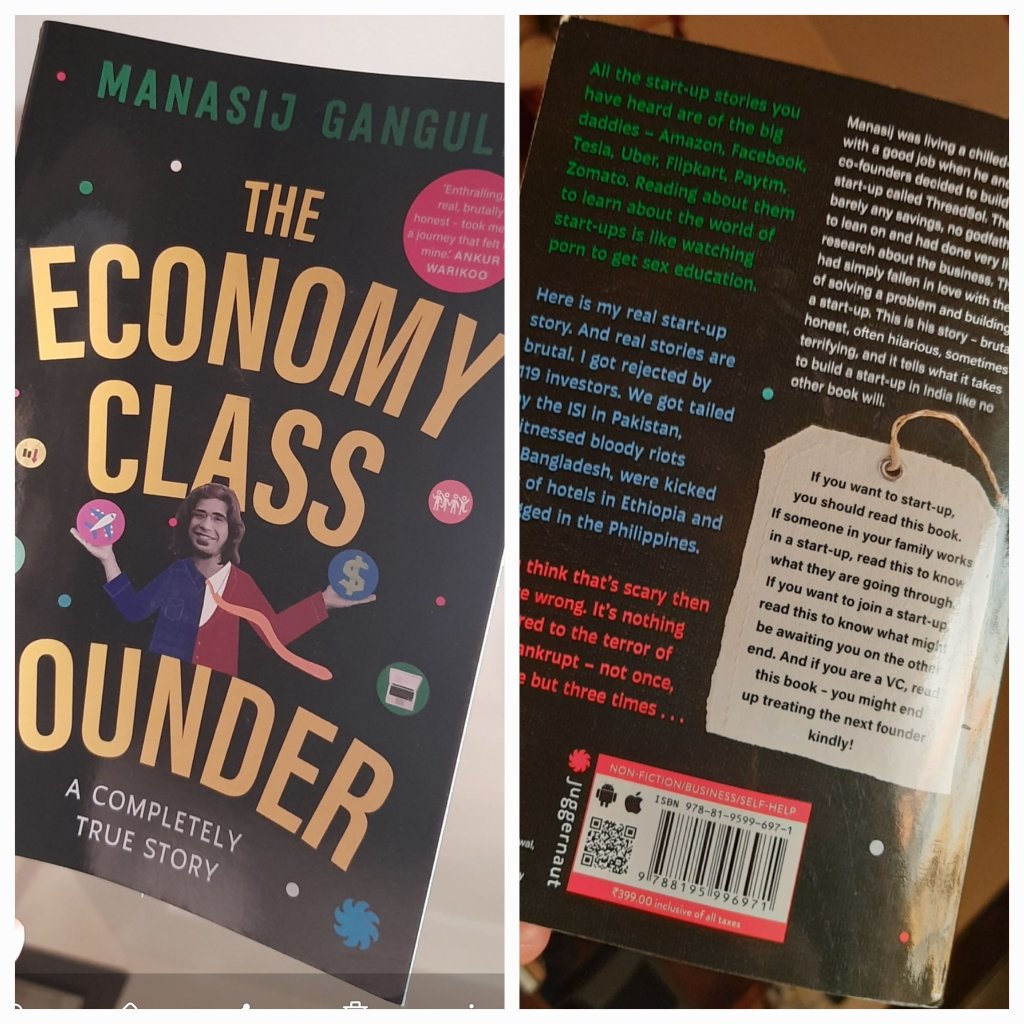
The cover and title of the book are both eye-catching and intriguing. The cover shows a man in a suit and tie, holding a laptop and a backpack, standing in front of an airplane. The title, The Economy Class Founder, suggests that the book is about a founder who travels the world on a budget, while building a successful startup. The cover and title also convey a sense of humor and adventure, which are reflected in the author’s writing style and tone. The cover and title are effective in attracting the attention and curiosity of the potential readers, especially those who are interested in entrepreneurship, startups, and travel.
The book The Economy Class Founder by Manasij Ganguli is generally well-received by the readers and critics, who appreciate the author’s candid and humorous narration of his startup journey, his realistic and relatable portrayal of the challenges and learnings of entrepreneurship, and his insights and reflections on the Indian startup ecosystem. However, some aspects of the book could have been better, such as:
The book could have been more balanced and objective in presenting the perspectives and opinions of the other stakeholders involved in the startup, such as the co-founders, the investors, the customers, and the employees. The book mostly focuses on the author’s personal experiences and views, which may not capture the whole picture or the diversity of the startup world.
The book could have been more structured and organized in terms of the flow and the content. The book sometimes jumps from one topic to another, or from one time period to another, without a clear transition or connection. The book also contains some repetitions and digressions, which may affect the readability and the coherence of the story.
The book could have been more informative and educational in terms of the technical and domain knowledge related to the product and the industry. The book does not go into the details of how the software solution works, how it solves the problems of the apparel industry, and what are the competitive advantages and the unique value propositions of the startup. The book also does not provide enough data or evidence to support the claims or the achievements of the startup.
Conclusion:
The Economy Class Founder by Manasij Ganguli is a book that tells the story of a first-time entrepreneur who built a successful startup from scratch, while traveling the world on a budget. The book is a candid and humorous memoir of the author’s startup journey, full of anecdotes and insights that illustrate the realities and complexities of the startup world, especially in the Indian context. The book is also a reflection and a lesson on the passion, vision, and impact of entrepreneurship, and the challenges, failures, and learnings that are inevitable in any entrepreneurial journey. The book is a valuable and inspiring read for anyone who is interested in entrepreneurship, startups, and travel. The book is also a compelling and entertaining story of a man who followed his dream and achieved his goal of creating a positive change in the world.

 Poetry Hub
Hello. Thanks for visiting. I’d love to hear your thoughts! What resonated with you in this piece? Drop a comment below and let’s start a conversation.