India’s Rapid Military Modernization: A Sign of War Preparation?
India is undergoing a massive military modernization program, with a focus on developing indigenous arms and weapon systems. The country has conducted at least half a dozen missile tests in the last week, showcasing its capabilities in various domains such as air, land, sea, and space. Some of the notable weapons that India has tested or plans to develop are:
- Agni-P: A medium-range ballistic missile that can carry nuclear warheads and has a range of over 2,000 km. It is designed to replace the older Agni-1 and Agni-2 missiles and has features such as maneuverable re-entry vehicle and composite motor casing.
- AMCA: An advanced medium combat aircraft that is expected to be a fifth-generation stealth fighter jet with multi-role capabilities. It will be powered by an indigenous engine and will have features such as supercruise, thrust vectoring, and internal weapon bay.
- Tejas Mk2: An improved version of the Tejas light combat aircraft that is currently in service with the Indian Air Force. It will have a higher thrust engine, increased fuel capacity, enhanced avionics, and better weapon integration.
- ATAGS: An advanced towed artillery gun system that is designed to be the world’s longest-range artillery gun. It can fire shells up to 48 km and has features such as an electronic suite, a digital fire control system, and an automatic ammunition loading system.
- MaRG: A medium-range guided rocket system that can fire rockets up to 120 km and can be mounted on a truck or a helicopter. It can be used for precision strikes against enemy targets such as bunkers, radar stations, and airfields.
- Akash NG: A new generation surface-to-air missile system that can intercept aerial targets up to 70 km and can engage multiple targets simultaneously. It has a seeker-based guidance system, a high-speed propulsion system, and a digital signal processor.
- Brahmos ER: An extended-range version of the Brahmos supersonic cruise missile that can strike targets up to 800 km. It has a ramjet engine, a stealthy body, and a terminal guidance system. It can be launched from land, sea, air, and underwater platforms.
- New destroyers and indigenous submarines: India is building seven new stealth destroyers and six indigenous submarines under its Project 15B and Project 75I respectively. The destroyers will have advanced weapons and sensors, such as long-range surface-to-air missiles, anti-submarine rockets, and multi-function radars. The submarines will have air-independent propulsion, land-attack cruise missiles, and torpedoes.
- Plans for 3rd IAC: India is planning to build its third indigenous aircraft carrier, which will be larger and more capable than its existing carriers. It will have a displacement of 65,000 tonnes, a catapult launch system, and a nuclear propulsion system. It will be able to carry up to 50 aircraft, including fighters, helicopters, and drones.
These weapons and platforms are part of India’s vision to achieve self-reliance in the defence sector and to enhance its deterrence and combat capabilities. However, some analysts also see them as a sign of India’s war preparation, especially in the context of its rising tensions with China and Pakistan. India has been engaged in a border standoff with China in Ladakh since last year, which resulted in a violent clash that killed 20 Indian soldiers and an unknown number of Chinese troops. India has also accused Pakistan of sponsoring terrorism and violating the ceasefire along the Line of Control in Kashmir.
Some experts believe that India is preparing for a limited war with China and/or Pakistan, and that its military modernization is aimed at creating a credible conventional and nuclear deterrent. They argue that India’s Prime Minister Narendra Modi is aware of the impending threat and is taking proactive measures to secure India’s interests and sovereignty. They cite Modi’s statements and actions, such as his visit to Ladakh in July 2020, his signing of the India-U.S. Basic Exchange and Cooperation Agreement (BECA) in October 2020, and his participation in the Quad summit in March 2021, as evidence of his war readiness.
However, other experts caution that India’s military modernization does not necessarily imply a war intention, and that it is rather a response to the changing security environment and the growing challenges posed by China and Pakistan. They contend that India’s defence policy is still guided by the principles of restraint, responsibility, and dialogue, and that India does not seek a war with any country. They point out that India’s weapons and platforms are still under development and testing, and that they will take time to be fully operational and integrated. They also highlight that India faces many constraints and risks in waging a war, such as economic costs, diplomatic isolation, and escalation scenarios .
In conclusion, India’s rapid military modernization is a reflection of its ambition to become a major power and a self-reliant nation in the defence sector. It is also a manifestation of its need to cope with the emerging threats and challenges from its adversaries, especially China and Pakistan. Whether India’s military modernization is a sign of war preparation or not is a matter of debate and perception, but it is clear that India is not a passive or weak actor in the regional and global arena, and that it is ready to defend its interests and sovereignty if necessary.
India is pursuing several ambitious military modernization projects to enhance its defense capabilities and self-reliance in the face of growing threats and challenges from China and Pakistan. Some of the future plans that India has in the pipeline are:
- Project 75 (India): A project to acquire six advanced diesel-electric submarines with air-independent propulsion and land-attack cruise missiles. The project is still under discussion and is expected to cost around $7 billion.
- Light tank Zorawar: A project to develop an indigenous light tank for the land forces, especially for high-altitude operations. The tank will have a weight of 25-30 tonnes, a 105 mm gun, and a crew of three. The project has been approved by the government and is expected to be completed by 2026.
- Kaveri Marine Gas Turbine (KMGT): A project to develop an indigenous gas turbine engine for naval ships and submarines. The engine will have a power output of 12-18 MW and will reduce India’s dependence on foreign suppliers. The project is in the advanced stage of development and is expected to be ready by 2024.
- Project DURGA: A project to equip the army with advanced night-vision devices and thermal imaging systems. The project will enhance the army’s ability to conduct night operations and detect enemy movements. The project is in the final stage of procurement and is expected to be completed by 2023.
- Future Ready Mechanized Platforms: A project to acquire futuristic infantry combat vehicles and advanced main-battle tanks for the army. The vehicles will have features such as stealth, mobility, firepower, and survivability. The project is in the initial stage of design and development and is expected to be completed by 2030.
These are some of the major projects that India is working on to ramp up its military modernization. India is also investing in other areas such as drones, missiles, radars, satellites, and cyber warfare to strengthen its defense capabilities and deterrence posture. India is one of the world’s top five arms importers, but it is also striving to achieve self-reliance and indigenization in the defense sector. 🇮🇳
India’s military is one of the largest and most powerful in the world, ranking fourth in the Global Firepower Index for 2023. India has a total population of over 1.3 billion, with about 653 million available manpower and 1.45 million active personnel. India’s defense budget is $54.2 billion, which is the fourth-highest in the world. India has a strong and diverse arsenal of weapons and platforms, including nuclear weapons, ballistic missiles, fighter jets, tanks, submarines, and aircraft carriers.
China and Pakistan are India’s main rivals in the region, and both pose significant threats and challenges to India’s security and interests. China ranks second in the Global Firepower Index for 2023, with a total population of over 1.4 billion, about 750 million available manpower, and 2.1 million active personnel. China’s defense budget is $208 billion, which is the second-highest in the world. China has a formidable and modern military, with advanced capabilities in cyber, space, and artificial intelligence. China also has a large and growing inventory of nuclear weapons, ballistic missiles, stealth fighters, hypersonic weapons, and aircraft carriers.
Pakistan ranks seventh in the Global Firepower Index for 2023, with a total population of about 243 million, about 104 million available manpower, and 654,000 active personnel. Pakistan’s defense budget is $7.5 billion, which is the 29th-highest in the world. Pakistan has a relatively smaller and less sophisticated military than India and China, but it compensates with its asymmetric and unconventional warfare tactics, such as sponsoring terrorism and using proxy forces. Pakistan also has a sizable and credible nuclear deterrent, with an estimated 160 nuclear warheads and various delivery systems.
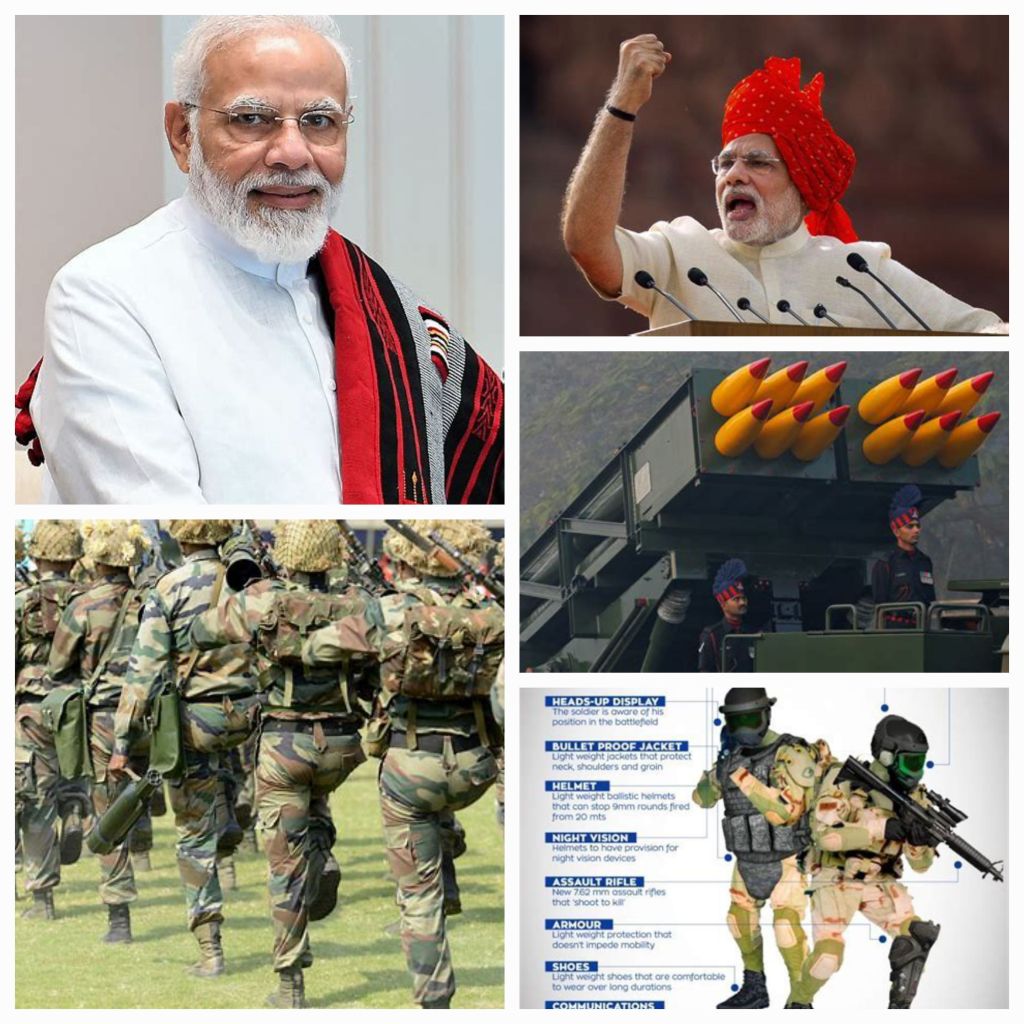
India, China, and Pakistan have a history of conflicts and disputes over territorial, ideological, and strategic issues. India and China fought a brief but bloody war in 1962 over their disputed border in the Himalayas, and have been engaged in a tense standoff in Ladakh since 2020. India and Pakistan have fought four wars since their partition in 1947, mainly over the disputed region of Kashmir, and have been involved in several skirmishes and crises along the Line of Control. India faces the challenge of a two-front war scenario, where it may have to fight both China and Pakistan simultaneously or in quick succession. India has developed a strategy based on deterrence and dissuasion to prevent any loss of territory or escalation of conflict, but it also faces many constraints and risks in waging a war, such as economic costs, diplomatic isolation, and escalation scenarios.
In conclusion, India’s military is a formidable force that can defend its interests and sovereignty against any adversary, but it also faces significant challenges and threats from China and Pakistan, who have their own strengths and advantages. India’s military comparison with China and Pakistan is not a simple or straightforward matter, as it depends on many factors and variables, such as the nature, scope, and intensity of the conflict, the political and diplomatic context, the operational and logistical aspects, and the human and moral dimensions. India, China, and Pakistan are all nuclear-armed states, which adds another layer of complexity and uncertainty to their military relations. Therefore, it is in the interest of all parties to avoid a war and pursue peaceful and cooperative solutions to their disputes and differences. 🕊️

 Poetry Hub
Hello. Thanks for visiting. I’d love to hear your thoughts! What resonated with you in this piece? Drop a comment below and let’s start a conversation.