Discover the significant developments in Indian electoral governance as the Chief Election Commissioner bill takes center stage. Lok Sabha’s approval on December 21, 2023, marks a transformative shift in the regulation of Election Commission appointments and procedures. Explore the key aspects of this groundbreaking bill and its potential implications for the democratic process in India.
The Chief Election Commissioner bill has been passed by the Lok Sabha on December 21, 2023. Here are some key points about the bill and its implications:
- The bill supersedes the 1991 Act that regulated the salary and tenure of the Election Commission and the manner of conducting its business. It provides for the appointment, salary, and removal of the Chief Election Commissioner (CEC) and Election Commissioners (ECs).
- The bill proposes that the CEC and ECs will be appointed by the President upon the recommendation of a Selection Committee. The Selection Committee will consist of the Prime Minister, a Union Cabinet Minister, and Leader of Opposition/leader of the largest opposition party in Lok Sabha.
- The bill also specifies that the salary and conditions of service of the CEC and ECs will be equivalent to that of Cabinet Secretary. Under the 1991 Act, it was equivalent to the salary of a Supreme Court Judge.
- The bill has been criticized by the opposition parties and some experts for undermining the independence and autonomy of the Election Commission. They argue that the bill violates the Supreme Court’s direction that the Election Commission should be selected by a panel comprising the Prime Minister, the Leader of the Opposition, and the Chief Justice of India (CJI).
- The government has defended the bill, saying that it is aimed at bringing transparency and accountability in the appointment process of the Election Commission. It also claims that the bill does not alter the constitutional status of the CEC and ECs, and that they will continue to enjoy the same protection and immunity as before.
The purpose behind the Chief Election Commissioner and Other Election Commissioners (Appointment, Conditions of Service and Term of Office) Bill, 2023 is to regulate the appointment, conditions of service and term of office of the Chief Election Commissioner (CEC) and other Election Commissioners (ECs), and the procedure for transaction of business by the Election Commission. Here is a detailed explanation of the bill and its various aspects:
- Background: The Constitution specifies that the President will appoint the CEC and ECs, subject to the provisions of an Act of Parliament. However, until now, there was no such Act that prescribed the selection process of the Election Commission. The existing law, the Election Commission (Conditions of Service of Election Commissioners and Transaction of Business) Act, 1991, only provided for the salary and tenure of the CEC and ECs, and the manner of conducting the business of the Election Commission. The appointment of the CEC and ECs was done by the executive without any parliamentary oversight or judicial scrutiny.
- Intent: The government has stated that the bill is intended to bring transparency and accountability in the appointment process of the Election Commission, and to ensure that the CEC and ECs are persons of high integrity and competence. The government has also claimed that the bill does not alter the constitutional status of the CEC and ECs, and that they will continue to enjoy the same protection and immunity as before.
- Need: The need for a statutory framework for the appointment of the Election Commission has been highlighted by various committees and experts over the years. For instance, the Law Commission of India, in its 255th report in 2015, recommended that a collegium headed by the Prime Minister, and comprising the Leader of Opposition and the Chief Justice of India, should make recommendations for the appointment of the CEC and ECs to the President. The Commission also suggested that the qualifications, experience, and procedure for appointment should be specified in the law⁴. Similarly, the Second Administrative Reforms Commission, in its 4th report in 2007, recommended that the CEC and ECs should be appointed by the President on the advice of a committee consisting of the Prime Minister, the Leader of Opposition, and the Chief Justice of India.
- Necessity: The necessity of having a statutory mechanism for the appointment of the Election Commission arises from the need to safeguard its independence and autonomy from the executive. The Election Commission is entrusted with the responsibility of conducting free and fair elections, which is the cornerstone of democracy. Therefore, it is essential that the CEC and ECs are appointed through a transparent and participatory process, and that they are insulated from any political interference or influence. The Supreme Court, in its judgment in March 2023, observed that the selection of the Election Commission should be done by a panel comprising the Prime Minister, the Leader of Opposition, and the Chief Justice of India, until the parliament frames a law prescribing the selection process. The Court also noted that the Election Commission performs quasi-judicial functions, and hence, its members should have the same status and protection as the judges of the Supreme Court.
- Impacts: The bill, if enacted, will have several impacts on the functioning and credibility of the Election Commission. Some of the possible impacts are:
- The bill may undermine the independence and autonomy of the Election Commission, as the selection process may be dominated by the government. The bill proposes that the CEC and ECs will be appointed by the President upon the recommendation of a Selection Committee, which will consist of the Prime Minister, a Minister from the Union Cabinet, and the Opposition Leader/leader of the biggest opposition party in the Lower House. This means that two out of three members of the Selection Committee will be from the ruling party, and they may have a decisive say in the appointment of the Election Commission. Moreover, the bill states that the recommendations of the Selection Committee will be valid even when there is a vacancy in this Committee. This may effectively lead to a monopoly of government members in selecting candidates.
- The bill may also compromise the impartiality and accountability of the Election Commission, as the eligibility criteria and removal process may be influenced by the government. The bill specifies that the eligibility for the posts of CEC and ECs includes holding (or having held) a post equivalent to the Secretary to the central government. This may limit the pool of candidates to senior bureaucrats, who may have served under the government, and may exclude other suitable candidates from other fields. The bill also makes the salary and conditions of service of the CEC and ECs equivalent to that of Cabinet Secretary. This may lead to government influence, as the salary of the Cabinet Secretary is fixed by the government. This differs from the salary of a Supreme Court judge, which is determined by a law passed by Parliament. Furthermore, the bill does not specify the grounds and procedure for the removal of the CEC and ECs, and leaves it to the discretion of the President. This may create scope for arbitrary and politically motivated removals.
- The bill may also violate the Supreme Court’s direction that the Election Commission should be selected by a panel comprising the Prime Minister, the Leader of Opposition, and the Chief Justice of India. The bill has dropped the Chief Justice of India from the Selection Committee, in an attempt to keep the judiciary away from the selection process. However, this may be seen as a disregard for the Supreme Court’s judgment, which was aimed at ensuring the independence and judicial character of the Election Commission.
- Usefulness: The bill, if implemented properly, may have some usefulness in terms of providing a statutory framework for the appointment of the Election Commission, which was lacking so far. The bill may also bring some clarity and uniformity in the salary and tenure of the CEC and ECs, which were previously determined by the executive. The bill may also enhance the transparency and accountability of the Election Commission, by requiring the Selection Committee to publish the names of the candidates and the reasons for their selection or rejection.
- Drawbacks: The bill, however, may have more drawbacks than benefits, as it may compromise the independence, autonomy, impartiality, and accountability of the Election Commission, which are essential for conducting free and fair elections. The bill may also undermine the constitutional mandate and the Supreme Court’s direction for the selection of the Election Commission. The bill may also create a conflict of interest and a potential for abuse of power, as the government may appoint the Election Commission, which is supposed to act as a watchdog over the government’s conduct during elections.
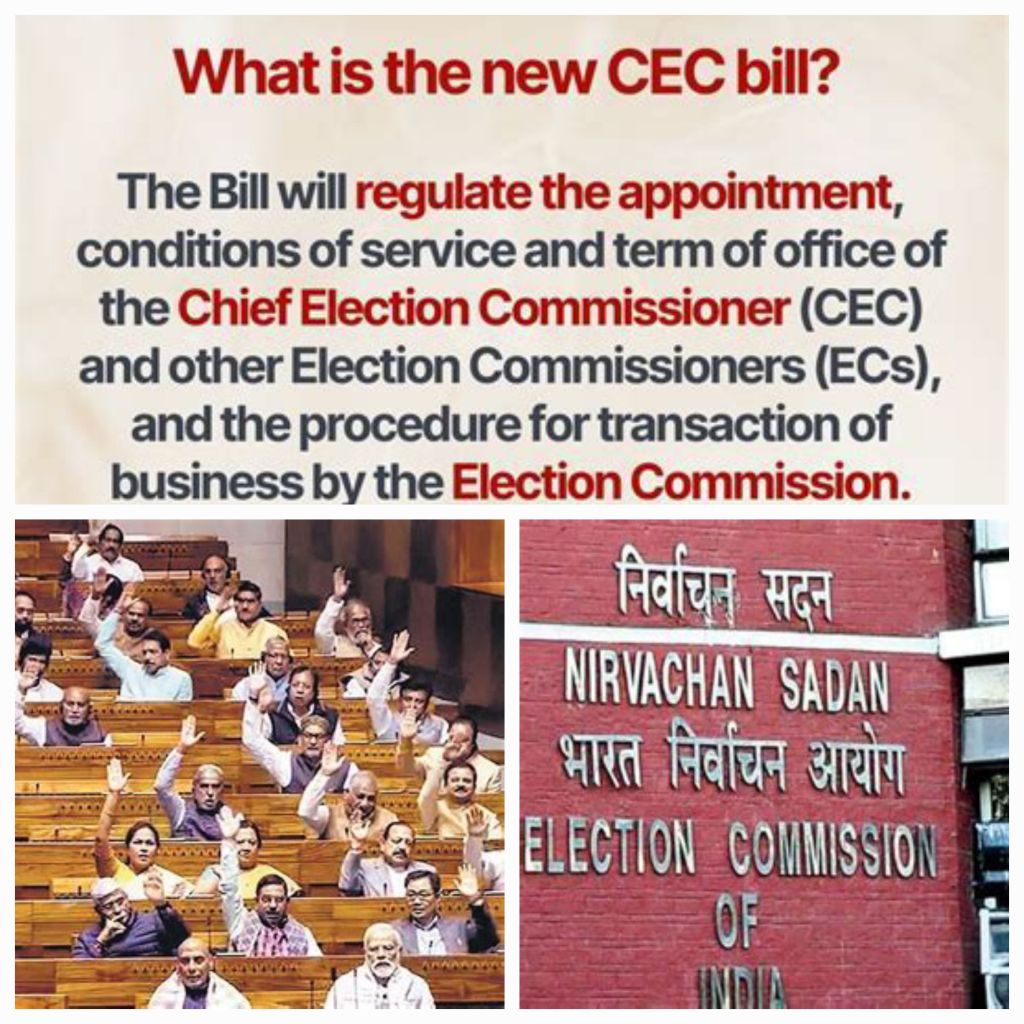
In conclusion, the Chief Election Commissioner and Other Election Commissioners (Appointment, Conditions of Service and Term of Office) Bill, 2023, emerges as a crucial piece of legislation reshaping India’s electoral landscape. Delve into the nuances of this bill, weighing its intended transparency against concerns of compromising the Election Commission’s independence. As the nation anticipates the impact of this legislative stride, stay informed about the ongoing discourse surrounding this pivotal development.

 Poetry Hub
Hello. Thanks for visiting. I’d love to hear your thoughts! What resonated with you in this piece? Drop a comment below and let’s start a conversation.