1: The Shadows of Indirapuram: Echoes of a Fighter
In the depths of Indirapuram, a place alive with sounds, where footsteps echo day and night against the cramped, crumbling concrete of narrow alleys, where voices blend into a constant hum, a hum that fills every corner, every shadowed nook where men and women huddle, whispering, conspiring, breathing in the heavy, thick air, there—there beats the heart of a beastly empire, hidden beneath the surface like a lurking predator, muscles tensed, always ready to pounce, and at the center of this seething, pulsing world, Ramesh sits like a spider in a web, threads stretching out, vibrations bringing news of money, fear, blood, oh the fights, yes, the fights with stakes so high, screams rising like a tempest, men falling like flies, and oh, in the middle, Dev, Dev the fighter, Dev the beast, Dev the weapon—Dev, who knows no other world but this, this electric, violent underbelly that Ramesh commands with iron and threats, with sharp smiles that cut quicker than the knives flashing in the dim underground lights.
And oh, Dev, found, yes found like a lost puppy at a mela, swirling colors and lights blurring into a kaleidoscope of chaos, crying, lost, so very lost until those hands, those large, knowing hands, picked him up, out of the dirt, away from the noise, and into silence, a different kind of silence, heavy, thick, oppressive, like the air before a storm, and isn’t Dev the storm, isn’t he just, trained in kicks that crack bones, punches that bruise souls, moves fluid like the monsoon rains sweeping across the parched earth of Indirapuram, and still, still with every fight, every victory, every snap of bone and spirit, he returns to that silence, that suffocating training room where Ramesh’s voice drills into him, where commands become his gospel, his mantra, his only truth, because what is truth but what is told, repeated, hammered into you until the metal kara on his wrist feels like part of his skin, a second skeleton, binding, reminding, controlling.
Ramesh, master, guardian, god in his eyes, because who else is there, who else has ever been there but Ramesh, who found him, fed him, raised him, not with soft words and gentle touches but with the harsh reality of life as Ramesh sees it, life as a fight, endless, brutal, one ring to another, one opponent down, another rising, endless, relentless, and Dev moves through it all like a dancer, each step memorized, each gesture full of meaning, deadly grace, for what is grace but the economy of movement, economy of truth, his truth, the only truth, taught with fists and feet and the cold, hard glint in Ramesh’s eyes, eyes that rarely soften, for softness is for the weak, and Dev is not weak, no, Dev is strong, Dev is the storm, and storms know no masters, only paths of destruction, yet, yet—there’s a whisper in his heart, a small, insistent whisper like the rustle of leaves before the wind turns fierce, a whisper of other places, other lives where fights aren’t the currency, where blood isn’t spilt for sport, for pleasure, a whisper so at odds with the roar of the crowd, the clash of the fights, the relentless commands of Ramesh.
And sometimes, sometimes when the metal kara clicks open and he’s unleashed, set free yet not free, bound by everything he’s ever known, everything he’s ever been taught, every silent command etched into his very bones, he wonders, oh how he wonders, what it would be like to walk away, to step out of the shadows, into the light, light so bright, so pure, an echo of the lights at the mela, not chaotic, not frightening, but warm, welcoming, a new day, perhaps, a new dawn, and in that moment, in that fleeting, shimmering moment, Dev imagines, dreams—before the crowd roars, before the next opponent steps forward, before the metal kara snaps shut, silencing the whispers, ushering in the storm once more.
2: Echoes Through the Cage: Dev’s Silent Rebellion
Dev’s world, ah, it’s small, confined, Ramesh’s home feels like a universe but so suffocating, those walls, those damp walls whisper secrets, secrets of violence, of control, Ramesh’s commands echoing, bouncing off concrete, seeping into his skin, and then the basements, oh those dark, dingy basements, the musty air thick, heavy, filled with the scent of sweat and blood, the crowd a faceless mass above, shouting, cheering, a cacophony, a mad symphony of voices, their cries feeding the adrenaline that surges through him, adrenaline that’s like fire, like life pumping through veins that have known too much pain, too much brute force, a body honed for fighting, muscles moving with memory, memory of each punch thrown, each kick landed, pain inflicted, pain endured, that’s life, that’s existence, that’s survival, and survival is all there is when the world is just a series of fights, one after another, never-ending, relentless.
But, ah, those moments, brief, fleeting, like flashes of color on a monochrome canvas, when the world outside peeks through the cracks of his fortress, when they move from one shadow to another, from one fight to the next, the town, it beckons, a swirl of colors, vibrant, alive, shops bursting with hues of blues and greens and yellows, windows like eyes into another world, a world bright and bustling, not dark and closed, and families, families walking together, laughing, a sound so foreign, so curious, it tickles his ears, unfamiliar, a melody he knows he’ll never grasp, never understand, because his life, his world, it’s not open, it’s closed, shut tight, but he sees them, the kids, especially the kids, running down streets, laughter trailing behind like ribbons in the wind, free, so free, a stark, harsh contrast to his own life, his own isolation, where laughter doesn’t exist, only grunts, only groans, only the referee’s call and the next fight looming, looming always.
Does he dare to dream of that freedom? The laughter, could it ever be part of his rhythm, his existence so far removed from theirs, so alien, so isolated, so confined? What is it like, he wonders, to run without purpose, without a destination, just running because the space is there, because the legs carry joy and not just strength, not just survival? These glimpses, they haunt him, haunt him amidst the cheers, the roars, the pain, fleeting but sharp, cutting through the routine, planting seeds of wonder, of ‘what if,’ what if there’s more than this, more than fights, more than Ramesh’s sharp commands, more than survival in a ring that feels increasingly like a cage, a cage too small, too constricting?
And sometimes, sometimes when the lights go out, when the crowd disperses, when the pain lingers and the adrenaline fades, he lies there in the darkness, eyes open, staring at nothing, nothing but shadows, and in those shadows dance the colors of the shops, the laughter of families, the freedom of those kids, and it’s beautiful, it’s terrifyingly beautiful, because it’s so far out of reach, maybe too far, and yet, he clings to it, clings to the brief, fleeting visions, because even a glimpse, even a moment of something else, something more, it gives him hope, hope that maybe, maybe there is a rhythm different from his, a rhythm not defined by fighting, not confined by walls, a rhythm where he might find not just survival, but life, real life, the life that whispers to him in those fleeting moments, and whispers still in the silence of the night.
3: Shadows and Light: Meera’s Touch
Meera, the gentle soul, her days filled with children’s laughter and lessons of love, of sharing, her evenings spent in the quiet service of others at the community center, her life a tapestry of tender touches and caring whispers, teaching and reaching, always reaching out to those who seemed to stand too long in the shadows, those who needed, perhaps, a smile, a kind word more than most. Ah, her gentle demeanor, a known refuge in this bustling town of Indirapuram, where lives cross and clash under the weight of surviving, just surviving, while she, she offers a breath, a pause, a moment of peace.
And then, one evening, that evening, dusk creeping over the sky like a quiet sigh, the colors dimming, the world softening, Meera walking, always walking, from a late class, her mind still echoing with the questions of curious children, when there, on the poorly lit road, a form, a body, broken, bruised, like a discarded puppet whose strings had been cut too harshly, too suddenly. It was Dev, though she did not know him, not him specifically, just a young man, a soul in pain, his clothes torn, body marred with the vicious vocabulary of violence, a living, breathing testament to the city’s darker deeds, his kara, his metal kara, missing, as if destiny had unlocked him from his bounded path and tossed him, quite literally, at her feet.
Curiosity first, then concern, her heart a well of both, always, because wasn’t that her way? Meera approached, cautious, yes, but determined, as he looked up, those eyes, wary and wild, trapped animal eyes, eyes that had seen too much and yet perhaps not enough of what mattered. He flinched, oh, but of course, for kindness was a language he had not been taught, his lessons had been of fists and fury, and her gentle approach was foreign, alien script he couldn’t read, not yet.
But exhaustion, that cruel yet honest companion, had taken him by the shoulders, pulling him away from the instincts to flee, to fight, grounding him there in his vulnerability on the cold, hard concrete. And Meera, she took him, guided him with her quiet strength to her small home, her sanctuary lined with books and plants, warmth that was alien to him, a stark contrast to the dark, damp corners he was used to; here there were curtains, soft and fluttering gently with the evening breeze, cushions that held the imprint of many a peaceful evening.
She treated his wounds, her hands steady, a balm not just on his flesh but his spirit, the antiseptic stinging less than the sudden, surprising tears he blinked back—care without conditions, this was new, this was novel. With every gentle dab, every careful bandage, layers of his hardened exterior, built tough by years of abuse and aggression, began to peel away, revealing beneath not the fighter, not the weapon, but just Dev, just a young man who had known so little of this, this simple, profound kindness.
Night deepened, and as he lay there, in a clean bed for the first time in years, the room dimly lit by the soft glow of a bedside lamp, he listened, listened to the quiet sounds of a normal household, the tick of a clock, the distant bark of a dog, the murmur of a television from a neighboring apartment, sounds of peace, of normalcy. And Meera, she brewed tea, the steam rising like prayers, and talked, her voice a soothing melody about nothing and everything—school, children, the weather, her plants needing repotting, normal things, everyday things, beautiful, mundane things.
Dev listened, a storm quieting inside him, his breath finding a rhythm it had never known, slow, unlabored, not gasping, not grunting through exertion in a ring, but just breathing, just living. And in this simple, profound space Meera had woven around him, he felt, perhaps for the first time, what it might mean to be safe, to be cared for, to be seen not as a fighter, not as a weapon, but as a human, as Dev.
4: Harmony Beyond the Fight: Dev’s Awakening
With Meera, oh, the world, it opened up like a book, one of those books from her shelf, spines worn from love and handling, pages filled with worlds upon worlds, each a promise of something beyond the narrow, vicious confines of his past. Music, too, music that didn’t roar or scream like the crowds, but whispered, hummed, spoke softly of other places and emotions that weren’t wrapped in pain or coated in blood. Dev listened, sometimes closing his eyes, letting the melodies wash over him like rain, like cleansing rain, and isn’t it strange, he thought, how a simple sequence of sounds could tug at something deep inside him, something he hadn’t known was there, a tender spot untouched by fists, by fear.
And the food, the meals Meera cooked, nothing like the quick, forgettable bites snatched in the fleeting quiet between fights; no, her meals were a ritual, a celebration of flavors. He’d sit at the small kitchen table, watching her move around the stove, a dance of sorts, her hands confident, adding a pinch of this, a dash of that, ingredients blending under her touch as if they belonged together, as if they were meant to find harmony in the heat of her pots and pans. Eating these meals, Dev found himself savoring each bite, the spices a revelation, textures and tastes that made him think, perhaps, perhaps there is a world where every moment can be savored, where life isn’t just endured but enjoyed.
Meera, with her unwavering belief in redemption, in the possibility of change, she saw him, really saw him, not as the fighter he had been conditioned to be, but as the man he might become. To her, he was not a weapon forged in the fires of violence, but a wounded soul deserving of a chance at a better, kinder life. Her kindness, it wasn’t naive, it was fierce, a fierce belief in transformation, and in her eyes, he saw a reflection of a self he couldn’t yet fully imagine.
This peace, this warmth he found in her presence, it was alien, unsettling in its newness, yet so profoundly comforting. In the quiet moments, often just before sleep claimed him, Dev found himself wrestling with questions that had never dared to surface before. Who was he if not the fighter? What purpose did he hold if not to be the strongest, the most lethal? The very nature of his existence, which had always been defined by survival, by obedience, now seemed up for question, a narrative unmoored and drifting towards unknown shores.
As these questions churned within him, as the days slipped into weeks, Dev felt something shift. It was like the slow, steady growth of a plant, the kind Meera tended in her small balcony garden, unnoticeable at first but undeniable over time. He began to see life not as a series of battles to be won, but as a path to be walked, wondered at, a journey of discovery. And he dared, dared to dream, something so fragile yet vital, a dream of a life beyond fighting, a life where his worth wasn’t measured by his ability to inflict damage but by his capacity to nurture, to heal, perhaps to love.
This transformation, it wasn’t sudden, wasn’t dramatic, but unfolded day by day, each day a step away from what had been, a step toward what might be. With Meera’s guidance, Dev ventured out more, into the community, where he was met not with fear or awe but with smiles, with welcomes. He volunteered at the same center where Meera spent her evenings, finding in each task, no matter how small, a kind of redemption, a building back of the self he had been denied. Through it all, through the music, the books, the shared meals, and the quiet, steadfast belief Meera held in him, Dev was reborn, not as a weapon, not as a fighter, but simply, beautifully, as himself.
5: Strings Unbound: The Rebellion of Dev
When the realization hit Ramesh like a sucker punch, not in the gut where it buckles you over but right in the chest, tight, constricting, that burning rage, how it kindled, flared, an inferno from the pit of his being because Dev, Dev was gone, his Dev, his creation, his masterpiece, sculpted by his own hands from the raw, lost boy at the mela into something formidable, something fearsome. Dev was his, wasn’t he? Molded, made, mastered by Ramesh, and losing him, oh it wasn’t just about the money, the bets, the fights, though those were plenty, it was the betrayal, the slicing, searing betrayal that stung sharpest, that dug deepest.
Fury, fury drove him now, through the bustling lanes of Indirapuram, this town that he thought he controlled, thought he knew like the back of his hand, and wasn’t it a slap to that face, a mockery, that Dev, his creature of combat, could just slip away? Strings, he pulled them, all of them, every contact, every owed favor called upon, his network, extensive, expansive, reaching into the dark corners and hidden spots where whispers and secrets lay. Ramesh, using everything, everyone, to claw his way to where Dev hid.
And then, found him, of course he did, it was only a matter of time, wasn’t it? In that quiet neighborhood, where life went on blissfully unaware of the dark tendrils creeping in from the fringes, creeping right up to Meera’s doorstep. Ramesh, with the storm of his wrath howling within, stood at that door, the audacity, the sheer gall of Dev, to choose this, this normalcy over the life he’d been given.
The confrontation, yes, inevitable as the dawn, but when it came, it was not just a clash of wills but of worlds. There, on that threshold, Ramesh, the dark, looming presence of everything Dev had known, the authority, the absolute, the law of his life, and he demanded, commanded, his voice a whip, that Dev return, return to the fold, to the fight, to the life carved out for him.
But Dev, standing there, oh how he stood, not the cowering child nor the unleashed beast, but a man, a man made new, reborn in the simple, profound peace of Meera’s world. Resistance, a new feeling, unfamiliar, unwieldy like a weapon he’d never trained with, but he wielded it, wielded it with a strength that came not from muscle but from something deeper, something sturdier, found in the quiet moments of healing and hope that Meera had nurtured.
“No,” a simple word, but from Dev, it was a declaration, a rebellion, the first true fight of his choosing, and how it echoed, there in the small, tidy yard, bouncing off the walls of Meera’s home, shaking the very foundations of the life Ramesh had built for him. Meera, behind him, her presence a bastion, her belief in him a shield.
Ramesh, seeing the defiance, his world tilting, the balance of power shifting in a gaze, in a stance, in a single word, felt the grip of his control slip, felt the edges fray. And wasn’t it a mirror, showing him not the master but the man, small, shrinking as Dev grew in stature, grew in self, right before his eyes.
The standoff, a palpable tension thick as the humid air, neighbors peeking through curtains, the street holding its breath. Ramesh, with his threats, his venom, spitting rage and disbelief, but Dev, Dev who had tasted freedom, who had savored kindness, stood firm, and in standing, in speaking that “no,” he didn’t just reject Ramesh, he rejected everything he had been forced to be.
It was a pivot, a turn, monumental in its quiet, personal revolution, for in that moment, Dev didn’t just stand up to Ramesh; he stood up for himself, for the life he never dared to dream of until Meera showed him it could be real, it could be his. And Ramesh, with his machinations unraveling, found his fury impotent against the simple, profound strength of a soul reborn.
6: Echoes of Freedom: Dev’s Final Stand
In the cramped confines of Meera’s living room, smaller still under the weight of what was to unfold, the final confrontation, oh not like any that Dev had known, no dim lights or howling crowds, no referee or bell, just Meera’s modest furnishings, her plants a silent audience, photos on the walls witnesses to this last, most critical bout. This room, where tea had been sipped and stories shared, transformed now into an arena where Dev, standing firmer than he ever had in any ring, armed himself not with fists but with words, words that were his newly discovered, carefully wielded weapons.
Each word he spoke, like a chisel chip-chipping away at the stone of his past life, each sentence a step, another step away from the identity that had been imposed on him. “I am not your weapon,” he declared, the room still, Ramesh’s eyes, those dark tunnels of fury, boring into him. “I am not your creation to command,” further still he stepped back, and each step was liberation, the shackles of his past clinking, loosening, as if his words were keys unlocking chains long wrapped tight around him.
Ramesh, this man of power and fear, now in this small, lived-in space seemed somehow less formidable, his figure looming but his aura diminished as Dev’s words continued to carve new air around them, new space. Ramesh’s understanding faltering, failing to grasp this reversal of roles, his grasp on control slipping as sand through desperate fingers, threatened then, his voice a raw scrape of desperation, violence on its edge, the only language he’d ever mastered, the only response he knew when faced with defiance.
But here, here in this moment, the community, oh the community Meera had woven around them, began to manifest at the door, at the windows, faces known and friendly, neighbors not just of streets but of heart, rallied by the silent summons of what was right, what was just. This gathering, a human barricade, shielding Dev with their bodies, their presence, their collective will rejecting the violence Ramesh embodied.
Outnumbered, outmaneuvered, Ramesh’s threats, those desperate claws of a beaten beast, echoed, hollow, ineffective against the solid wall of community resolve. His retreat, a bitter, grudging slink back into the shadows from which he’d come, into the night that seemed to swallow him whole, leaving behind a palpable relief, a collective exhale as the door closed, closing off the dark chapter he represented.
Aftermath, the room still echoing with the ghost of confrontation, but now, now filled with possibilities, with open doors and windows letting in night air fresh with the scent of after-rain, of renewal. Dev, standing amid the remnants of his old life, the ring left behind, faced forward into a life newly his own to shape. Meera, her hand light on his arm, her presence a promise of support, of shared tomorrows. Together, they faced the task of rebuilding, of healing wounds deeper than flesh, wounds inflicted on soul and self.
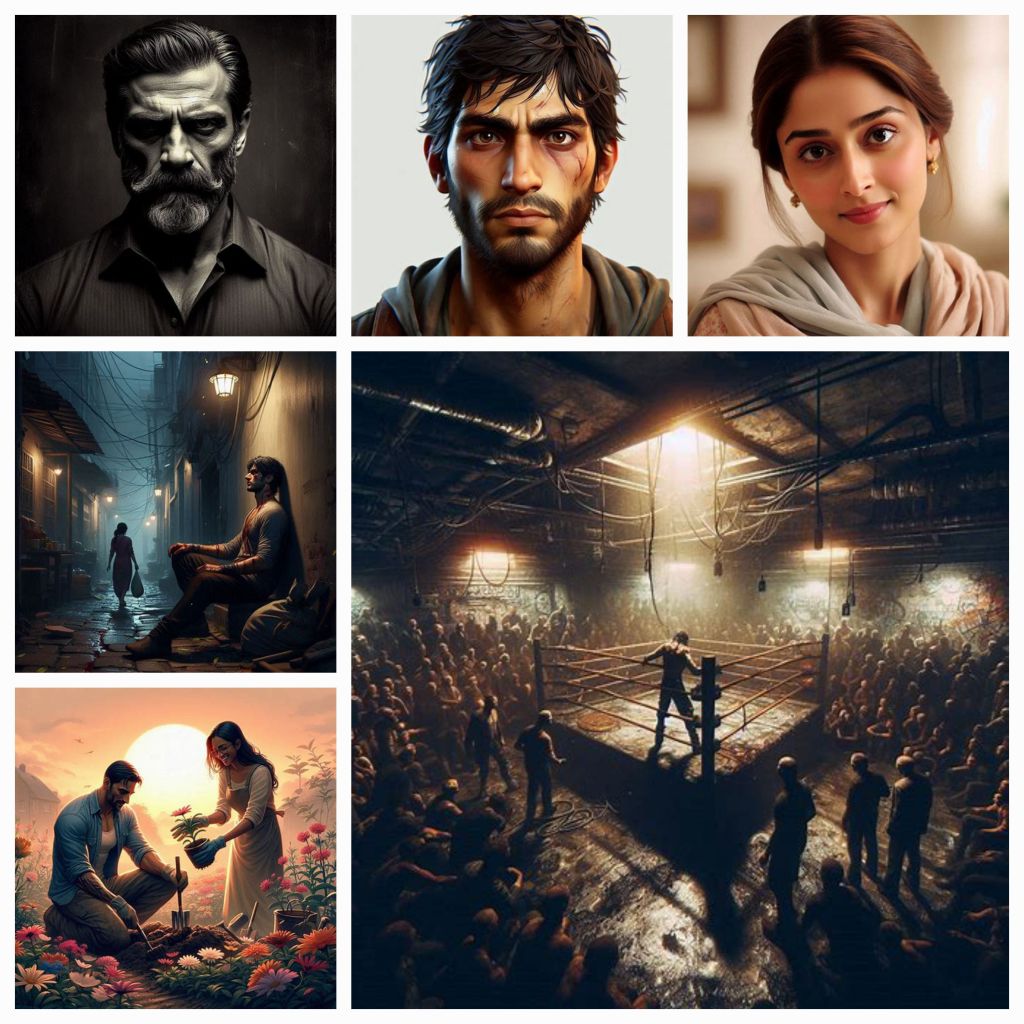
The journey of healing, long and winding as any road worth traveling, saw Dev exploring identities never allowed to him before—friend, helper, lover perhaps. Each new role a stitch in the fabric of his new life, each day a step in the dance of becoming. With Meera’s steady love, her unwavering belief in the man he could be, he found strength not in the power of his punches but in the gentle grips of hands held, in smiles shared, in meals cooked together, in quiet evenings and lively mornings.
Thriving, yes, that was the word, thriving not just surviving, because survival had been his past, a passive state of enduring, but thriving, that was active, a state of growth, of blooming resilience like the flowers in Meera’s balcony garden, reaching for the sun, rooting in rich soil, blossoming against odds. Dev, once a weapon, now wholly human, wholly himself, found in the aftermath of confrontation a life not defined by battles fought, but by battles won within, the quiet victories of peace over violence, of love over control, of freedom over fear.
#UnchainedSpirits #RedemptionJourney #FightForFreedom #IndianFiction #CommunityStrength #InspirationalTales

 Poetry Hub
Hello. Thanks for visiting. I’d love to hear your thoughts! What resonated with you in this piece? Drop a comment below and let’s start a conversation.