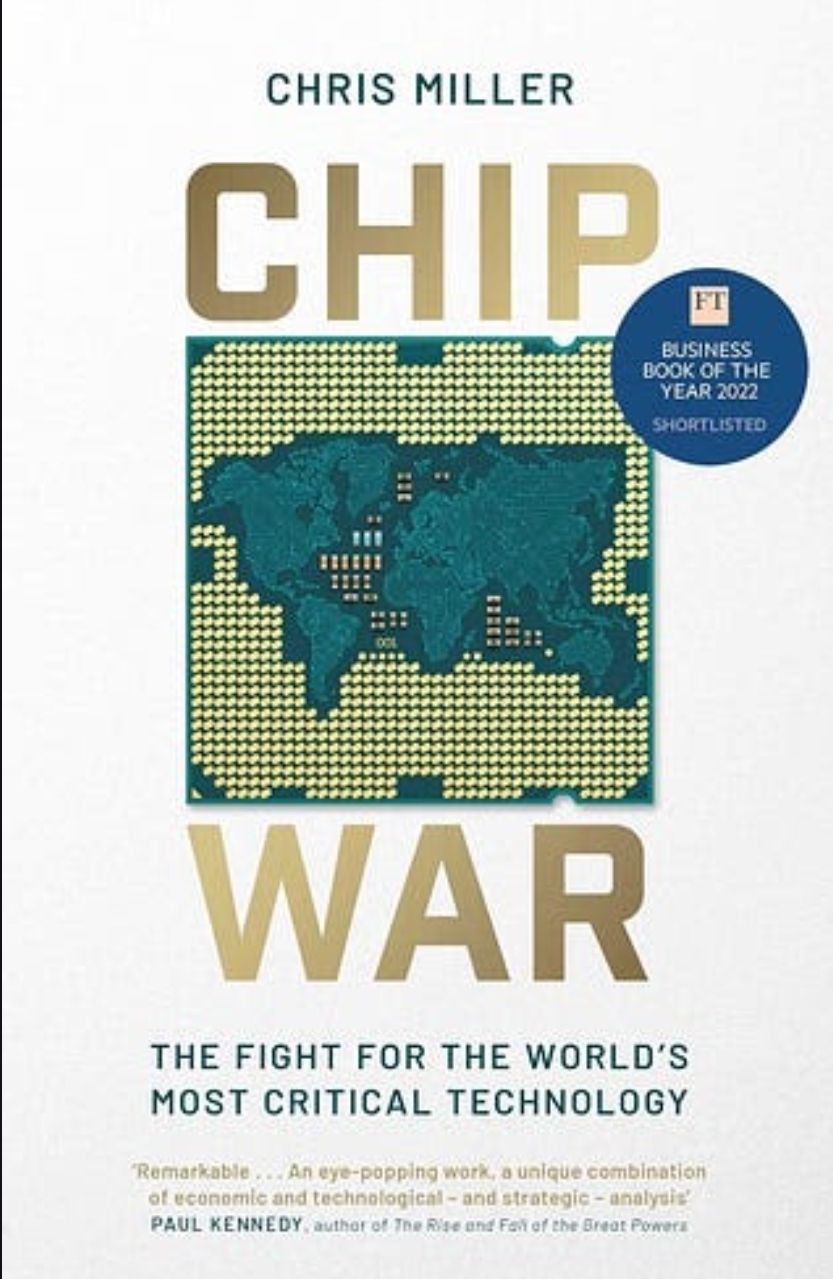
Hello. This is a comprehensive review of “Chip War” by Chris Miller. I have structured this review to cover various aspects of the book, including its content, historical context, analysis, and impact. Let’s begin:
1. Overview and Main Thesis
“Chip War: The Fight for the World’s Most Critical Technology” by Chris Miller, published in 2022, is a meticulously researched and compellingly written account of the semiconductor industry’s history and its pivotal role in geopolitics. Miller, an associate professor of international history at Tufts University’s Fletcher School, argues that the control of advanced chip manufacturing has become a central issue in the technological and economic competition between the United States and China.
The book’s central thesis is that semiconductors – the tiny silicon chips that power our modern world – are not just crucial components in our electronic devices but are also at the heart of global economic and military power. Miller contends that the nation that controls the most advanced chip technology will have a significant advantage in both economic growth and military capabilities.
2. Historical Context and Narrative Structure
Miller traces the history of the semiconductor industry from its beginnings in the mid-20th century to the present day. He starts with the invention of the transistor at Bell Labs in 1947 and follows the industry’s development through key milestones such as:
- – The founding of Fairchild Semiconductor and the birth of Silicon Valley
- – The rise of Intel and the personal computer revolution
- – Japan’s challenge to U.S. dominance in memory chips in the 1980s
- – The emergence of Taiwan Semiconductor Manufacturing Company (TSMC) and the foundry model
- – The growing importance of chip design firms like ARM and Nvidia
- – China’s push to develop its own advanced chip manufacturing capabilities
Throughout this historical narrative, Miller weaves in the geopolitical implications of each development, showing how governments have increasingly recognized the strategic importance of semiconductor technology.
3. Key Players and Companies
The book provides in-depth profiles of numerous key figures and companies in the semiconductor industry, including:
– William Shockley, one of the inventors of the transistor
– Gordon Moore, co-founder of Intel and author of Moore’s Law
– Morris Chang, founder of TSMC
– Jensen Huang, co-founder and CEO of Nvidia
Miller also delves into the roles of lesser-known but crucial companies in the chip supply chain, such as ASML, the Dutch company that makes the advanced lithography machines essential for producing cutting-edge chips.
4. Geopolitical Analysis
A significant portion of the book is dedicated to analyzing the geopolitical implications of semiconductor technology. Miller argues that:
– The U.S. has maintained its technological edge partly through its dominance in chip design and key parts of the supply chain.
– Taiwan’s central role in advanced chip manufacturing (particularly through TSMC) has made the island strategically crucial, potentially influencing China’s calculations regarding reunification.
– China’s efforts to develop an independent semiconductor industry are driven by both economic and national security concerns.
– The global nature of the semiconductor supply chain makes it vulnerable to disruptions, whether from natural disasters, geopolitical tensions, or pandemics (as evidenced by recent chip shortages).
5. Technical Aspects
While the book is accessible to a general audience, Miller doesn’t shy away from technical details. He explains complex concepts such as:
– The basics of how semiconductors work
– The intricacies of chip design and manufacturing processes
– The challenges of continuing to shrink transistor sizes (and the potential end of Moore’s Law)
– Emerging technologies like extreme ultraviolet (EUV) lithography
These technical explanations help readers understand why advancing chip technology is so difficult and expensive, and why only a handful of companies can produce the most advanced chips.
6. Economic Implications
Miller extensively discusses the economic aspects of the semiconductor industry, including:
– The massive capital investments required to stay competitive in chip manufacturing
– The role of government subsidies and support in developing national semiconductor industries
– The potential economic impacts of disruptions to the chip supply chain
– The importance of semiconductors in enabling other technological advancements and economic growth
7. Military and National Security Considerations
The book emphasizes the critical role of advanced semiconductors in modern military technology, including:
– Their use in precision-guided weapons, drones, and communication systems
– The potential for chip-level vulnerabilities to be exploited for espionage or sabotage
– The strategic advantage provided by having the most advanced chips in military applications
8. Future Projections
Miller speculates on the future of the semiconductor industry and its geopolitical implications, discussing:
– The potential for new materials or computing paradigms (like quantum computing) to supplement or replace traditional silicon-based chips
– The ongoing efforts of various countries to secure their semiconductor supply chains
– The possibility of increased tensions or conflict over control of this critical technology
9. Writing Style and Accessibility
One of the strengths of “Chip War” is Miller’s ability to make complex technical and historical information accessible to a general audience. He uses clear language and apt analogies to explain difficult concepts, and he interweaves personal stories and anecdotes to keep the narrative engaging.
10. Critical Reception
The book has been widely praised for its comprehensive coverage of a complex and crucial topic. It won the Financial Times Business Book of the Year award for 2022. Critics have lauded Miller’s ability to combine technical, historical, and geopolitical analysis into a coherent and compelling narrative.
Some reviewers have noted that while the book provides an excellent overview of the industry’s history and current state, it may not offer many novel insights for those already deeply familiar with the semiconductor industry. However, for most readers, the book offers a wealth of information and analysis.
11. Comparisons to Other Works
“Chip War” can be seen as part of a growing body of literature examining the geopolitical implications of technology. It complements works like “AI Superpowers” by Kai-Fu Lee, which focuses on artificial intelligence, and “The Perfect Weapon” by David Sanger, which examines cyber warfare. Miller’s book stands out for its specific focus on semiconductors and its historical depth.
12. Potential Criticisms
While the book is generally well-received, potential criticisms might include:
– A primarily U.S.-centric perspective, although Miller does attempt to provide global context
– Limited discussion of potential alternatives to the current semiconductor paradigm
– Insufficient attention to the environmental impacts of semiconductor manufacturing
13. Impact and Relevance
“Chip War” has contributed significantly to public understanding of the semiconductor industry’s strategic importance. Its publication coincided with increased government attention to semiconductor policy in many countries, including the CHIPS and Science Act in the United States.
The book’s insights remain highly relevant as geopolitical tensions continue to affect the global semiconductor supply chain, and as countries invest heavily in developing their domestic chip industries.
Conclusion:
“Chip War” by Chris Miller is a tour de force that illuminates the critical role of semiconductors in modern geopolitics and economics. By tracing the history of this vital technology and explaining its current strategic importance, Miller provides readers with the context needed to understand one of the most crucial technological and geopolitical issues of our time. Whether you’re a policymaker, a technology enthusiast, or simply a curious reader, “Chip War” offers valuable insights into the invisible yet indispensable technology that underpins our modern world.
In this review I have tried my best to provide a comprehensive overview of the book’s content, context, and significance. Thanks for stopping by.

#ChipWar #SemiconductorIndustry #TechGeopolitics #ChrisMiller #BookReview #TechWars #GlobalTechnology #MooresLaw #SiliconValley #ChipShortage #TechSecurity #USChinaTechWar #BookishLeague @BohoBibliophile #TBRChallenge #bookchatter @Blogchatter
This post is part of the Bookish League blog hop hosted by Bohemian Bibliophile.
You can buy book here
I’m participating in the #TBRChallenge by Blogchatter


Leave a Reply