
“Thinking, Fast and Slow” by Daniel Kahneman is a groundbreaking work that synthesizes decades of research in psychology and behavioral economics. Published in 2011, this book represents the culmination of Kahneman’s illustrious career, for which he was awarded the Nobel Prize in Economic Sciences in 2002. Kahneman, a renowned psychologist and economist, presents a compelling exploration of the human mind, offering readers a new framework for understanding decision-making and cognitive processes.
At the heart of Kahneman’s thesis is the concept of two distinct systems of thinking: System 1, which is fast, intuitive, and emotional; and System 2, which is slower, more deliberative, and logical. This dual-system model serves as the foundation for the entire book, with Kahneman meticulously examining how these two systems shape our judgments and decisions in various aspects of life.
The book is structured in a way that gradually builds the reader’s understanding of these cognitive processes. Kahneman begins by introducing the two systems and then delves into the various heuristics and biases that influence our thinking. He explores concepts such as anchoring, where we rely too heavily on the first piece of information encountered; the availability heuristic, which leads us to judge the probability of an event based on how easily examples come to mind; and confirmation bias, our tendency to seek information that confirms our existing beliefs.
One of the most significant contributions of the book is its exploration of Prospect Theory, which Kahneman developed with his longtime collaborator Amos Tversky. This theory challenges traditional economic models by demonstrating that people’s attitudes toward risks concerning gains can be quite different from their attitudes toward risks concerning losses. This insight has had far-reaching implications in fields ranging from economics to public policy.
Kahneman’s writing style is remarkably accessible given the complexity of the subject matter. He employs a wealth of thought experiments and real-world examples to illustrate abstract concepts, making the book engaging for both academic and general audiences. For instance, he uses the example of judging the probability of a terrorist attack to explain the availability heuristic, and he explores the concept of anchoring through examples of real estate pricing and judicial sentencing.
Throughout the book, Kahneman introduces readers to a wide array of cognitive biases and heuristics. He discusses the planning fallacy, which leads us to underestimate the time, costs, and risks of future actions; the halo effect, where our overall impression of a person influences how we feel and think about their character; and the peak-end rule, which suggests that our judgments of past experiences depend almost entirely on how we felt at the most intense moment and at the end. These concepts are not merely academic; Kahneman shows how they apply to real-world situations, from personal decision-making to large-scale policy implementations.
One particularly intriguing section of the book deals with the concept of two selves: the experiencing self and the remembering self. Kahneman argues that these two selves often have different interests, which can lead to seemingly irrational decisions when viewed from the perspective of experienced utility. This insight has profound implications for how we think about happiness and well-being, challenging conventional wisdom about what makes a good life.
The impact of “Thinking, Fast and Slow” extends far beyond the fields of psychology and economics. Business leaders have used its insights to improve decision-making processes and understand consumer behavior better. Policymakers have applied behavioral insights derived from Kahneman’s work to design more effective policies. On a personal level, many readers report that the book has transformed how they think about their own cognitive processes, making them more aware of their biases and more cautious about trusting their intuitions in complex situations.
Despite its widespread acclaim, the book has not been without its critics. Some have pointed out that certain psychological studies cited in the book have failed to replicate in subsequent research, a concern that reflects the broader replication crisis in psychology. Others have argued that the two-system model of thinking is an oversimplification of complex cognitive processes. There have also been criticisms that the research primarily draws from studies conducted in Western, educated, industrialized, rich, and democratic (WEIRD) societies, potentially limiting its universal applicability.
Nonetheless, the book’s overall message about the dual nature of human thinking and the prevalence of cognitive biases remains powerful and relevant. Kahneman’s work has spawned numerous popular articles and discussions about decision-making and has influenced fields as diverse as marketing, medicine, and artificial intelligence.
“Thinking, Fast and Slow” can be seen as part of a broader trend in popular science writing that seeks to explain complex psychological and economic concepts to a general audience. It shares similarities with books like “Predictably Irrational” by Dan Ariely and “Nudge” by Richard Thaler and Cass Sunstein. However, Kahneman’s work stands out for its comprehensive nature, the authority of its author, and its ability to bridge the gap between academic research and practical application.
One of the book’s greatest strengths is its potential to change how readers think about their own thinking. By making us aware of the pitfalls of fast, intuitive thinking and the value (and difficulty) of slow, deliberative thinking, Kahneman provides tools for better decision-making in both personal and professional contexts. He encourages readers to recognize situations where errors are likely and to slow down their decision-making processes. He also highlights the power of framing in communication and decision-making, showing how the way information is presented can significantly influence our choices.
The legacy of “Thinking, Fast and Slow” continues to grow nearly a decade after its publication. Its insights have been applied in fields ranging from behavioral economics to public health, and its ideas have become part of the common lexicon for discussing decision-making and cognitive biases. The book has inspired further research into human cognition and decision-making, contributing to the growing field of behavioral economics.
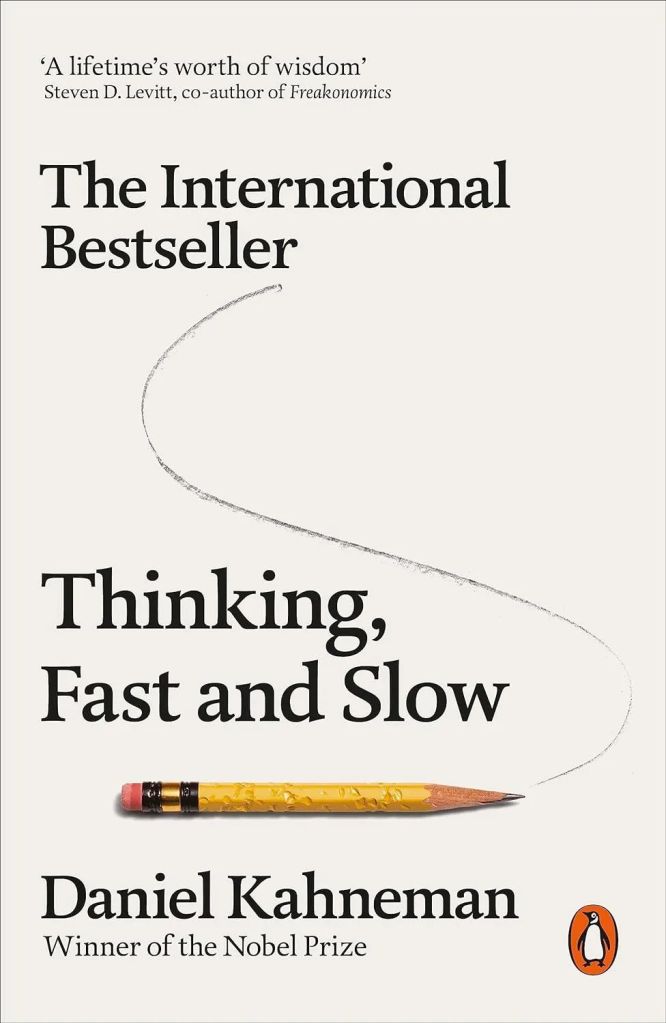
In conclusion, “Thinking, Fast and Slow” is a monumental work that offers readers a new vocabulary and framework for understanding their own thought processes. It challenges us to question our intuitions and to recognize the biases that can lead to poor decisions. While it can be a challenging read due to the density of information and ideas presented, it rewards careful study with profound insights into the workings of the human mind. Whether you’re a psychologist, an economist, a business leader, or simply someone interested in how the mind works, “Thinking, Fast and Slow” offers valuable insights and a compelling read. It’s a book that continues to spark discussion and further research years after its initial publication, cementing its place as a classic in the field of cognitive psychology and behavioral economics.
#ThinkingFastAndSlow #DanielKahneman #BehavioralEconomics #CognitiveBias #DecisionMaking #CriticalThinking #Psychology #NobelPrize #MindHacks #BehavioralScience #BookReview #SystemThinking @PenguinBooks
You can buy book here
I’m participating in the #TBRChallenge by Blogchatter

 Poetry Hub
Hello. Thanks for visiting. I’d love to hear your thoughts! What resonated with you in this piece? Drop a comment below and let’s start a conversation.