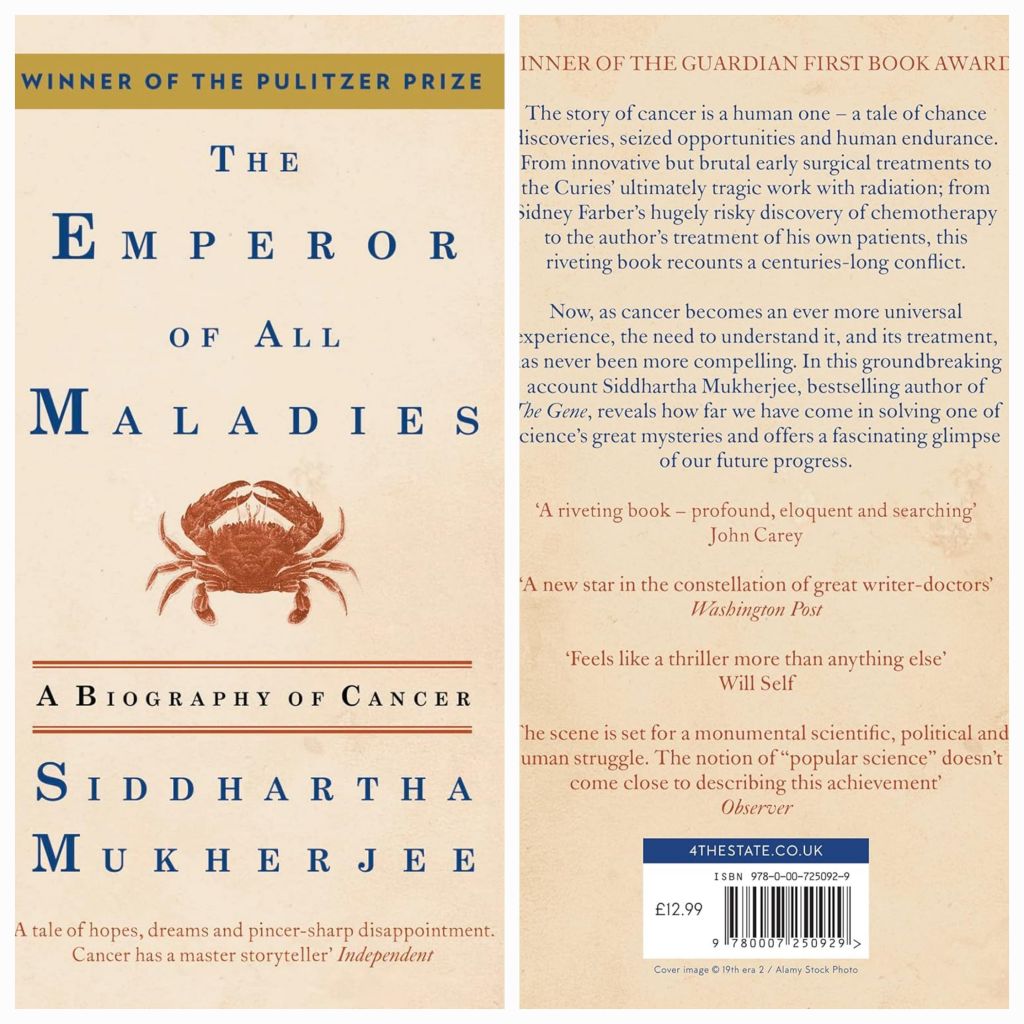
The Emperor of All Maladies: A Biography of Cancer by Siddhartha Mukherjee
Siddhartha Mukherjee’s The Emperor of All Maladies: A Biography of Cancer is a landmark work in understanding the history, science, and emotional impact of cancer. Mukherjee, an oncologist, masterfully weaves the intricate narrative of cancer’s origins, its devastating effects on humanity, and the efforts over centuries to understand and combat this complex disease. His book is more than just an exploration of medical history; it is a deeply personal and philosophical reflection on human mortality, resilience, and the relentless pursuit of knowledge.
A Journey Through Time: Cancer’s Early Origins
Mukherjee takes readers back to ancient Egypt, where the first recorded case of cancer was documented around 2625 BCE by Imhotep, an Egyptian physician. Imhotep identified breast cancer in a patient and grimly noted, “there is no treatment.” This early reference encapsulates the fear and helplessness that humanity has often felt in the face of cancer—a sentiment that persisted for thousands of years. From ancient Greece to medieval Europe, cancer was largely misunderstood, and treatments were brutal and ineffective.
For centuries, doctors believed that cancer was caused by an excess of black bile, one of the four bodily humors according to Hippocratic medicine. This idea dominated Western medical thought until the rise of scientific inquiry in the Renaissance. By then, cancer was more frequently studied, but the disease remained elusive and poorly understood.
Mukherjee traces the gradual accumulation of knowledge that occurred over centuries, marking major milestones like the development of the microscope in the 17th century, which allowed scientists to see cancerous cells for the first time. These discoveries, while groundbreaking, were often met with frustration, as the more scientists understood about cancer, the more complex and formidable the disease seemed to become.
The Dawn of Modern Cancer Treatment
One of the most pivotal figures in the modern history of cancer treatment is Sidney Farber, often called the “father of modern chemotherapy.” In the 1940s, Farber’s experiments with antifolates, a class of drugs that inhibit cell division, marked a breakthrough in cancer treatment. Farber’s work was particularly focused on childhood leukemia, a devastating cancer that had, until then, been a death sentence for young patients.
Farber’s relentless pursuit of a cure, despite repeated failures, became emblematic of the larger war against cancer. Mukherjee poignantly describes the emotional toll that Farber endured, witnessing his young patients die one by one, while continuing to push forward in his research. His successes, though limited at first, were groundbreaking. He proved that chemotherapy could induce remission in some cases of leukemia, offering a glimmer of hope where none had existed before.
Mukherjee notes that Farber’s work was as much a battle against the medical establishment as it was against cancer. At the time, many doctors were skeptical of chemotherapy, believing it to be too toxic and dangerous to use on already weakened cancer patients. But Farber’s persistence paid off, and his work laid the foundation for modern cancer treatments that use aggressive systemic therapies to target the disease.
The War on Cancer and Beyond
The political and social dimensions of cancer treatment are a recurring theme in The Emperor of All Maladies. Mukherjee discusses the “War on Cancer,” declared by President Richard Nixon in 1971. Although well-intentioned, this initiative frequently raised more questions than it provided answers. Billions of dollars were poured into research, but many of the early efforts were based on the simplistic assumption that cancer was a singular disease that could be cured with a one-size-fits-all approach.
Instead, scientists began to realize that cancer is a shape-shifter—a term Mukherjee uses to describe the disease’s ability to evolve, adapt, and resist treatment. Rather than being one disease, cancer is actually hundreds of different diseases, each with its own characteristics, behaviors, and responses to treatment. This understanding shifted the focus of cancer research from trying to find a universal cure to developing more targeted and personalized therapies.
Mukherjee also highlights the advent of targeted therapies and immunotherapy, two of the most promising developments in cancer treatment in recent decades. Targeted therapies are drugs designed to attack specific genetic mutations that drive the growth of cancer cells, while leaving healthy cells unharmed. Immunotherapy, on the other hand, harnesses the body’s own immune system to fight cancer. Both approaches represent a more sophisticated understanding of cancer and have led to significant improvements in the treatment of certain types of the disease, such as melanoma and lung cancer.
The Human Side of Cancer: Stories of Survival and Loss
While much of The Emperor of All Maladies focuses on the science of cancer, Mukherjee never loses sight of the human impact of the disease. He intersperses his historical and scientific narrative with deeply moving personal stories of cancer patients and their families. These stories serve as a powerful reminder that cancer is not just a medical challenge, but a profoundly emotional and psychological one as well.
One particularly moving story is that of Carla, a young woman diagnosed with leukemia. Her journey through treatment and eventual recovery is a testament to the incredible progress that has been made in cancer care. Mukherjee also recounts stories of patients who were not so fortunate, emphasizing the unpredictability of cancer and the limits of modern medicine.
The stories of survival and loss in The Emperor of All Maladies humanize the often-abstract scientific concepts discussed in the book. Mukherjee’s compassionate portrayal of his patients underscores the emotional complexity of treating cancer—a disease that tests the limits of human endurance, both for patients and for the doctors who care for them.
Cancer as a Metaphor: The Philosophical Underpinnings of the Book
At its core, The Emperor of All Maladies is not just a history of cancer; it is a meditation on life, death, and the human condition. Mukherjee draws on literature, philosophy, and art to explore the deeper meaning of cancer, often referencing the work of writers like Susan Sontag, whose seminal essay Illness as Metaphor examined the ways in which diseases like cancer are imbued with cultural and psychological significance.
Mukherjee also touches on the existential questions that cancer forces us to confront. Why do we get cancer? What determines why one person survives while another does not? What does it mean to fight a disease that is, in some ways, a natural part of being human—our own cells, mutated and turned against us?
These philosophical reflections elevate The Emperor of All Maladies beyond a simple medical history. Mukherjee invites readers to grapple with the uncomfortable truths about cancer and the limits of human knowledge, while also offering hope for the future of cancer research and treatment.
Conclusion: A Monumental Achievement
The Emperor of All Maladies is a monumental achievement in both scope and depth. Mukherjee’s ability to seamlessly blend scientific rigor with human stories and philosophical reflection makes the book a powerful and moving account of one of humanity’s greatest challenges. It is a must-read for anyone interested in the history of medicine, the science of cancer, or the resilience of the human spirit.
The book’s title, The Emperor of All Maladies, reflects the enormity of the disease and its far-reaching effects on humanity. Yet, as Mukherjee’s narrative shows, cancer is not an unconquerable enemy. The progress made in the fight against cancer is a testament to the perseverance of scientists, doctors, and patients alike. Though the war against cancer is far from over, Mukherjee’s book offers a hopeful reminder that each battle won brings us closer to victory.
#CancerHistory #CancerResearch #Oncology #SiddharthaMukherjee #ModernMedicine #Immunotherapy #Chemotherapy #Healthcare #MedicalBreakthroughs #TheEmperorOfAllMaladies
I’m participating in the #TBRChallenge by Blogchatter

 Poetry Hub
Hello. Thanks for visiting. I’d love to hear your thoughts! What resonated with you in this piece? Drop a comment below and let’s start a conversation.