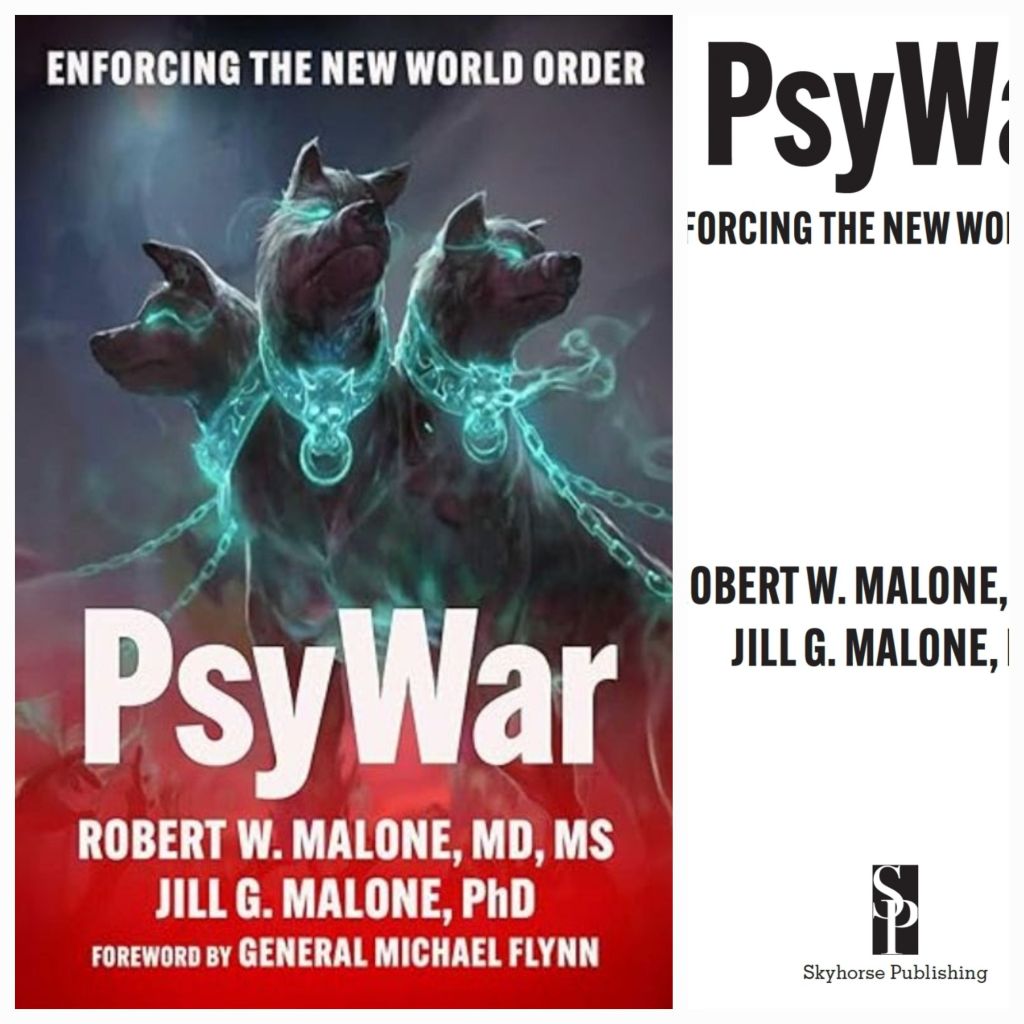
Psychological Warfare in the Modern World: A Deep Dive into PsyWar: Enforcing the New World Order
The digital age has not only revolutionized communication but also transformed the battlefield for psychological warfare, or “psywar.” In their upcoming book, PsyWar: Enforcing the New World Order, Dr. Robert W. Malone and Dr. Jill Glasspool Malone examine the subtle and insidious tactics governments and corporations use to influence and manipulate public thought. The book is a warning and an analysis of how modern psywar has evolved, placing citizens and their liberties in the crosshairs of a growing techno-totalitarian state.
This long-form article explores the book’s central themes, expanding on its context, significance, and implications for individuals, society, and democracy. It aims to give a comprehensive understanding of how psywar techniques have permeated nearly every aspect of modern life.
1. The Evolution of Psywar: From Military to Civilian Targets
Psychological warfare, traditionally used by military organizations to demoralize or influence enemy troops, has increasingly been adapted to target civilian populations. Governments and corporations now use psychological operations (PSYOPs) to shape public opinion, control narratives, and manipulate behavior.
During the Cold War, propaganda leaflets and radio broadcasts were employed to instill fear, confusion, or allegiance. Today, social media platforms, algorithmic control, and behavioral economics represent new weapons in this battlefield. The book claims that the digital era has exponentially increased the reach and subtlety of psywar tactics. Every aspect of digital life, from newsfeeds to online interactions, can be exploited as a medium for psychological control.
In PsyWar, the Malones highlight that modern-day psychological warfare no longer seeks just short-term victories but long-term behavioral changes. With information overload and targeted disinformation, the public is often left disoriented and unsure about which information to trust. This erosion of trust creates fertile ground for manipulation, as those in power control the terms of the debate.
2. Surveillance Capitalism and Psywar: The Role of Big Data
One of the most significant developments in psywar has been the rise of surveillance capitalism, where personal data is commodified and used to influence behavior. Big tech companies like Google, Facebook, and Amazon harvest vast amounts of personal data to target advertisements. However, the same data is used to understand and manipulate users’ thoughts, emotions, and actions.
In their book, the Malones argue that surveillance capitalism allows governments and private entities to monitor populations at an unprecedented scale. Data collected from smart devices, social media posts, and even fitness apps offer a real-time glimpse into human behavior. This data is analyzed to create predictive models that inform targeted campaigns, political messaging, and even social control.
What makes this dynamic particularly concerning is the collaboration between government bodies and tech corporations. For instance, during political campaigns, micro-targeting tactics use behavioral science and voter data to nudge public opinion in specific directions. According to PsyWar, such control mechanisms leave individuals vulnerable to manipulation without even realizing they are being influenced.
The Malones believe that the fusion of mass data collection with modern psychology represents a dangerous shift. If left unchecked, this new form of psywar could lead to a society where behavioral control is not only possible but normalized.
3. Censorship, Propaganda, and Thought Control
Governments have historically used censorship and propaganda to control public opinion. In modern times, however, these tactics have become far more sophisticated. The Malones argue that instead of simply restricting information, modern psywar techniques work by drowning out dissenting voices, flooding the digital space with conflicting information, or steering conversations in a particular direction.
The concept of “manufacturing consent,” famously explored by Noam Chomsky and Edward S. Herman, is central to the Malones’ critique. By controlling the media narratives, governments and corporations can ensure that specific viewpoints dominate the public discourse while others are marginalized or silenced.
The book presents several examples of recent high-profile events where this type of psywar played a significant role:
COVID-19 Pandemic: The use of fear-based messaging, conflicting health advice, and censorship of alternative viewpoints helped drive specific political and economic outcomes. The Malones focus particularly on the response to the pandemic, arguing that it exemplified how psywar tactics can be used to shape mass behavior.
Elections and Disinformation: From the 2016 U.S. presidential election to Brexit, targeted disinformation campaigns have been weaponized to sway public opinion and undermine trust in democratic processes. The Malones delve into how political psywar campaigns are often aided by foreign governments or private interests to destabilize societies.
Censorship in Social Media: Governments increasingly rely on private companies like Facebook and Twitter to police online speech. Under the guise of curbing hate speech or disinformation, these platforms often enforce the interests of those in power while sidelining dissenting voices.
By exploring these examples, PsyWar underscores the fragility of truth in the digital age. When information is filtered through biased algorithms or used selectively to reinforce government policies, the very foundation of democracy — open dialogue — is under attack.
4. Psywar and the Rise of Techno-Totalitarianism
According to the Malones, one of the most disturbing trends in modern psywar is the growing convergence of state and corporate power into what they describe as a techno-totalitarian regime. Unlike authoritarian regimes of the past that relied on brute force, today’s system uses more subtle methods of control: the collection of personal data, constant surveillance, and psychological operations aimed at creating conformity.
China’s social credit system, for example, is often cited as a prototype for this kind of digital dystopia. The government uses data to monitor and score citizens’ behaviors, rewarding those who align with the state’s objectives and penalizing those who do not. Although the West has not reached this level of control, the Malones argue that surveillance capitalism and psywar tactics have laid the groundwork for a similar system to emerge.
The increasing use of AI and machine learning algorithms in predictive policing, behavioral nudging, and surveillance poses new threats to individual liberty. The authors express concern that without proper regulation, such systems could easily be used to enforce a type of “soft totalitarianism,” where citizens are controlled not by fear of punishment, but by incentives and engineered consent.
5. Fighting Back: The Role of Free Speech and Public Awareness
Amidst the growing threat of psywar, the Malones see free speech as the most potent weapon of resistance. In their view, the ability to freely exchange ideas without fear of censorship is the foundation of democratic society. However, they also stress that free speech is under attack in multiple ways: through online censorship, disinformation campaigns, and the weaponization of cancel culture.
The authors argue that public awareness of psychological operations is the first step in fighting back. By understanding the tactics used to manipulate thought and behavior, individuals can become more discerning about the information they consume. Media literacy and critical thinking are crucial to resisting the effects of modern psywar.
They call for a renewed commitment to transparency, the protection of individual privacy, and the promotion of decentralized, open platforms that are resistant to corporate or governmental control. In doing so, they hope to create a world where free speech and independent thought can thrive, even in the face of overwhelming pressure from powerful interests.
Conclusion: The Future of Psywar
PsyWar: Enforcing the New World Order is a wake-up call for the digital age. The book’s exploration of psychological warfare tactics, surveillance capitalism, and the rise of techno-totalitarianism provides a sobering look at the challenges facing modern democracies. With every click, every like, and every comment, individuals contribute to a vast data ecosystem that can be used to control, manipulate, and ultimately shape society.
However, the Malones emphasize that it is not too late to act. By fostering awareness, protecting free speech, and advocating for greater transparency in media and government, society can push back against the growing tide of psywar and reclaim its autonomy.
As we enter an era where information itself is a battlefield, understanding the tools of psychological manipulation will be essential for safeguarding the future of individual liberty.
#PsyWar #PsychologicalWarfare #SurveillanceCapitalism #Propaganda #Disinformation #Techno-totalitarianism #FreeSpeech #AI #DataPrivacy #DigitalAge
I’m participating in the #TBRChallenge by Blogchatter


 Poetry Hub
Hello. Thanks for visiting. I’d love to hear your thoughts! What resonated with you in this piece? Drop a comment below and let’s start a conversation.