The New Gaze of Justice: An Exploration of India’s New Lady of Justice
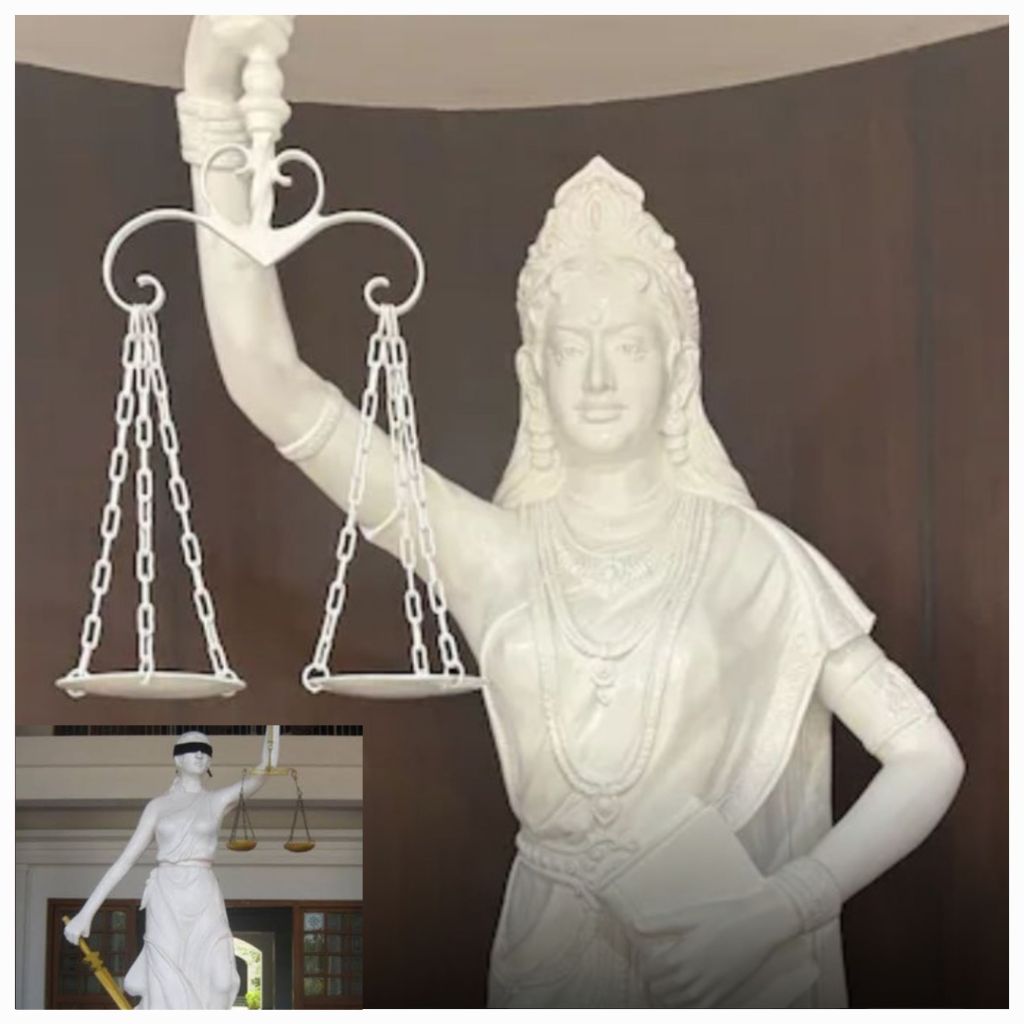
In the marble hallways of history, she stood there, blindfolded, sword in one hand, scales in the other. A symbol frozen in time, she gazed into the abyss of human morality, choosing ignorance of who stood before her, weighing only the cold facts of the case. But the tides of justice, like time, are always in flux. The Supreme Court of India, that temple of democracy and law, now dares to unveil a new symbol. Gone is the blindfold. Gone is the sword. Instead, she stands tall, eyes wide open, cradling the Indian Constitution in her one hand, and scale in another. A silent shift echoes through the corridors of power—her sight restored, her intent clearer, and her message radical.
This is the new Lady of Justice, a figure who doesn’t shy away from seeing. She doesn’t hide from the world, but embraces it, watching it with an unflinching gaze. No longer a passive adjudicator bound by abstraction, this Lady stands rooted in the laws of the land, symbolically gripping the Constitution, the pulse of India’s democracy.
A New Vision: The End of Blindfolded Justice?
In the new realm, symbols are living organisms. They evolve, mutate, absorb the spirit of their times, and occasionally, they shatter the past. The Supreme Court’s introduction of this new Lady of Justice without her blindfold and sword is, at its core, an act of symbolic rebellion—a defiant rupture from the tradition that suggests fairness comes only from impartiality, that to be truly just is to be blind.
But blindness, we know, is not always just. It can be ignorance. It can be complicity in silence. So, what happens when justice opens her eyes?
The blindfolded Lady—universal, stoic, detached from the messy intricacies of human lives—was born from an era that believed in mechanical, emotionless justice. She didn’t care if you were rich or poor, if you were Dalit or Brahmin, if you stood in rags or in silk. She only saw your case file, the weight of your evidence. That was justice, they said, in its truest, coldest form.
But the world has changed. India has changed. The law has changed. And with it, the very fabric of justice needs to be rewoven. This new Lady—bare-eyed, vulnerable, and accountable—rejects the illusion that fairness comes from ignorance. Instead, she challenges us with a stark reminder: Justice cannot afford to be blind in a world where prejudice and privilege often go unseen. And using scale blindfolded has no meaning.
Her open eyes scream a truth too many have avoided. Blindness is a luxury, and for too long, justice’s supposed impartiality has allowed inequality to flourish beneath her shadow. To see is to know, to acknowledge the layered realities of caste, gender, religion, and power.
A Sword Sheathed, a Constitution Held: The Rewriting of Power
The sword is conspicuously absent in her hands. Another quiet revolution embedded in the statue’s form. No longer does she rely on the sharp edge of violence to enforce the law. No longer is the threat of punishment her primary tool. This is a justice grounded not in fear but in knowledge. By holding the Constitution, she declares that the law of the land, the collective will of the people, is her weapon, her guide, and her strength.
The Constitution—sacred, complex, a living document—becomes the foundation of her authority. She wields words instead of steel, relying on the nuanced interpretations of a text that itself contains multitudes. It’s a bold, almost utopian vision of justice that sees the rule of law as the final arbiter, where violence is not necessary for justice to prevail.
This is, of course, deeply, a defiance of the past that is both thrilling and terrifying. To hold the Constitution in hand is to bear witness to the contradictions of India’s present, a nation caught in the crosswinds of progress and tradition, modernity and antiquity. The law is as alive as its people, shifting with every decision, every judgment.
The Unmasked Gaze: The Politics of Visibility
Her gaze, open to the world, is both unsettling and empowering. What does it mean for justice to see? In a country as complex as India, where identities are layered and histories are fraught with trauma, the act of seeing becomes a political statement.
She sees the marginalized. She sees the powerful. She sees the loopholes, the corruption, the systemic inequalities. She sees the people who have been crushed under the weight of bureaucracy, the citizens who have been silenced by the complexities of law that do not serve them. She sees the courtroom dramas that play out not just in legal briefs but in the lives of ordinary people, in the streets, in the slums, in the high-rises of a growing metropolis.
But to see is also to be seen. In making justice visible, this new Lady makes herself visible too. There is no more hiding behind the blindfold, no more pretending that justice is a distant ideal. She stands in the open, exposed, vulnerable to critique, to the scrutiny of a million eyes that watch her back. The power dynamics shift.
Justice is no longer an abstraction carried out in the hallowed halls of courts but becomes a participatory act. We are all invited to see alongside her, to watch the unfolding drama of law and society with a clarity that was once denied to us.
The Absence of the Sword: A Subtle Subversion of Power?
Her sword, once a defining feature of her iconography, is absent. Is this a statement on the changing nature of justice itself? Perhaps it is a recognition that justice cannot be enforced through brute force alone. In holding the Constitution, this new Lady of Justice signals a shift away from punitive power towards restorative justice, where the law is meant to heal and not harm.
The removal of the sword is also an invitation to rethink the very nature of power. The law is not merely a weapon to be wielded; it is a complex, living system designed to protect and serve, not to punish and dominate. By placing the Constitution in her hands, this statue suggests that the law’s greatest power lies in its ability to uplift, to educate, to evolve.
A Silent Revolution in the Heart of Tradition
In this seemingly simple act of redesign, a silent revolution hums at the heart of tradition. The Supreme Court of India, long considered the guardian of the Constitution, is now introducing a new vision of that very guardianship. By presenting a Lady of Justice without her blindfold, holding scales and the Constitution, they are offering a radical critique of justice’s role in contemporary society.
This statue asks uncomfortable questions of us all: What does it mean to see justice? Can justice truly be impartial in a world divided by race, class, gender, and caste? What role does the Constitution play in our daily lives, and how can we ensure that it is upheld not just in courts but in our homes, schools, and communities?
As we stand before this new symbol, we are confronted with a challenge. We must look back at ourselves, at our society, and at the very foundations of justice. The statue is not just an ornament of the legal system; it is a mirror reflecting the soul of a nation in flux. The real question is: are we ready to be seen?
The Open Eyes of Tomorrow
The new Lady of Justice with her open eyes, her embrace of the Constitution, and her abandonment of the sword is not just an aesthetic shift—it’s a profound statement on the nature of justice in India’s future. She embodies the contradictions of a legal system that must evolve, one that must learn to see the people it serves, and one that must learn to wield its power with compassion, foresight, and knowledge.
In her eyes, we find the future—one that is no longer blind to the past but is instead open, aware, and striving towards a more equitable tomorrow. The question remains: will we join her in that gaze?
#LadyOfJustice #SupremeCourtOfIndia #JusticeUnveiled #IndianConstitution #JusticeWithoutBlindfold #LegalReform #RestorativeJustice #Justice #ModernLaw #LegalSymbolism #EqualityInjustice #SupremeCourt #LadyJustice


 Poetry Hub
Hello. Thanks for visiting. I’d love to hear your thoughts! What resonated with you in this piece? Drop a comment below and let’s start a conversation.