What historical event fascinates you the most?
Reflecting on history is akin to peering into a kaleidoscope. Each rotation yields new patterns, shifting the narrative in unexpected ways. The event that fascinates me most, though, is a fragment of time shaped by tension and ingenuity—a convergence of fear, curiosity, resilience, and discovery. That moment is the Space Race, a mid-20th-century event that was not just a race to the stars, but a colossal symbol of human ambition, scientific progress, and the turbulent geopolitics of the Cold War.
Growing up, I viewed the moon as a silent guardian—distant, unchanging, something we could never hope to touch. It was surreal to learn that, one day in 1969, a few humans broke that barrier. They touched what once was only to be admired from afar. But more than the achievement, it was the journey that captivated me, as nations pushed their limits and scientists reimagined the possible, all under the shadow of an impending nuclear threat. The Space Race was not just a scientific quest but a cultural one. It influenced films, books, and art and became part of the collective imagination. To me, it wasn’t only about Sputnik or Apollo 11, but about the extraordinary risks and the collision of science and philosophy in a way few historical events have mirrored.
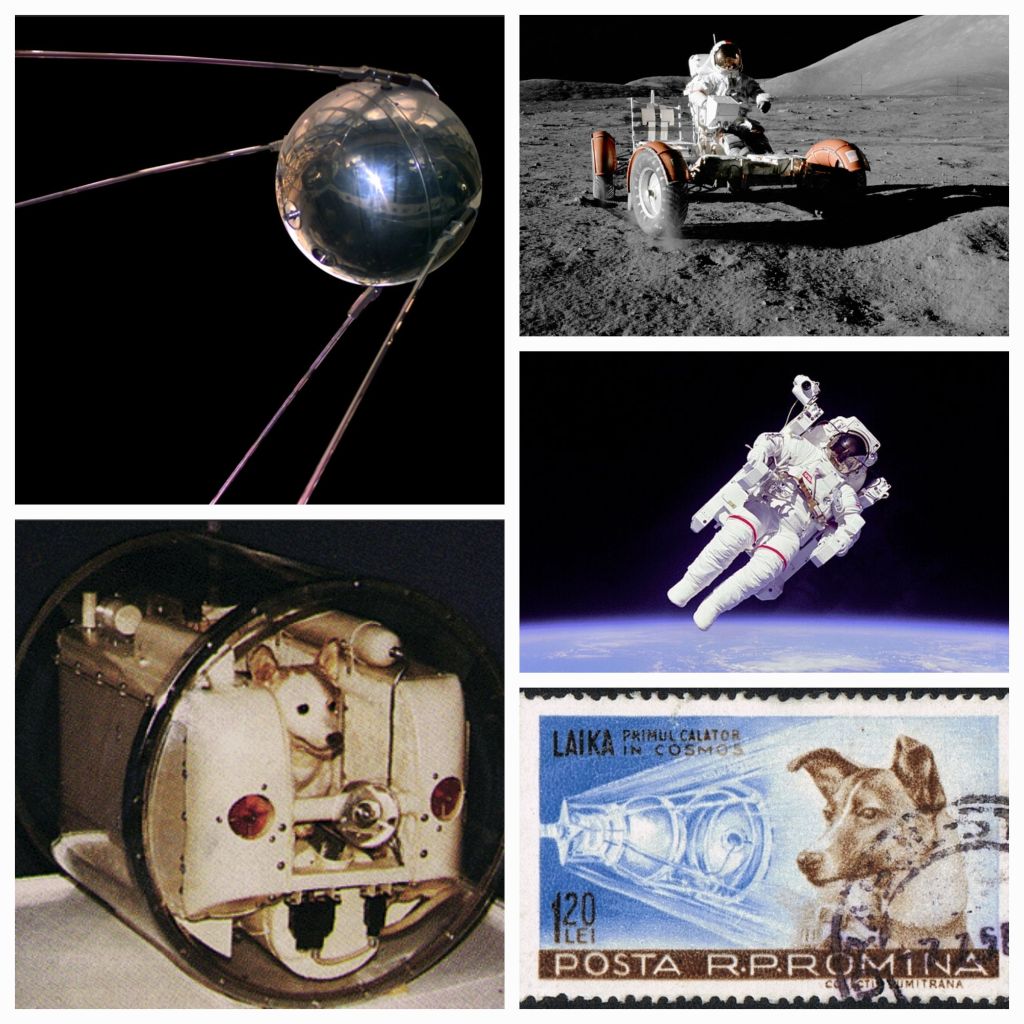
As a child, I found myself drawn to those black-and-white images of astronauts in bulky suits, their alien visors reflecting a dreamscape no artist could fully capture. I wondered about the adrenaline, the anxiety they must have felt as they left Earth’s atmosphere, entering the dark silence of space. It was a peculiar contradiction: that we humans, living our whole lives tethered to the soil, could be so drawn to the heavens. There’s a magic in that contradiction. It reveals our deepest yearning to expand, to know, to reach what is unknown.
I often think about Laika, the little stray dog, sent up in Sputnik 2—alone, silent, and sacrificed for science. It’s easy to focus on the humans, the scientists, and politicians, but then there was this small, unnamed dog from the streets of Moscow, embodying the cost of progress. It brings a sense of raw humility to the whole affair, a reminder of the sacrifices, ethical quandaries, and sometimes cruel undertakings woven into the very fabric of our advancements. Laika’s story grounds the Space Race in a reality that’s difficult to ignore. This venture into the cosmos wasn’t just a scientific quest; it was an exploration of moral boundaries as well.
The Space Race is rich with metaphors for human existence. Every launch felt like an eruption of collective aspirations. With each milestone, society was reminded of its collective dream to escape, to understand the universe, and, perhaps, to understand itself. The calculations were ruthless, often involving split-second decisions, minute tolerances, and a relentless commitment to precision. Behind it all, however, was this paradox: a pursuit of discovery motivated as much by fear as by hope. The moon landing was the crescendo, an act of defiance against nature’s boundaries and perhaps even our own limitations. But within that moment, I feel there was something almost spiritual—an experience so fundamentally human it transcends borders, political leanings, or allegiances. Armstrong’s “small step” was paradoxically the largest step imaginable, a message that rippled back to Earth with profound humility.
What strikes me most is the people who lived through this era. It was a time when the impossible became possible, when each launch was both a nationalistic victory and a unifying feat for humankind. They witnessed the collision of the human and the divine, as science crossed the boundaries of belief. The astronauts themselves were not just pioneers of a physical journey but avatars of an age when technology could mimic the mythic. To the engineers, scientists, and mathematicians involved, the Space Race was a Rubik’s Cube of physics and human grit, requiring both innovation and trust in the unknown. To the rest of the world, they were symbols of possibility, dreams writ large across the night sky.
In many ways, the Space Race feels like an existential test, a question posed to humanity about our place in the universe. By striving to escape the confines of Earth, we ended up discovering something even more profound within ourselves. What began as a competition between nations became a journey toward a collective future, an effort that nudged us to look beyond the superficial divisions and contemplate what it means to be alive, to dream, and to seek meaning in an indifferent cosmos.
In the decades since, we’ve seen technological leaps, wars, cultural revolutions, and a rapidly evolving world, yet the allure of that moment—the first footprints on the moon, the flickering screens capturing the collective gasp of Earthlings—remains unchanged. To me, the Space Race is a tapestry of contradictions and revelations. It’s a testament to our flaws and our virtues, our courage, and our fear. This grand ballet of rockets and ideals still captivates because it is, ultimately, a story of what it means to be human, our desire to reach, to question, and to understand—no matter how far we must go to do so.
#SpaceRace #Apollo11 #MoonLanding #HumanCuriosity #ColdWar #SpaceExploration #HistoryOfScience #HumanAchievement #NASA #SovietSpaceProgram

 Poetry Hub
Hello. Thanks for visiting. I’d love to hear your thoughts! What resonated with you in this piece? Drop a comment below and let’s start a conversation.