Do you or your family make any special dishes for the holidays?
I’ll start with a question: Do you or your family make any special dishes for the holidays? Not the ones that are dictated by cookbooks, but the ones etched in the grooves of memory—half-measures, whispered secrets, and spices measured in heartbeats. Indian festivals demand such culinary rituals, don’t they? They’re not just celebrations; they’re a slow unraveling of stories told through food, layered like the finest phyllo, or perhaps like your grandmother’s parathas—each fold concealing a universe.
It begins weeks before the festival, doesn’t it? In your house, as in mine, the air is thick with anticipation, heavier than the weight of jaggery melting in cast-iron kadhais. The whispers of mothers and grandmothers weave through the house, mingling with the scent of roasted cardamom. You’re drawn into the kitchen by the invisible pull of tradition, but you don’t arrive as an observer. No, you arrive as a participant—though reluctant at first.
“Hold this,” someone says, pressing a chunk of kneaded dough into your hands. It’s soft, pliable, alive. Your hands work with the dough, guided by voices that tell you when to stop kneading, when to let the gluten rest. “Don’t rush,” they say. “Festivals are about patience.”
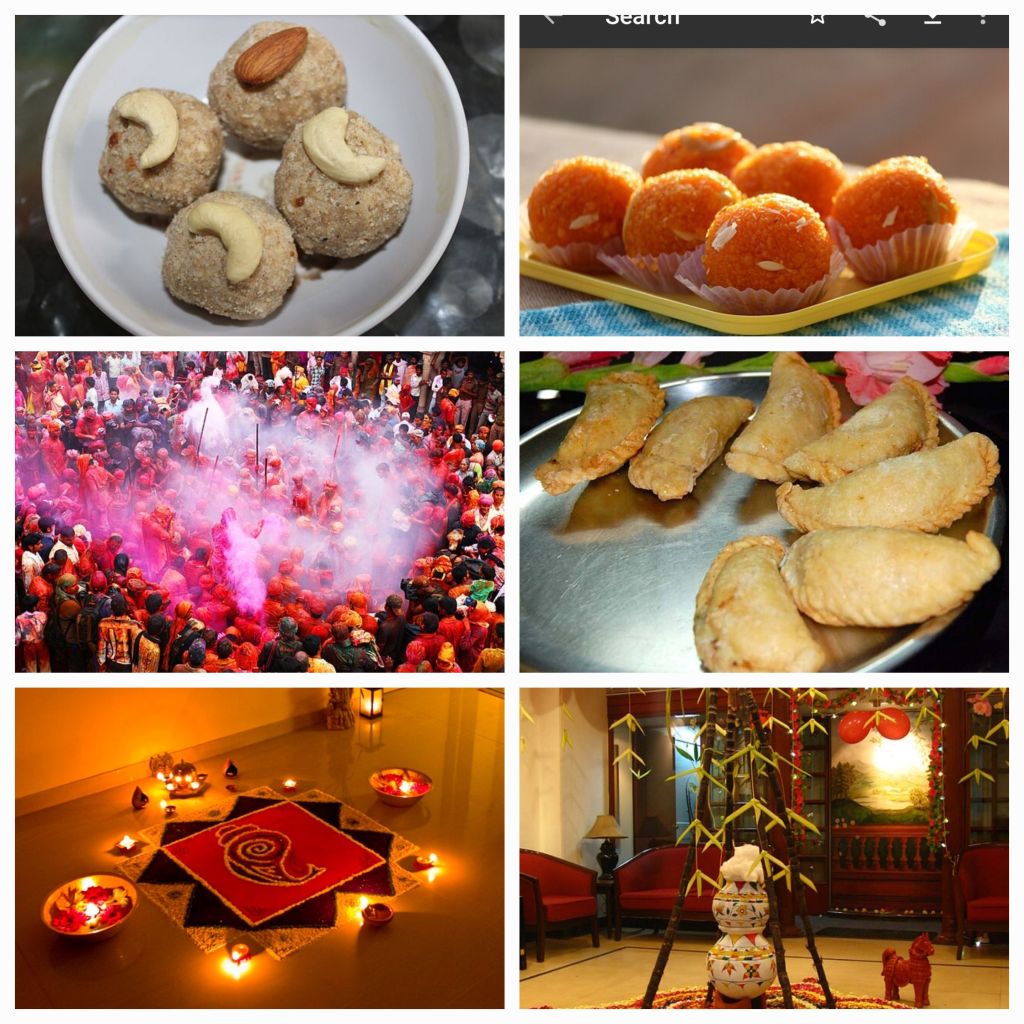
Perhaps it’s Diwali, and the kitchen is transformed into a temple of sweetness. Laddoos roll off the palms like tiny suns, their golden glow promising warmth in the chill of an autumn evening. “Don’t make them too small,” your grandmother warns. “They should feel generous.” Isn’t that the pure essence of Diwali?, the real generosity of spirit?, the unmeasured kindness? that overflows like the oil in the lamps we light?
Or maybe it’s Holi, and everything is chaos. Your hands are stained with the deep magenta of grated beets, and your face glows with smears of turmeric. Gujiyas are being filled in assembly-line precision, the edges crimped and pinched into floral patterns that could rival the rangoli outside. Someone laughs—not at you, but with you. Festivals, after all, are about letting go, aren’t they? The gujiya dough tears, but no one minds. “The filling will hold it together,” you’re told, and for a fleeting moment, it feels like a metaphor for life.
And then there’s Pongal—the festival where simplicity reigns supreme. It’s less about the flair and more about the earthiness of rice and jaggery bubbling into a harmonious embrace. You watch as someone—perhaps an aunt or an uncle—leans over the pot, waiting for the moment it overflows. “Pongal-o-pongal,” they shout, and you echo the chant, though you don’t quite know why. But you feel it in your chest, in the way the sweetness of the pongal fills the room, in the way the harvest feels like a collective triumph.
You see, festivals in India are never just festivals. They’re a sensory overload—the crackle of oil in a pan, the sight of dough puffing into perfect puris, the fragrance of saffron dissolving into warm milk. They’re also about people—the uncles who tease you for sneaking a piece of fried batter, the cousins who complain about having to stir the halwa, the mothers who insist you try the first batch, even if it’s scorching hot.
But here’s the truth: it’s not the food itself that stays with you. It’s the act of making it. You remember the feel of turmeric-dyed fingers, the sound of laughter echoing in the kitchen, the way the warmth of the stove seeped into your very being. Years later, when you’re far from home, you’ll find yourself recreating these dishes. You’ll burn the first batch of jalebis, and your modaks will collapse into sugary puddles. But you’ll keep trying. Because these aren’t just recipes—they’re heirlooms, passed down not through words but through shared moments.
I wonder: Do you ever think about the festivals not yet celebrated? The dishes not yet mastered? In my house, there’s always talk of new experiments. A fusion mithai with a twist of matcha, a savory samosa with global spices. But the roots remain firm. Even as we innovate, we return to the past, because festivals—Indian festivals especially—are about continuity. They’re the golden thread that binds us, stretching across time zones, kitchens, and generations.
So, the next time a festival approaches, step into the kitchen. Listen carefully to the whispers and stories of those who came before you. Let the aroma of spices guide you. Let the rhythm of tradition—kneading, frying, tasting—be your mantra. And as you sit down to feast with your family, let the flavors tell you their stories.
What stories will your festival dishes tell? What memories will they carry into the future? Perhaps the answers lie not in the food itself, but in the spaces between the rituals—in the laughter, the love, the infinite warmth of togetherness.
#IndianFestivals #FestiveFood #HolidayTraditions #IndianCuisine #FamilyCelebrations #FoodCulture #FestivalRecipes #CulinaryCreativity

 Poetry Hub
Hello. Thanks for visiting. I’d love to hear your thoughts! What resonated with you in this piece? Drop a comment below and let’s start a conversation.