The Architect of Shadows: A Journey into Imagination’s Chamber
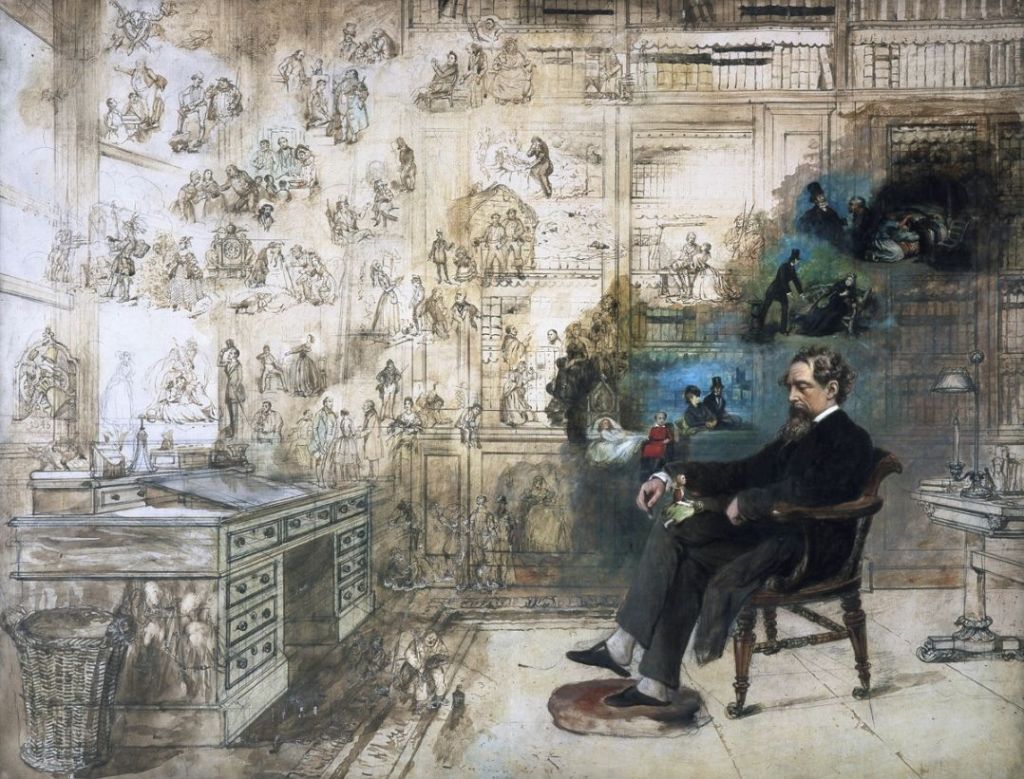
I sit here now, staring into this painting as though it were a mirror. You’ve seen it too, haven’t you? The desk, the man, the swirling phantoms of thought that crowd the air like ghosts in no hurry to leave. Charles Dickens, they say, but I see more than him. Don’t you? This is not just a man at work. This is a shrine to creation, a chaotic yet sacred temple where stories come to live and die.
You lean closer, don’t you? As I did. You see the desk first, its wooden surface worn smooth by years of restless scribbling. You see the chair, rigid yet oddly inviting, as if calling you to take Dickens’s place. But no. Look deeper. The desk is not empty, and the walls are alive. They teem with characters—not just his, but yours.
There is Pip, yes, staring wide-eyed at the vast world he’s stumbled into. There is Nancy, shivering but unbroken. But wait—who is that figure just beyond them? Ah, it’s someone from your own mind, isn’t it? Someone you’ve dreamed of but never dared to write. They linger at the edge of the painting, waiting for you to invite them in.
And Dickens himself? He sits, not as an author but as a medium. His quill is his wand, his ink his blood, each line he writes a binding spell for the figures he pulls from the ether. His eyes are heavy, yet you can almost hear the hum of his thoughts: Who next? Who shall I summon now?
Close your eyes for a moment. Yes, really. Indulge me. Imagine stepping into this room. Feel the coolness of the wooden floor beneath your feet, the faint smell of ink and parchment hanging in the air. The figures on the wall shift and stir, aware of your presence. Do they recognize you? Perhaps. After all, they might belong to you just as much as they do to Dickens.
You move closer to the desk, fingers brushing against its surface. It’s warm, alive somehow, as though it remembers every word that has been written upon it. And then—without realizing it—you sit. The chair creaks softly beneath you, and the quill finds its way into your hand. What do you write? No, let me rephrase that. What writes you?
Because that’s the secret, isn’t it? The stories are not yours. Not entirely. They come to you like whispers, like dreams you can barely remember but cannot forget. Dickens knew this. Look at him—lost in his thoughts, or perhaps found in them. He doesn’t command his characters; he listens to them. He lets them speak, lets them guide his hand. And now, sitting here in his place, you feel the same.
Who speaks to you first? Is it a child from your own memory, clutching a toy you’d long forgotten? Or is it a figure you’ve never seen before, yet know intimately, as though they’ve been waiting for you all along? They tell you their story, and you write it down, line by trembling line.
But wait. Something catches your eye. The wastebasket. It sits quietly in the corner, filled with crumpled pages. Did Dickens discard them, or did his characters? You wonder, as I did, how many ideas were thrown away before they had the chance to breathe. And what about you? How many stories have you abandoned, convinced they were not worth the ink?
The room grows darker now, the figures on the wall shifting like shadows at dusk. Dickens’s face is somber, almost mournful. He knows, as you do, that creation is both a gift and a burden. For every story that comes to life, another is left behind. The room is heavy with them—unwritten books, unfinished thoughts, untold lives. And yet, there is beauty in this weight, isn’t there?
Take a moment. Look around you, not just at the painting but at your own life. What stories have you carried with you? What characters live within you, waiting to be heard? Maybe it’s the memory of a friend you haven’t spoken to in years. Or the dream you had last night, fleeting but vivid. Or perhaps it’s something darker, a fear or regret that you’ve tried to ignore.
They are all here, in this room. Dickens’s ghosts, your ghosts, my ghosts. They mingle and dance, weaving a tapestry of memory and imagination. You realize, as I have, that the act of creation is not about control. It’s about surrender. It’s about opening the door and letting the shadows in, no matter how terrifying they might seem.
And so, here we are. You, me, Dickens, and the endless parade of characters that bind us together. The room is not his or mine or yours. It belongs to all of us, a shared space where stories are born and reborn.
I ask you now: What will you do with it? Will you seriously pick up the quill and write? Will you let the walls speak to you, let the figures guide your hand? Or will you leave the room, letting the stories fade back into the ether?
The choice is yours, as it was mine, as it was his. But remember this: The room will always be here, waiting. The desk, the chair, the wastebasket—they are yours to return to whenever you need them. And the ghosts? They will wait too, patient and persistent, until you are ready to let them in.
So, my friend, what will you write? Or perhaps I should ask: What will write you?
#CharlesDickens #CreativeWriting #Storytelling #Imagination #WritersLife #LiteraryInspiration #VictorianLiterature #ArtOfWriting #GhostsOfStories #WritingCommunity


 Poetry Hub
Hello. Thanks for visiting. I’d love to hear your thoughts! What resonated with you in this piece? Drop a comment below and let’s start a conversation.