A Journey Through the “Eye of the Sun”
The coastal breeze swept across my face as I approached HaYovel Square in Ashdod. There it stood, a towering marvel that seemed to defy the mundane passage of time and space: the “Eye of the Sun.” The very air around it felt charged with anticipation, as though it were whispering secrets of the cosmos.
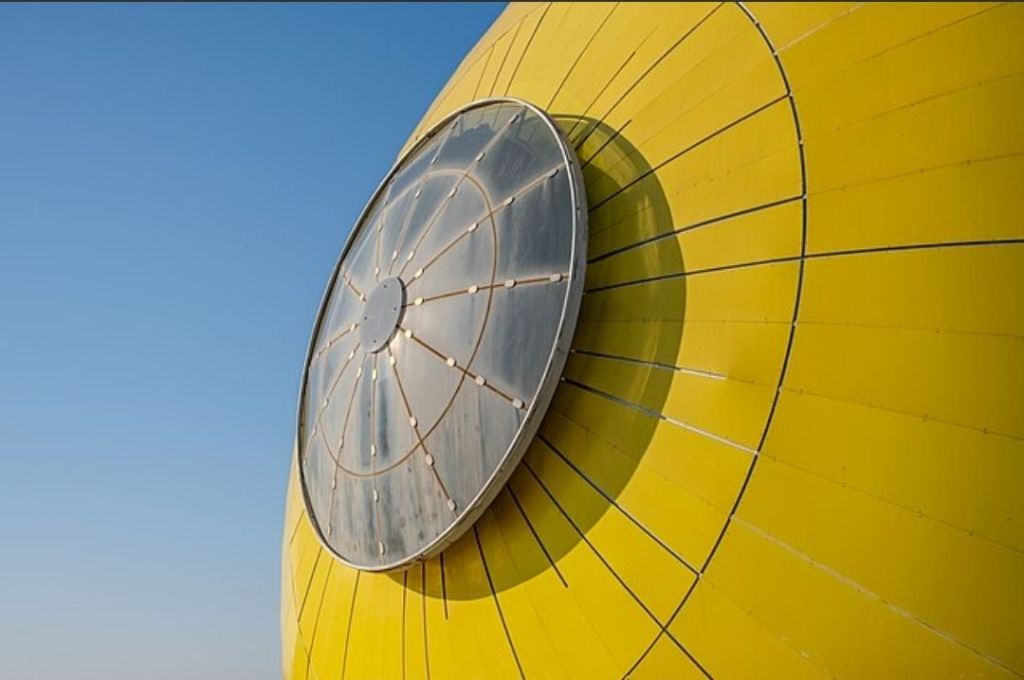
Standing 18 meters tall, the sculpture loomed above me, commanding attention. Its eastern side glowed with a radiant yellow, evoking the power and warmth of the sun. This side seemed alive, pulsating with an energy that made me think of dawn breaking across the horizon. The yellow wasn’t just paint; it was a declaration—a reminder of the sun’s omnipresence and vitality.
“Come closer,” it seemed to beckon. And so I did.
I circled around to its western side. Here, the mood shifted entirely. The gray surface, sleek and understated, whispered of the moon. It wasn’t merely a contrast to the sunlit side; it was a counterpart, a partner in an eternal dance. The gray felt like a veil of mystery, the kind of enigma one associates with moonlit nights. I reached out to touch it and imagined the coolness of lunar craters beneath my fingertips. It was as though I had stepped into a duality—day and night, warmth and coolness, energy and tranquility—encapsulated in this massive lens-like form.
Historical Significance
The “Eye of the Sun” is not merely a sculpture; it is a testament to the city of Ashdod’s history and evolution. Designed by the renowned Israeli artist Motti Mizrachi, the sculpture was unveiled in 2006 as part of the celebrations for Ashdod’s 50th anniversary. This milestone marked a half-century of growth and transformation, as Ashdod rose from a small coastal town to one of Israel’s major cities and a key port on the Mediterranean Sea.
Mizrachi’s vision captures the essence of Ashdod’s identity as a meeting point of contrasts—modernity and antiquity, land and sea, light and shadow. The city itself is steeped in history, its roots tracing back to ancient times when it was a significant Philistine city mentioned in biblical texts. The “Eye of the Sun,” with its dual representation of the sun and moon, seems to echo the balance between the old and the new, the traditional and the contemporary.
Geographic Context
Situated in HaYovel Square, near Ashdod’s southernmost beach, the sculpture occupies a unique geographical location. This beach is where the land gently meets the sea, a boundary that reflects the themes of the sculpture itself. The Mediterranean coastline, with its ever-changing tides and expansive horizons, serves as the perfect backdrop for a piece that contemplates celestial rhythms and earthly contrasts.
The square, named “Jubilee Square,” is more than just a public space; it is a communal hub where locals and visitors gather to celebrate, reflect, and connect. The placement of the “Eye of the Sun” here transforms the area into a symbolic space where earth meets sky and day transitions into night. The sculpture becomes a focal point for these transitions, mirroring the constant interplay of natural elements.
Artistic Vision
Motti Mizrachi’s design is both simple and profound. The sculpture’s dual faces—one yellow and vibrant, the other gray and subdued—embody the interplay of opposites that define our world. The yellow side represents vitality, energy, and the life-giving force of the sun. In contrast, the gray side speaks of calmness, mystery, and the introspective qualities of the moon.
The central lens-like form ties these elements together, serving as a metaphorical eye that observes and connects. It invites viewers to consider the balance in their own lives, the harmony between action and reflection, and the unity within diversity. Mizrachi’s work challenges us to see beyond surface appearances and embrace the deeper connections that bind us to the cosmos and to one another.
A Spectacle of Light
As the day gives way to night, the “Eye of the Sun” undergoes a transformation. The sculpture, which is striking in daylight, becomes a dynamic canvas for light after dark. A sophisticated lighting system bathes its surface in shifting colors—red, blue, green, and purple—creating a mesmerizing spectacle. These lights are programmed to change for holidays and special occasions, making the sculpture a living, evolving part of Ashdod’s cultural fabric.
On the evening I visited, the sunset cast a golden glow on the yellow side, amplifying its brilliance. Meanwhile, the gray side seemed to absorb the encroaching darkness, preparing to harmonize with the rising moon. When the lights came on, the sculpture came alive in a new way, its surface morphing into a kaleidoscope of hues. It felt as though the sculpture were telling a new story with each color, each shift in light.
A Personal Encounter
I found myself drawn to the sculpture not just as a work of art but as a companion in contemplation. “What do you see?” I asked, in a very loud tone, standing before the central lens. It didn’t answer, of course, but its presence felt profoundly conversational. It seemed to challenge me to look inward, to examine the dualities within myself and the world around me.
The longer I lingered, the more I felt the interconnectedness of all things. The sculpture’s gaze seemed to extend outward, encompassing the sun’s journey across the sky, the moon’s phases, and the rhythmic dance of the tides. At the same time, it felt deeply rooted in the here and now, observing the lives of the people who gathered around it—children playing, couples strolling, and visitors like me marveling at its beauty.
A Lasting Impression
As I finally turned to leave, I glanced back at the “Eye of the Sun.” Its gray side now glowed softly under the moonlight, fully embracing its lunar counterpart. I felt a deep sense of gratitude—to Motti Mizrachi for his artistic vision, to the city of Ashdod for preserving its history while embracing modernity, and to the universe for this wonderful endless interplay of light and shadow, energy and calm.
The “Eye of the Sun” is not merely a sculpture, it’s a lot more than that. It is a celebration of contrasts, a reflection of life’s dualities, and a reminder that balance is both beautiful and essential. For those who stand before it, it offers not just a view but a vision—a chance to see the world, and themselves, in a new light.
“Until we meet again,” I murmured as I walked away. The “Eye of the Sun” seemed to glow in acknowledgment, as if it understood the farewell was not forever.
#EyeOfTheSun #AshdodArt #IsraeliLandmarks #PublicArt #MottiMizrachi #MediterraneanBeauty #ArtAndHistory #CelestialSculpture #TravelIsrael #CulturalLandmarks

 Poetry Hub
Hello. Thanks for visiting. I’d love to hear your thoughts! What resonated with you in this piece? Drop a comment below and let’s start a conversation.