Camus and the Infinite Whispers of the Absurd
I first met Camus not in a dusty library, nor in the academic eulogies of professors, but in the bitter solitude of my own questions. You, too, may have felt it—the quiet rebellion against the ridiculous, mundane rituals of life. There was a morning, cold and pale, when I stumbled across The Stranger like one stumbles upon a mirror. That was the moment when I realized that Camus wasn’t just a writer. He was a shadow cast over your existential despair, a guide through the chaos of living without a map.
The Stranger: A Quiet Earthquake
“Mother died today. Or maybe yesterday, I don’t know.”
Who begins a novel like that? Not a storyteller, but a confessor. Camus gave us Meursault, a man unshackled from sentimentality, who stared at death and the absurdity of human conventions with a defiance you may envy. Or fear. I remember reading it and feeling the world shift beneath me.
Meursault isn’t you, but he is. He is the person you might be if you stripped away the polite lies—about love, about duty, about the absurd hope that life must mean something. When he stood in the courtroom, judged for his indifference rather than his crime, I felt a twinge in the back of my mind. You probably felt it too, the question: Do I live by rules I never agreed to?
The Absurd Has a Face: The Myth of Sisyphus
If The Stranger was the punch, The Myth of Sisyphus was the explanation whispered afterward, almost apologetically. I picture Camus himself sitting across from me, leaning forward, gesturing as he speaks:
“Life is absurd. You know that. But the question isn’t whether life has meaning. The question is whether you can go on knowing it doesn’t.”
Ah, Sisyphus. The man condemned to push a rock uphill for eternity, only to watch it roll back down. A laughable punishment, yes, but Camus, with that sly grin of his, flips the narrative. Sisyphus isn’t a victim; he’s a rebel.
You and I, we’re Sisyphus too, aren’t we? Our lives are full of uphill battles. Yet Camus tells us to embrace the absurdity, to find joy in the struggle itself. Imagine Sisyphus happy, he urges. I dare you—imagine yourself happy, not despite the struggle, but because of it.
The Plague: Humanity in Quarantine
And then there was the plague, which was not a plague, but it was. The Plague is a chronicle, but also a metaphor, for all that oppresses us: tyranny, disease, indifference. Camus traps us in Oran, alongside Dr. Rieux, whose quiet perseverance is the soul of humanity itself.
I read The Plague during a recent pandemic, as you might have. And didn’t it feel prescient? Camus seemed to anticipate how isolation brings out both the best and the worst in us. You, me, everyone—we are all in quarantine, not just from viruses but from each other, from meaning, from certainty.
Dr. Rieux reminded me of what I often forget: heroism isn’t grand. It’s showing up every day. It’s continuing to care when it’s easier not to. And maybe you, too, felt a flicker of hope in his quiet rebellion against despair.
The Fall: A Mirror You Can’t Look Away From
In The Fall, Camus stops asking you to observe and instead pulls you directly into his confessional booth. Jean-Baptiste Clamence, the narrator, becomes your mirror—your judge, your accuser, your fellow sinner.
Do you remember the way he dissects human morality? How he points out, with clinical precision, the hypocrisy in our acts of kindness? I hated him, at first. Then I hated myself for recognizing the truths he revealed. Camus wasn’t kind in The Fall. He didn’t have to be. Truth rarely is.
The Rebel: Rebellion as a Symphony
By the time I read The Rebel, I thought I understood Camus. But then he turned the question again: What does it mean to rebel?
Camus didn’t romanticize rebellion. He didn’t call for chaos or destruction. Instead, he saw rebellion as an act of creation. To rebel is to affirm. To resist tyranny, nihilism, despair—it’s not a denial of life’s absurdity. It’s an embrace of it.
Think of your own rebellions, small or large. Against injustice. Against despair. Against the silent pull to give up. Camus saw those moments as sacred. I do, too.
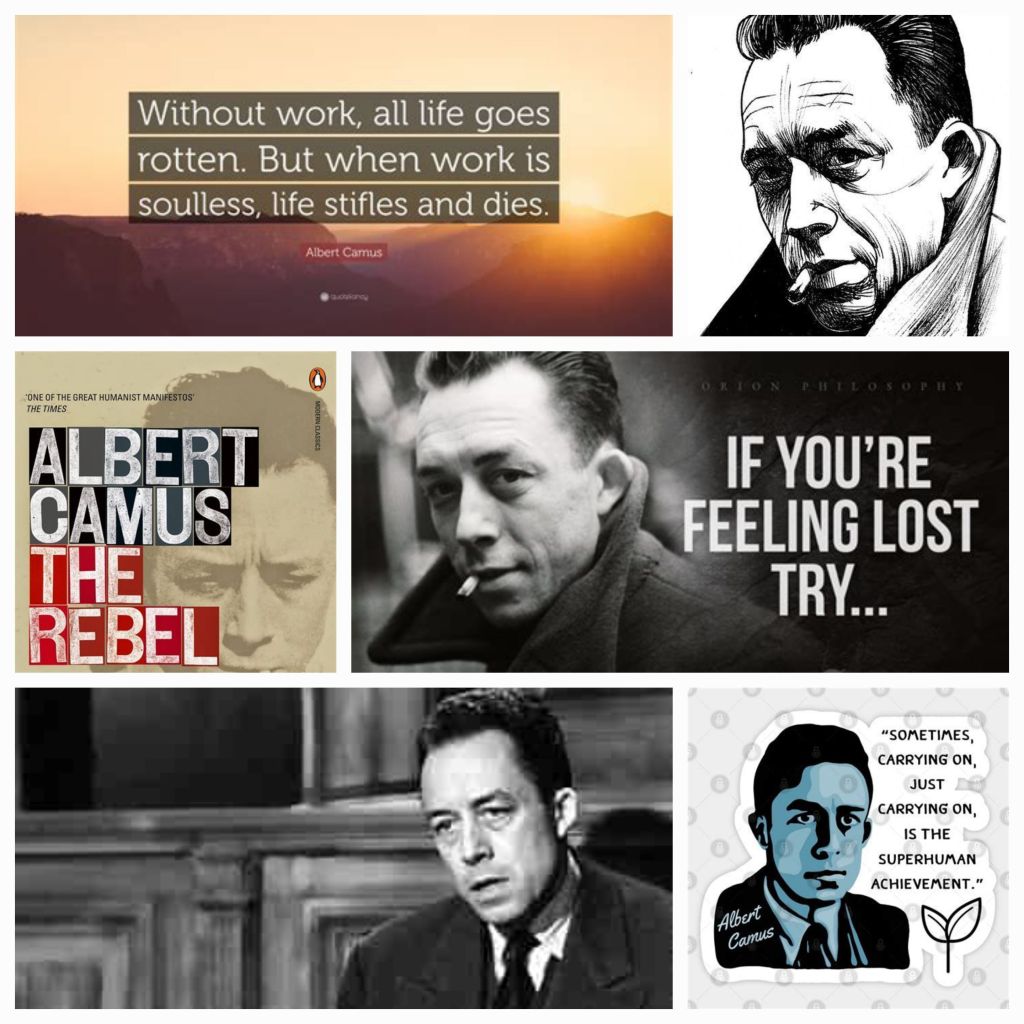
Camus Lives Where You Are
Perhaps the greatest gift Camus gave us wasn’t his books, but the way he redefined living. His world wasn’t comforting; it wasn’t meant to be. He didn’t offer answers; he taught us how to live with the questions.
I still hear him, don’t you? In the moments when life feels unbearably heavy, and yet you keep pushing that rock upward. In the quiet acts of defiance, of choosing to care, to love, to create, even when it seems futile.
Camus is here, in you, in me, in the absurdity of it all. And if you listen closely, he’s still whispering:
“The struggle itself toward the heights is enough to fill a man’s heart.”
Do you hear it? That’s the astounding sound of the rock rolling back down. It’s the sound of your next step. It’s the sound of life.
#AlbertCamus #Absurdism #Existentialism #TheStranger #TheMythOfSisyphus #FrenchPhilosophy #LiteratureLovers #PhilosophyOfLife #ThePlague #MeaningOfLife

 Poetry Hub
Hello. Thanks for visiting. I’d love to hear your thoughts! What resonated with you in this piece? Drop a comment below and let’s start a conversation.