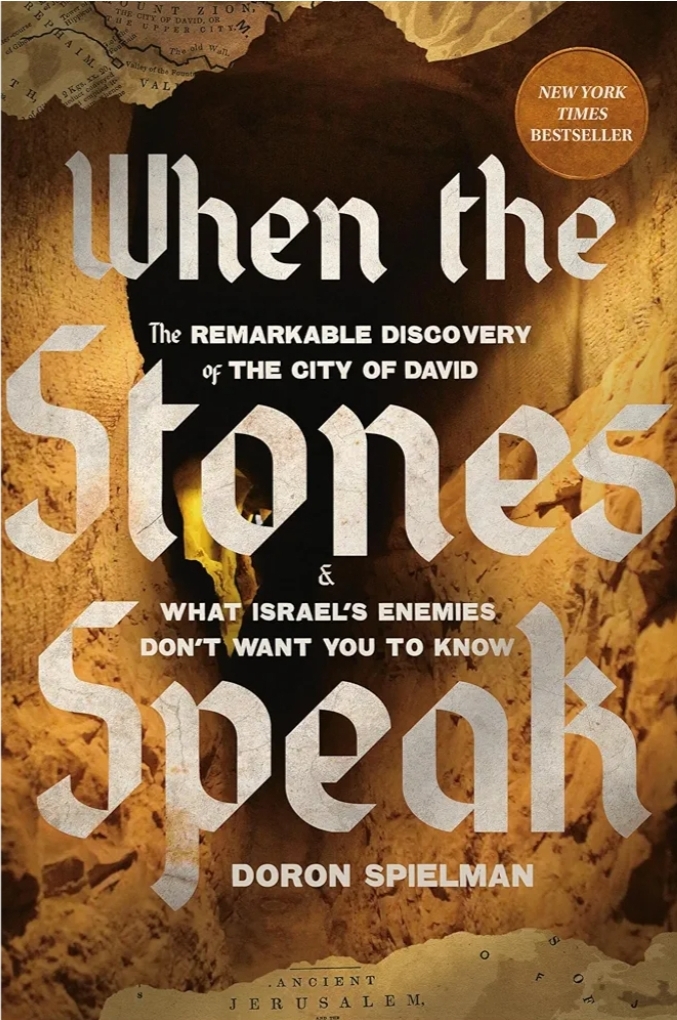
Published by Hachette Book Group, 2024
In an era where historical narratives increasingly serve as weapons in geopolitical conflicts, Doron Spielman’s “When the Stones Speak” emerges as both archaeological chronicle and ideological manifesto. An instant New York Times bestseller, this work attempts to bridge the gap between scholarly excavation and popular advocacy, presenting archaeological findings from Jerusalem’s City of David as definitive proof of Jewish indigeneity to the Holy Land.
The Author’s Authority and Perspective
Spielman brings considerable credentials to this undertaking. As vice president of the City of David Foundation and former IDF spokesperson, he has spent two decades working closely with archaeologists at what he describes as Israel’s largest excavation site. His unique position—straddling military service, archaeological administration, and public advocacy—provides him with unprecedented access to both the physical discoveries and the political implications of the dig.
As Spielman himself summarizes: “The proof that we have pulled out of the ground shows without a doubt that Jews are indigenous to Jerusalem and Israel.” This declarative statement encapsulates both the book’s central thesis and its primary challenge: the tension between archaeological evidence and absolute historical claims.
Archaeological Merit and Narrative Structure
The book’s strength lies in its vivid documentation of recent archaeological discoveries. Since 1995, when archaeologists discovered remnants of a very large fortress surrounding the Gihon Spring, excavations have resulted in significant finds including the Givati excavations and other remarkable discoveries that have fundamentally altered our understanding of ancient Jerusalem’s layout and significance.
Spielman’s narrative prowess shines in his ability to transform dry archaeological reports into compelling storytelling. What makes “When the Stones Speak” unique is its blend of adventure and polemic. Spielman is not a dispassionate observer; he is a passionate advocate, bringing the ancient city to life through detailed descriptions of excavation processes, artifact discoveries, and the painstaking work of interpretation.
The book effectively contextualizes the City of David’s significance within broader biblical and historical narratives. The seat of government and the palaces of King David and King Solomon were located to the immediate south of the Temple Mount, opposite the Dung Gate, in the Kidron Valley, Spielman explains, grounding his arguments in specific geographical and archaeological evidence.
The Polemical Dimension
Where “When the Stones Speak” becomes more contentious is in its explicitly political framing. The subtitle—”What Israel’s Enemies Don’t Want You To Know”—immediately signals the book’s adversarial positioning. Spielman suggested in an interview that the book is aimed at what he calls “the middle group of people” — “logical, reasonable people” who don’t know whether they’re pro-Israel or anti-Israel, yet the confrontational tone may paradoxically limit its appeal to undecided readers.
The book’s treatment of UNESCO’s 2016 ruling regarding Jerusalem’s status serves as a central organizing principle. Irrefutable archaeological evidence of Jewish history in Jerusalem annuls UNESCO’s 2016 ruling, according to Spielman’s argument. This framing transforms archaeological discovery into political ammunition, raising questions about the relationship between scientific inquiry and advocacy.
Methodological Considerations
From a critical perspective, the book’s most significant weakness lies in its conflation of archaeological evidence with historical certainty. While the City of David excavations have undoubtedly yielded remarkable artifacts and structural remains, the interpretation of these findings requires careful consideration of alternative explanations and the limitations of archaeological evidence.
Spielman’s background as a military spokesperson and foundation executive, rather than a trained archaeologist, becomes relevant when evaluating his interpretive framework. His passion for the subject matter is evident and admirable, but it occasionally overshadows the nuanced uncertainty that typically characterizes responsible archaeological interpretation.
The book would benefit from more explicit acknowledgment of ongoing scholarly debates within the archaeological community. While Spielman presents his interpretations with confidence, the field of biblical archaeology remains contentious, with legitimate scholarly disagreement about the relationship between archaeological findings and historical narratives.
Literary and Pedagogical Value
Despite its polemical elements, “When the Stones Speak” succeeds as an educational tool for readers interested in understanding both the archaeological richness of ancient Jerusalem and the contemporary political implications of historical claims. It is not only rich in archaeology, but also very informative about the facts on the ground, as one reader noted.
The book’s accessibility makes complex archaeological concepts comprehensible to general audiences. Spielman’s storytelling ability transforms what could be dry technical material into engaging narrative, helping readers visualize the ancient city and understand the significance of various discoveries.
Contemporary Relevance and Impact
“When the Stones Speak” arrives at a moment when questions of indigenous rights, historical legitimacy, and territorial claims dominate international discourse. He reveals the remarkable findings that connect the Jewish people to their ancient capital—and the sinister effort to suppress them, positioning archaeological work within broader narratives of historical justice and contemporary politics.
The book’s emphasis on material evidence as a counterweight to political rhetoric reflects a broader cultural moment where empirical claims compete with ideological narratives. Whether readers find Spielman’s arguments convincing will likely depend on their pre-existing perspectives on Middle Eastern politics and the relationship between ancient history and contemporary claims.

Critical Assessment
“When the Stones Speak” represents both the potential and the perils of public archaeology. On one hand, it demonstrates how archaeological discoveries can capture public imagination and contribute to historical understanding. Spielman’s passion for the subject matter is infectious, and his ability to communicate complex archaeological concepts to general audiences deserves recognition.
On the other hand, the book’s explicit political agenda raises important questions about the relationship between scientific inquiry and advocacy. While Spielman’s interpretations may be correct, the certainty with which he presents them sometimes obscures the tentative nature of archaeological interpretation.
The book’s title itself—”When the Stones Speak”—suggests that archaeological evidence speaks for itself, but as any archaeologist knows, stones require interpretation, and interpretation involves human judgment, cultural context, and scholarly debate.
Conclusion
“When the Stones Speak” succeeds as both popular archaeology and political advocacy, though readers should approach it with awareness of its dual nature. Spielman has produced a compelling narrative that brings ancient Jerusalem to life while making a forceful case for Jewish historical connection to the land.
The book’s value lies not necessarily in its political conclusions but in its detailed documentation of remarkable archaeological discoveries and its demonstration of how ancient history continues to shape contemporary discourse. For readers interested in understanding both the archaeological richness of the City of David and the passionate debates surrounding its interpretation, “When the Stones Speak” provides an essential, if partisan, perspective.
Whether the stones truly “speak” with the clarity Spielman claims remains an open question, but there is no doubt that his book has succeeded in amplifying their voice in contemporary discussions about history, identity, and belonging in one of the world’s most contested spaces.
Rating: 4/5 stars – A compelling work of public archaeology that succeeds in its educational mission while raising important questions about the relationship between scientific evidence and political advocacy.
#BookReview #Archaeology #BiblicalArchaeology #Jerusalem #CityOfDavid #DoronSpielman #AncientHistory #JewishHistory #PublicArchaeology #HistoricalNarrative #ArchaeologicalEvidence #MiddleEastHistory #PoliticalAdvocacy #NYTBestseller #HistoricalTruth

 Poetry Hub
Hello. Thanks for visiting. I’d love to hear your thoughts! What resonated with you in this piece? Drop a comment below and let’s start a conversation.