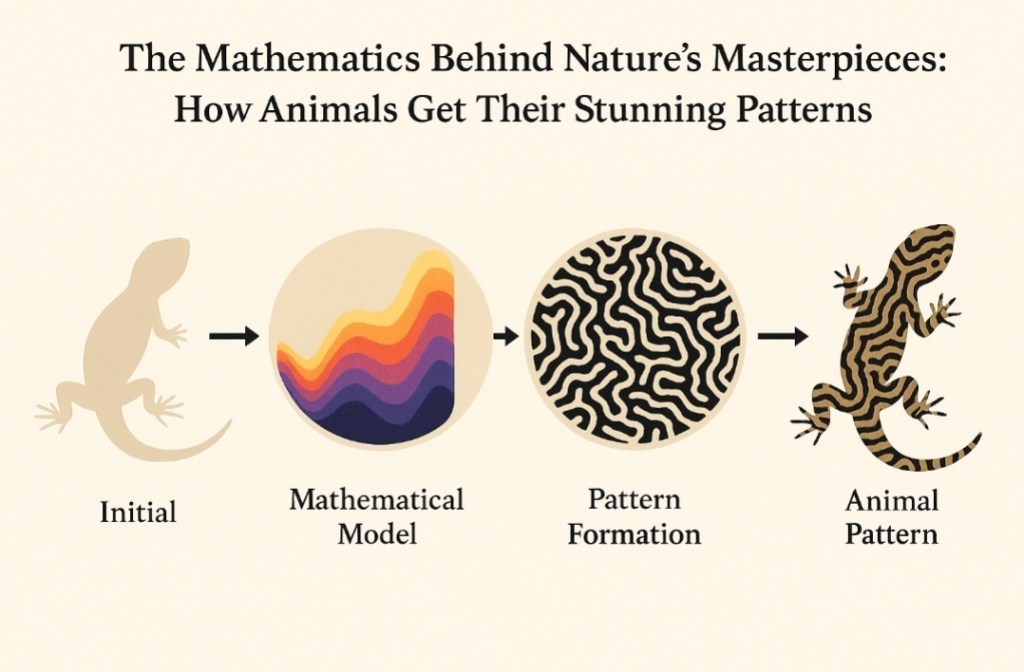
A leopard’s rosettes aren’t random art—they’re mathematical masterpieces encoded in biology. Every spot, stripe, and swirl adorning the animal kingdom follows precise mathematical rules that would make any mathematician weep with joy. From the zebra’s bold racing stripes to the intricate lacework of a giraffe’s coat, nature has been conducting the most sophisticated geometry class on Earth for millions of years.
But here’s where it gets truly mind-blowing: the same mathematical principles that create these breathtaking patterns are now helping scientists understand everything from how soap cleans your clothes to how we might cure genetic diseases. Welcome to the fascinating intersection where math meets biology, where equations come alive in fur and feathers.
The Turing Revolution: When Math Predicted Life
Back in 1952, Alan Turing—yes, the same brilliant mind who cracked the Enigma code and laid the groundwork for modern computing—proposed something revolutionary. He suggested that biological patterns could form through a simple mathematical process involving two chemicals: an activator that promotes pattern formation and an inhibitor that suppresses it.
Imagine two invisible forces playing an eternal game of tag across a developing animal embryo. The activator rushes forward, shouting “Make a stripe here!” while the inhibitor follows close behind, whispering “But not too close to the last one.” This chemical dance creates waves of pattern formation that manifest as the stunning designs we see in nature.
For decades, Turing’s theory remained largely theoretical—a beautiful mathematical concept that seemed almost too elegant to be true. Scientists could see the patterns, measure them, and marvel at them, but the actual mechanisms remained frustratingly elusive. It was like knowing a magic trick was happening but being unable to see the magician’s hands.
Then, in 2023, everything changed. Researchers at the University of Colorado Boulder made a breakthrough that would make Turing himself smile from beyond the grave. They discovered that pattern formation involves not just chemical diffusion, but also diffusiophoresis—the same process that helps soap remove dirt from clothing.
The Soap and Spots Connection: Nature’s Cleaning Revelation
Here’s where things get deliciously weird. The same mechanism that makes soap so effective at cleaning your dishes is also responsible for creating the sharp, distinct patterns we see on animals. This process, called diffusiophoresis, involves chemical agents literally dragging pigment-producing cells along with them as they move through tissue.
Think of it this way: when you wash greasy dishes with soap, the soap molecules don’t just dissolve the grease—they actually grab onto the grease particles and drag them away from the plate. Similarly, chemical agents in developing animals diffuse through tissue and drag pigment-producing cells with them, creating sharp-edged patterns rather than blurry gradients.
This discovery explains one of biology’s most persistent mysteries: why animal patterns have such crisp, defined edges. Without this dragging mechanism, we’d expect to see fuzzy, watercolor-like blends where patterns meet. Instead, we get the razor-sharp transitions between a zebra’s black and white stripes, or the precise boundaries of a leopard’s rosettes.
The implications are staggering. This isn’t just about understanding pretty patterns—it’s about comprehending one of the fundamental ways that life organizes itself. Every time a cell decides where to go during development, every time a organ forms its intricate structure, similar principles might be at work.
Case Studies: Nature’s Pattern Portfolio
Let’s take a virtual safari through some of nature’s most stunning pattern exhibitions, armed with our new understanding of the mathematical forces at play.
Zebras: The Ultimate Thermostat
Those iconic black and white stripes aren’t just for show—they’re a sophisticated climate control system that would make any engineer jealous. The alternating dark and light bands create micro-differences in temperature across the zebra’s body. Dark stripes absorb more heat and create tiny updrafts, while lighter stripes reflect heat and create downdrafts. This creates a natural air conditioning system that helps zebras stay cool in the scorching African heat.
But that’s not all. Recent research has shown that zebra stripes are also incredibly effective at deterring biting flies. The insects become confused by the alternating pattern, unable to land properly on the zebra’s body. It’s like nature’s own bug spray, woven directly into the animal’s DNA.
The mathematical precision is remarkable: zebra stripes average 4-6 inches in width—the exact size needed to create optimal thermoregulation while maximizing fly deterrence. Too narrow, and the thermal effect disappears. Too wide, and the flies adapt. Evolution has fine-tuned this pattern to mathematical perfection.
Leopards: The Art of Disappearing
A leopard’s rosettes represent one of nature’s most sophisticated camouflage systems. These aren’t random spots—they’re carefully engineered optical illusions designed to mimic the dappled light filtering through forest canopies. Each rosette is roughly 2-3 inches in diameter, the perfect size to blend with the patches of sunlight and shadow in their woodland habitat.
What makes leopard patterns even more fascinating is their individuality. Like human fingerprints, no two leopards have identical rosette patterns. This allows researchers to identify individual animals in the wild, creating a natural ID system that’s been incredibly valuable for conservation efforts.
The formation of these rosettes follows Turing’s mathematical principles perfectly. The activator chemicals create the dark outer ring, while the inhibitor prevents pigment formation in the center, creating the characteristic hollow appearance. It’s a masterclass in mathematical precision disguised as natural beauty.
Tropical Fish: Living Kaleidoscopes
Perhaps nowhere are mathematical patterns more spectacularly displayed than in the vibrant world of tropical fish. From the precise chevron patterns of angelfish to the polka-dot perfection of pufferfish, these aquatic artists showcase the full range of Turing’s mathematical symphony.
These patterns serve multiple purposes: species recognition (helping fish identify potential mates), predator confusion (creating optical illusions that make it hard to track individual fish in a school), and territorial displays (advertising fitness and dominance to rivals). Each pattern is a multifunctional masterpiece, solving multiple survival challenges simultaneously.
Beyond Basic Patterns: The Complexity Revolution
As our understanding of pattern formation deepens, we’re discovering that many animals don’t just have single patterns—they have multiple pattern systems working together. This “pattern blending” creates the incredibly complex camouflage we see in animals like giraffes, whose coat combines multiple mathematical systems to create an almost textile-like complexity.
Modern research reveals that while genes determine what colors an animal can produce, physics determines where those colors appear. This means that even if you could somehow alter an animal’s genetics, the fundamental pattern structure would remain largely unchanged—because it’s written in the laws of physics themselves.
The evolutionary advantages of these patterns are numerous and sophisticated. Beyond the obvious benefits of camouflage, patterns serve as communication tools, thermoregulation systems, and even potential parasite deterrents. Each stripe, spot, and swirl has been tested by millions of years of natural selection, refined and perfected through countless generations.
The Future of Pattern Science
Understanding animal patterns isn’t just satisfying our curiosity—it’s opening doors to revolutionary applications. Biomimicry researchers are studying these natural patterns to develop new materials, create more effective camouflage for military applications, and even design better heat management systems for buildings.
Medical researchers are particularly excited about the implications. Understanding how cells organize themselves during pattern formation could lead to breakthroughs in tissue engineering, cancer treatment, and regenerative medicine. The same mathematical principles that create a zebra’s stripes might someday help us grow replacement organs or repair damaged tissue.

The Mathematical Poetry of Life
As we stand at the intersection of mathematics and biology, we’re witnessing something profound: the revelation that beauty and function are not separate entities in nature, but expressions of the same underlying mathematical truth. Every pattern in the animal kingdom is simultaneously a work of art and a solution to a complex survival problem.
The next time you see a zebra’s stripes or a leopard’s rosettes, remember that you’re looking at living mathematics—equations made flesh, formulas walking the Earth. In these patterns, we see the universe’s most fundamental truth: that chaos and order, randomness and precision, beauty and function are not opposites but dance partners in the grand ballroom of existence.
Nature doesn’t just follow mathematical rules—it IS mathematical rules, expressed in the most beautiful language imaginable. And every stripe, spot, and swirl is a letter in that cosmic alphabet, spelling out the story of life itself.
What patterns in nature fascinate you most? Share your thoughts and wildlife photographs in the comments below, and let’s continue exploring the mathematical mysteries that surround us every day.
Want to dive deeper into the science of animal patterns? Check out our related articles on genetic discoveries in animal coloration and the technology inspired by nature’s designs. Don’t forget to subscribe to PebbleGalaxy.blog for more fascinating insights into the mathematical beauty of our natural world.
#AnimalPatterns #NatureMath #WildlifeScience #TuringPatterns #ScienceTwitter #NatureLovers #BiologyFacts #WildlifePhotography #PatternFormation #NaturalSelection #ScienceEducation #BiologyResearch #NaturalScience #WildlifeScience #Biomimicry #ScienceCommunication #EvolutionaryBiology #ResearchInsights #NatureInspired #ScienceWriting

 Poetry Hub
Hello. Thanks for visiting. I’d love to hear your thoughts! What resonated with you in this piece? Drop a comment below and let’s start a conversation.