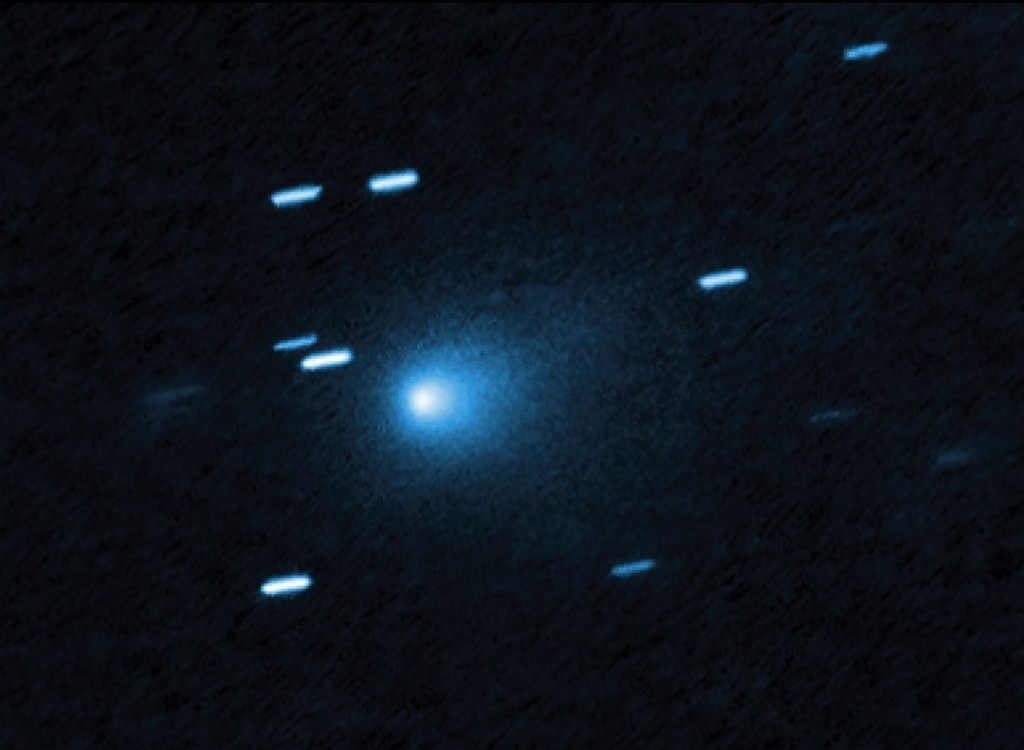
The Mysterious 3I/ATLAS: When Science Meets the Unknown
So here we are, standing at the precipice of one of astronomy’s most captivating mysteries. Picture this: a Manhattan-sized visitor from beyond our solar system, hurtling through space at speeds that would make your head spin. Meanwhile, one of Harvard’s most controversial astrophysicists is suggesting something that would make science fiction writers jealous – that this cosmic wanderer might just be alien technology.
A Discovery That Changed Everything
Initially, astronomers thought they had spotted another routine asteroid when the ATLAS telescope in Chile detected a faint moving object on July 1, 2025. However, within hours of follow-up observations, scientists realized they were witnessing something extraordinary. Furthermore, this wasn’t just any space rock – it was an interstellar visitor, only the third confirmed object from beyond our solar system.
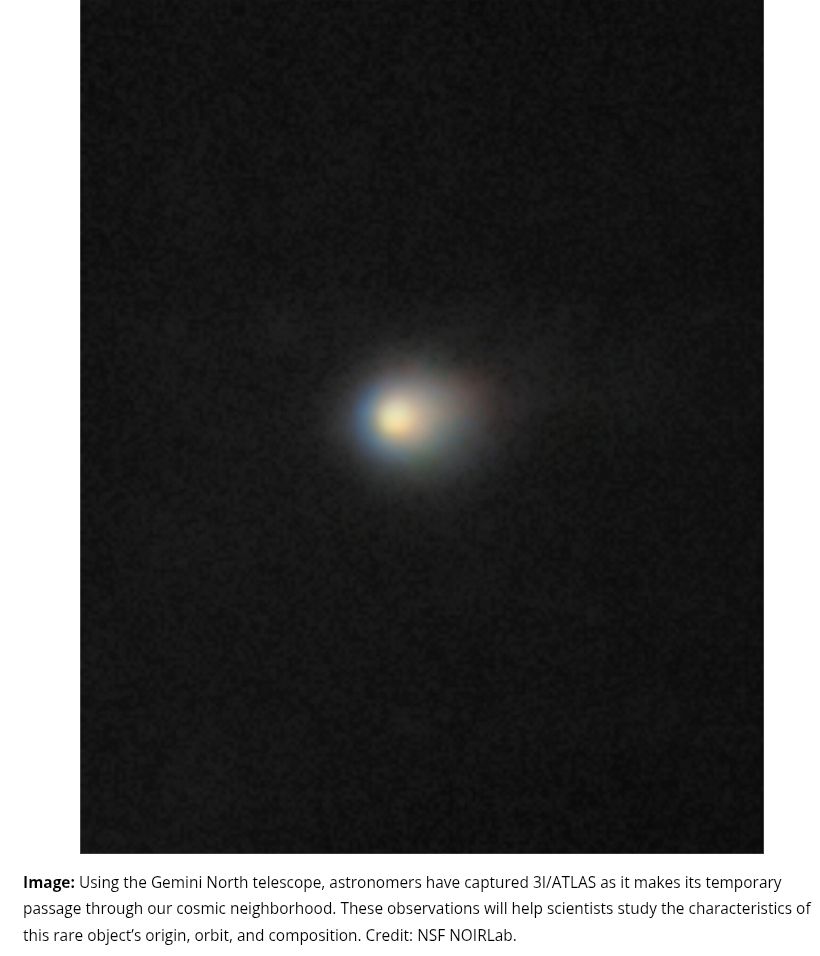
Subsequently, the object received its official designation: 3I/ATLAS, where “3I” signifies its status as the third interstellar object ever discovered. Additionally, astronomers confirmed it was a comet when they detected its characteristic coma – that fuzzy halo of gas and dust that forms when ice sublimates in the Sun’s heat.
What Makes This Visitor So Special
Size and Speed: Breaking All Records
Remarkably, 3I/ATLAS dwarfs its predecessors in almost every measurable way. While 1I/’Oumuamua measured roughly 100-400 meters in length and 2I/Borisov spanned about 1-2 kilometers, initial estimates suggested 3I/ATLAS could be up to 20 kilometers across. However, recent Hubble Space Telescope observations have refined these figures, indicating the nucleus is likely between 0.32 and 5.6 kilometers in diameter, with the most probable size being less than 1 kilometer.
Additionally, the speed difference is equally dramatic. Specifically, 3I/ATLAS races through space at nearly 60 kilometers per second (approximately 130,000 mph), significantly faster than ‘Oumuamua’s 26 km/s or Borisov’s 32 km/s. Consequently, this makes it the fastest solar system visitor ever recorded.
Age: A Cosmic Time Capsule
Perhaps most intriguingly, scientists estimate 3I/ATLAS to be between 3 billion and 11 billion years old, potentially making it older than our entire solar system. Moreover, spectral analysis reveals it contains water ice, carbon-rich materials, and ancient silicates that may have remained frozen for billions of years.
The Controversial Theory That’s Dividing Scientists
Loeb’s Bold Hypothesis
Currently, Harvard astrophysicist Avi Loeb, known for his unconventional theories about extraterrestrial objects, has proposed something that sounds straight out of a sci-fi thriller. Specifically, in a paper co-authored with researchers from the Initiative for Interstellar Studies, Loeb suggests 3I/ATLAS might not be a natural comet at all.
Instead, he proposes two possibilities for the object’s unusual characteristics. First, it could be “a rare fragment from the core of a nearby supernova that is rich in radioactive material”. Second, and more provocatively, it might be “a spacecraft powered by nuclear energy, with the dust emitted from its frontal surface” being accumulated space debris.
The Dark Forest Connection
Furthermore, Loeb’s theory draws from the “Dark Forest” hypothesis – a chilling solution to the Fermi Paradox. This concept suggests that alien civilizations remain silent and hidden, fearing destruction by other hostile species. Accordingly, if 3I/ATLAS were an alien probe, its stealthy behavior would make perfect sense within this framework.
Suspicious Trajectory Patterns
Moreover, several orbital characteristics support Loeb’s speculation. Notably, 3I/ATLAS’s path lies almost perfectly within the ecliptic plane, with only a 5-degree tilt, despite moving in retrograde direction. Additionally, astronomers calculate the probability of such precise alignment occurring by chance at roughly 0.2%.
Even more intriguingly, the object will approach surprisingly close to Venus, Mars, and Jupiter, with a combined probability of less than 0.005%. Furthermore, its trajectory will hide it behind the Sun from Earth’s perspective during its closest approach, potentially providing cover for covert maneuvers.
The October Mars Encounter: A Golden Opportunity
HiRISE to the Rescue
Excitingly, 3I/ATLAS will pass within 28.96 million kilometers of Mars on October 3, 2025, presenting an unprecedented observation opportunity. Consequently, Loeb has successfully encouraged NASA’s HiRISE team to use their high-resolution camera aboard the Mars Reconnaissance Orbiter to capture detailed images during this encounter.
Importantly, this Mars-based observation becomes crucial because Earth-based telescopes will struggle to observe 3I/ATLAS during this period due to its proximity to the Sun in our sky. Therefore, the Mars Reconnaissance Orbiter may provide our clearest view of this enigmatic visitor.
What We Hope to Learn
Specifically, these observations could reveal crucial details about 3I/ATLAS’s surface composition, structure, and activity levels. Additionally, scientists hope to determine whether the object shows signs of artificial construction or remains consistent with natural comet behavior.
Scientific Pushback and Peer Review
Critics Speak Out
Nevertheless, not all scientists embrace Loeb’s extraterrestrial hypothesis. Particularly, Oxford astronomer Chris Lintott has dismissed the alien theory as “nonsense,” arguing it undermines legitimate research into the object’s true nature. Similarly, other experts stress that extraordinary claims require extraordinary evidence.
The Natural Explanation
Meanwhile, mainstream astronomers maintain that 3I/ATLAS most likely represents a perfectly natural interstellar comet. Specifically, spectroscopic observations reveal water ice and typical cometary materials, supporting this conventional interpretation. Additionally, its behavior closely matches that of 2I/Borisov, the previous interstellar comet.
Advanced Observations Reveal New Secrets
Hubble’s Sharp Vision
Recently, the Hubble Space Telescope captured the sharpest images yet of 3I/ATLAS, revealing important details about its structure. Specifically, Hubble detected a dust plume ejected from the Sun-warmed side of the comet and hints of a dust tail streaming away from the nucleus. Moreover, Hubble’s observations suggest the nucleus contributes most of the object’s brightness, rather than the surrounding coma.
James Webb’s Infrared Eyes
Additionally, the James Webb Space Telescope has begun intensive observations using its Near-Infrared Spectrograph, searching for volatile molecules like H₂O, CO, CO₂, and NH₃. Remarkably, JWST has detected clear signs of water ice, carbon dust, silicates, and complex organic compounds frozen on the object’s surface for potentially 7 billion years.
The Path Ahead: Perihelion and Beyond
October’s Critical Moment
Significantly, 3I/ATLAS will reach its closest approach to the Sun (perihelion) on October 29-30, 2025, at a distance of approximately 1.4 astronomical units, just inside Mars’s orbit. During this time, intense solar heating will cause maximum sublimation of its icy materials, potentially revealing its true nature.
December’s Earth Encounter
Subsequently, the comet will make its closest approach to Earth in December 2025, coming within about 1.8 astronomical units (270 million kilometers) of our planet. Importantly, this distance ensures 3I/ATLAS poses absolutely no threat to Earth.
Visibility for Amateur Astronomers
Starting in mid-November 2025, 3I/ATLAS will become visible again as it emerges from the Sun’s glare. Specifically, estimates suggest it will reach magnitude 12.7-13.0 during late November and early December, making it potentially observable through large amateur telescopes from dark sites.
The Broader Implications
Rethinking Interstellar Objects
Regardless of whether 3I/ATLAS proves natural or artificial, its discovery is revolutionizing our understanding of interstellar visitors. Previously, astronomers estimated about 0.001 interstellar objects per cubic astronomical unit of space, but 3I/ATLAS’s detection suggests these visitors might be even rarer than initially thought.
Preparing for Future Visitors
Furthermore, 3I/ATLAS demonstrates the importance of rapid-response observation capabilities for studying these fleeting cosmic tourists. Consequently, upcoming survey telescopes like the Vera Rubin Observatory will be crucial for detecting and characterizing future interstellar objects.
The Verdict: Science at Its Most Exciting
Ultimately, whether 3I/ATLAS turns out to be an ancient comet or something far more extraordinary, it represents science at its most thrilling. Currently, the object serves as a perfect example of how the universe continues to surprise us, challenging our assumptions and pushing the boundaries of human knowledge.
Meanwhile, Loeb’s controversial hypothesis, regardless of its ultimate validity, demonstrates the importance of considering all possibilities when confronted with anomalous data. After all, as Carl Sagan famously noted, “Extraordinary claims require extraordinary evidence” – and scientists are working diligently to gather exactly that kind of evidence.
Finally, as we await the crucial observations from Mars in October and the enhanced visibility period in December, one thing remains certain: 3I/ATLAS has already secured its place in astronomical history. Whether it’s simply an ancient messenger from the depths of space or something far more profound, this cosmic visitor reminds us that the universe still holds countless mysteries waiting to be unraveled.
The coming months will undoubtedly provide answers to some of these questions, but they may also raise entirely new ones. In science, after all, the most exciting discoveries often come not from confirming what we expect, but from encountering the truly unexpected. And 3I/ATLAS, in all its mysterious glory, certainly fits that description perfectly.

 Poetry Hub
Hello. Thanks for visiting. I’d love to hear your thoughts! What resonated with you in this piece? Drop a comment below and let’s start a conversation.