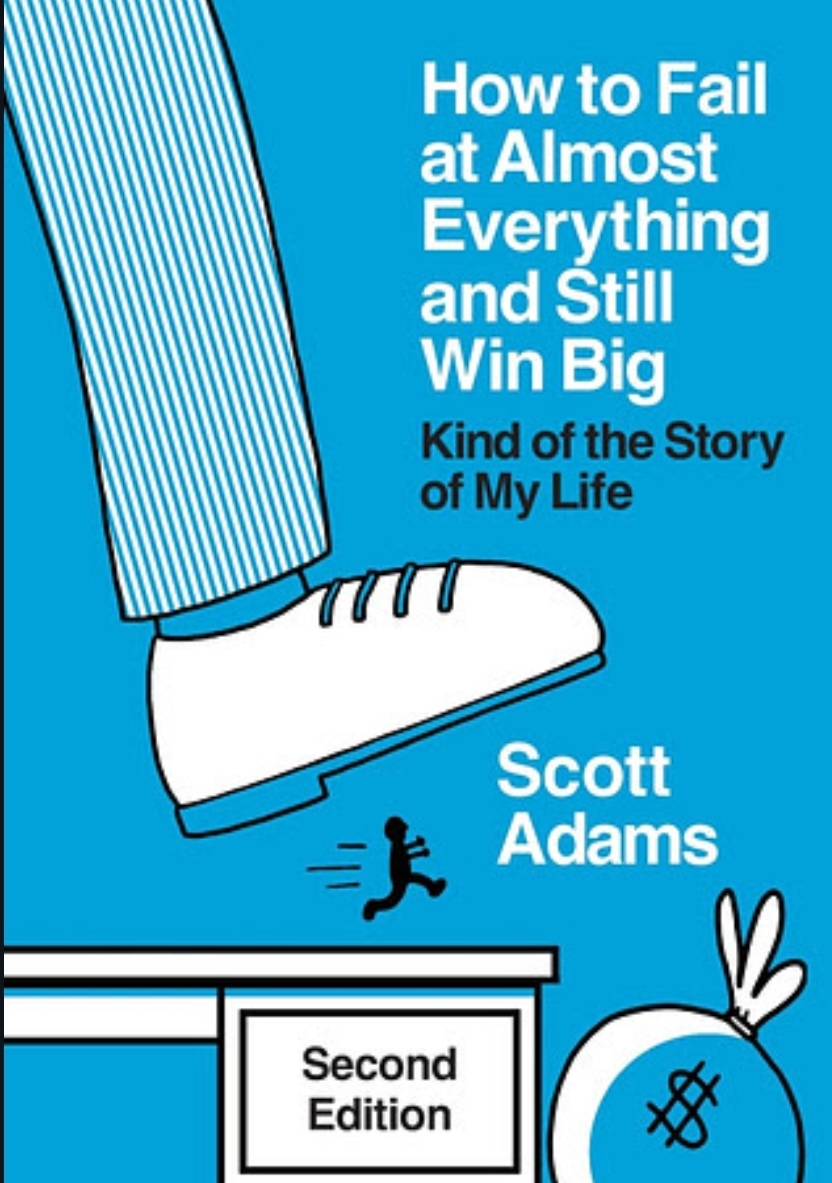
Success rarely follows a straight line. In How to Fail at Almost Everything and Still Win Big, Scott Adams dismantles conventional wisdom, showing that strategic failure, systems thinking, and a well-crafted talent stack create more reliable paths to success than passion, goals, or raw talent. With humility, humor, and research-backed insights, Adams reframes failure as an essential ingredient in a repeatable formula for achievement.
The Myth of Passion and the Power of “Selfish” Energy Management
Most success advice begins with “follow your passion.” Adams argues that passion without success is empty, while success begets passion. He rejects passion as the starting point. Instead, he prioritizes personal energy—physical, mental, and emotional—as the chief resource for achievement. By adopting “selfish” decision-making—putting health and energy first—you maximize your capacity to help others and sustain creative work. Exercise, sleep, and nutrition become nonnegotiable investments in your potential rather than optional routines.
Adams schedules tasks around his energy peaks. Creative work, such as drawing Dilbert strips, takes priority during morning highs, while administrative tasks occupy low-energy afternoons. This form of energy management outperforms rigid time management by aligning tasks with physiological rhythms, yielding consistent productivity and long-term well-being.
From Goals to Systems: Cultivating Ongoing Success
Goals create fleeting satisfaction and perpetual failure. If your goal is to lose 20 pounds, you remain a “failure” until you reach that exact target—and empty once you do. Adams advocates systems: ongoing processes that deliver daily wins and continuous improvement.
A system is anything you do repeatedly, while a goal is a single future outcome. Eating healthily every day is a system; losing twenty pounds is a goal. Exercising daily is a system; running a marathon in under four hours is a goal. Systems provide near-instant feedback and boost motivation, whereas goals leave you stranded in pre-success failure until they are achieved.
By focusing on systems, you feel successful every time you apply them, sustaining momentum and energy. This shift transforms work from a series of peaks and troughs into a steady climb.
Talent Stacking: The Snowball of Complementary Skills
Rather than chasing world-class mastery in one domain, Adams champions talent stacking—cultivating several “merely good” skills that combine into a unique competitive advantage.
Being mediocre at drawing, writing, and business might seem unremarkable singly. Yet, combining these skills forms a talent stack that few possess in toto. Mediocrity in multiple, complementary areas yields leverage superior to singular excellence, much like Kanye West’s mix of musical, design, and branding talents created his singular brand.
Adams distills his formula: “Every skill you acquire doubles your odds of success.” You don’t need to be top-tier; you simply must be above average at each skill and stack them wisely. Fields most universally valuable include public speaking, psychology, business writing, accounting, and design. By layering skills, you create a personal monopoly—your name becomes your niche.
Failing Forward: Learning from Setbacks as Market Research
Adams’ career brims with failures: a bankrupt restaurant, aborted product ventures, and corporate missteps. Yet each setback delivered vital lessons. Banking taught him business fundamentals; corporate drudgery fueled Dilbert’s satire; entrepreneurial flops honed his risk tolerance. Rather than viewing failures as endpoints, he treats them as high-cost, high-value education.
This concept of failing forward frames setbacks as iterative experiments. When his restaurant failed, Adams learned about location choice, customer behavior, and cash-flow management—insights directly informing future ventures. His failures weren’t mistakes but data points in a personal R&D program.
Managed Luck: Maximizing Serendipity
Luck isn’t random. Adams introduces managed luck—positioning yourself so that serendipity finds you. He likens his career to a slot machine that requires only time, energy, and focus, not money. Each draw costs effort but guarantees new learning, improving odds of a big payoff.
He broadened his “luck surface area” by relentlessly submitting cartoons to publishers, networking in diverse circles, and exploring varied side projects. When newspaper editors sought workplace comics, his system ensured Dilbert was ready to capitalize. By pursuing multiple paths concurrently, you tilt chance in your favor.
The Role of Probability and Psychology
Success hinges more on probability and psychology than narrow expertise. Adams stresses understanding persuasion, influence, and human biases to navigate corporate and social landscapes. Studying psychology sharpened his negotiation skills and enhanced his corporate satire’s resonance.
By recognizing that small probabilities compound over time, Adams embraced experimental ventures despite low odds of success. Each new project, whether a blog, product, or comic strip, marginally increased his cumulative chance of a breakthrough. He managed risk by ensuring failures still enriched his talent stack.
Health, Freedom, and Happiness
At the book’s core lies Adams’ happiness formula:
Happiness=Health+FreedomHappiness=Health+Freedom
He equates health with energy and freedom with autonomy over time and choices. Systems for exercise, sleep, and stress reduction secure health; diversified income streams and self-directed projects deliver freedom. Together, they sustain happiness and fuel ongoing success.
Practical Takeaways and Action Steps
Adams provides actionable advice:
- Build a system for every major goal. Write daily, exercise regularly, and network consistently.
- Stack modest skills to develop a unique profile. Prioritize widely applicable talents like writing, persuasion, and basic finance.
- Manage energy before time. Map tasks to energy peaks and replenish resources through sleep and nutrition.
- Fail forward by treating experiments as market research. Extract lessons from each setback and apply them to refine your system.
- Cultivate managed luck by increasing exposure: pitch ideas broadly, diversify projects, and engage in varied communities.
- Optimize health and freedom to bolster happiness. Prioritize well-being and autonomy to maintain momentum.

Conclusion: Reframing Failure as Opportunity
In How to Fail at Almost Everything and Still Win Big, Scott Adams reframes failure not as the enemy of success but as its ally. By adopting systems over goals, stacking complementary skills, managing energy, and orchestrating luck, you transform each setback into a stepping stone. This counterintuitive blueprint empowers ordinary individuals to achieve extraordinary results through deliberate, research-backed strategies rather than blind passion or single-minded ambition. Embrace failure—fail often, learn continually, and win big.
#ScottAdams #SuccessFormula #FailForward #TalentStack #SystemsOverGoals #EnergyManagement #ManagedLuck #PersonalDevelopment #ProductivityTips #HowToFailAtAlmostEverything

 Poetry Hub
Hello. Thanks for visiting. I’d love to hear your thoughts! What resonated with you in this piece? Drop a comment below and let’s start a conversation.