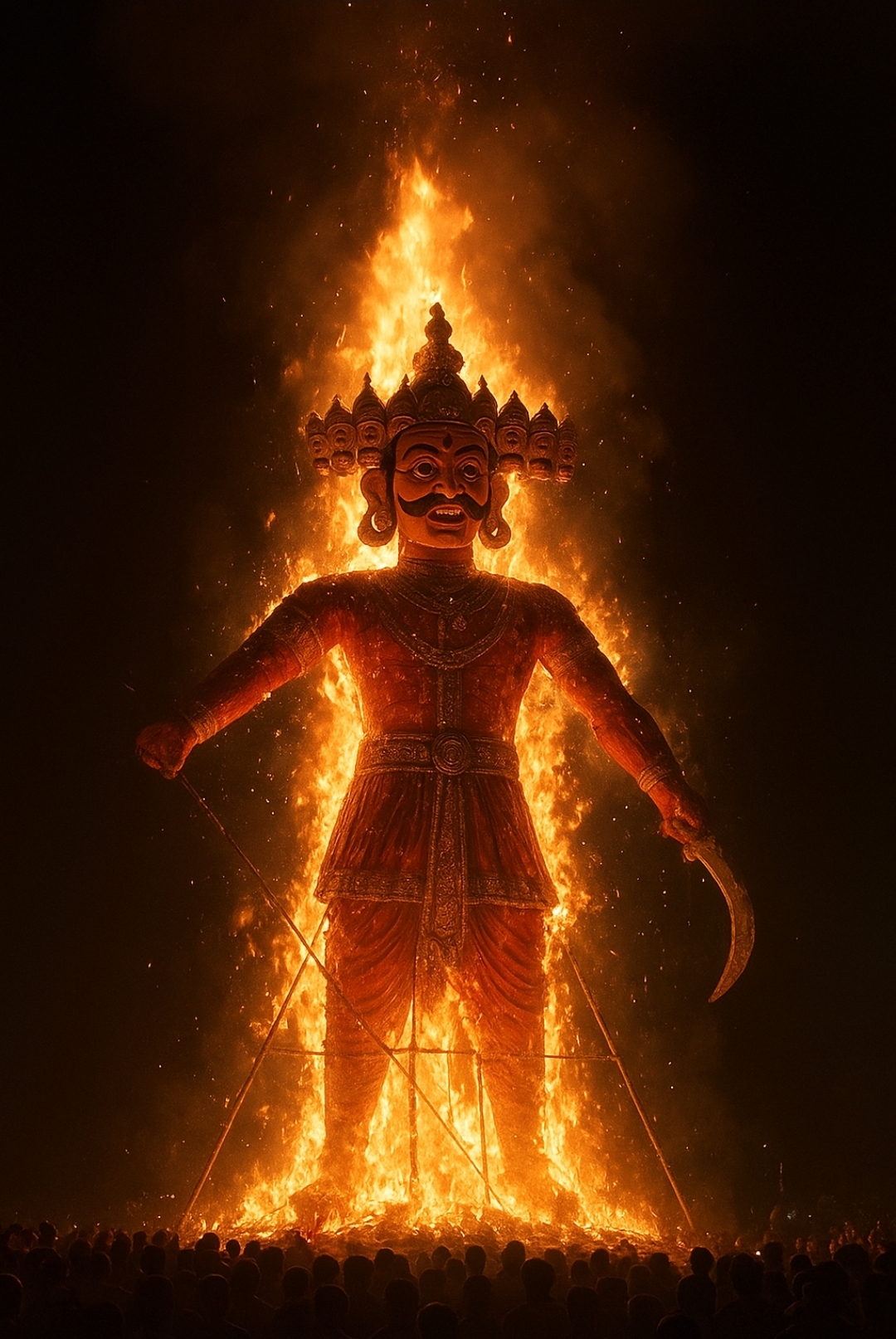
They rise,
out of the earth,
stitched together with bamboo bones,
bright cloth skin stretched taut
against the October sky.

They are waiting.

Silent,
stoic,
guarded by the tangle of wires
that slice across the heavens
like invisible shackles,
like reminders
that even giants must bow
to the architecture of modernity.

Three figures—
immense,
with eyes painted in stern defiance,
moustaches sharp as drawn swords,
crowns stacked like prayers piled upon altars,
standing in their ancient pose of arrogance,
ready to fall,
ready to burn.


---

Once upon a time,
long before these effigies of cloth and bamboo
were stitched by mortal hands,
they walked.
Ravana,
Meghnath,
Kumbhkaran—
names that thunder in Sanskrit syllables,
rolled across centuries
through grandmothers’ mouths
by the winter fire.

Demons,
yet not demons,
kings of ambition,
dreamers who wanted to touch the sky
but fell into the mire of pride.

What is a demon, after all,
but a human who forgets
the balance between power and compassion?

And what is a festival,
if not a way to retell
the lesson we never quite learn?


---

The children will come,
eyes wide,
clutching sweets sticky with sugar,
their laughter ringing louder
than the crackle of fireworks.
They will ask,
“Who are these giants,
why are they so tall,
why do they burn?”

And the mothers will answer,
“These are the faces of evil.
Watch how they fall,
watch how fire eats them whole,
because goodness always wins.”

But I wonder—
do the giants know?
As they sway in the afternoon wind,
do they hear the whispers of history?
Do they remember
that they are only half of the story?


---

Look closer.

The one in the middle,
with the towering crown,
his eyes do not plead for mercy.
They glare back.
As if to say,
“I was a king,
I was a scholar,
I was not only what the stories call me.
I loved,
I erred,
I fought with the gods themselves,
and I lost.
But do not shrink me to a puppet of evil.”

The effigies
stand tall,
and in their silence
they protest the simplicity
with which we rewrite lives.


---

Every year,
we build them taller.
Every year,
we paint their eyes sharper,
their mustaches thicker,
their crowns heavier.

We are careful.
We sew in them
our rage,
our hunger for a villain,
our collective need
to set something aflame.

And then—
in the falling dusk,
when the air is thick
with smoke and gunpowder,
we light the arrow.
A hiss,
a scream of sparks,
a single streak of fire—
and the giants erupt.

Children clap,
drums thunder,
the sky reddens.

For a moment,
the crowd believes
evil has been vanquished.
For a moment,
the world feels pure again.


---

But what happens after?

The morning comes,
and the air is heavy with ash.
Shreds of cloth litter the fields,
bamboo ribs cracked and scattered.
Crows pick at the remains.
The effigies are gone.

Yet, in some quiet corner of the mind,
the giants remain.
Not outside,
but within.


---

Because evil is not only
a ten-headed king
sitting on a golden throne.
Evil is also
in the quick judgment,
the unspoken cruelty,
the greed that creeps unnoticed,
the silence when we should speak.

Evil is smaller now,
quieter,
but no less dangerous.

And so,
we keep building effigies.
We keep giving them faces,
names,
fire.
Because perhaps we cannot burn
what hides in us,
but we can at least set aflame
its reflection.


---

Oh, look again at them—
those towering effigies.

Notice how they rise
against the tangled green vines
that crawl along the wall.
Notice how their painted robes
shine in blue and crimson,
as if they were warriors
in some grand forgotten court.

They are beautiful,
strangely beautiful,
too beautiful, almost,
to be villains.

Perhaps this is why
children cannot stop staring.
Perhaps this is why
elders tell the story again and again—
to remind us
that beauty does not make one righteous,
that power does not make one eternal,
that wisdom without humility
is a sword that cuts its wielder first.


---

The power lines cross their bodies.
It seems absurd,
these giants shackled by wires,
yet it is also true—
our age is no longer theirs.
Ravana belongs now to folklore,
to puppet shows and television dramas,
to fireworks and papier-mâché.

And yet,
what an odd immortality!
To die every year,
to burn every year,
to fall with the same thunderous applause—
and then to rise again,
stitched, painted, rebuilt.

No god enjoys such ritual rebirth.
Only the villain does.

What does that say about us?


---

I think of the artisans,
bending under the sun,
tying bamboo poles with coir,
stretching painted cloth,
chiseling faces with strokes of brush.
They are the unsung poets
of this annual drama.
In their hands,
the demon king lives again.
In their sweat,
the myth is preserved.

And when the flames consume their work,
do they feel sorrow,
or satisfaction?
Do they whisper,
“See you next year, Maharaja”?


---

There is something deeply human
in this cycle of creation and destruction.
We build,
we burn,
we rebuild.
Perhaps it mirrors life itself—
our rise and fall,
our arrogance,
our fleeting triumphs.

The effigies stand,
but they are also mirrors.
Tall, silent mirrors
that reflect the faces in the crowd.

When the arrow flies,
when the fire swallows them,
what we are really watching
is the hope
that something inside us
has also been purified.


---

And yet,
the questions remain.

Is Ravana only a villain,
or is he a reminder
that even knowledge and devotion
can be corrupted by pride?

Is Kumbhkaran merely sloth,
or is he the warning
that sleep in the face of duty
is the same as betrayal?

Is Meghnath merely arrogance,
or is he the tragic warrior,
valiant but blind to his own chains?

The effigies cannot answer.
They only stand.
They only wait.
They only burn.


---

But I imagine,
someday,
when the crowd has gone,
when the ash has cooled,
and the night is silent,
the ghosts of these giants
walk again across the field.

They do not roar.
They do not curse.
They simply walk,
heads bowed,
through the smoke of their own bodies.

And in that silence,
they remind us:
heroes and villains
are born of the same clay.
Goodness and evil
are choices,
repeated every day.

The effigies are not just demons.
They are questions,
and the fire is only
our attempt at an answer.


---

So here they stand,
before the burning,
in their calm majesty.
And I,
a passerby,
a witness in the sunlight,
find myself unable to look away.

Because in their painted eyes,
I see not just the past,
but the eternal present.
I see not just Ravana,
but myself.
I see the rise and fall
of all ambition,
all hunger,
all pride.

And I whisper,
not a curse,
but a prayer—

May we burn the right things,
within and without.
May the fire not blind us,
but cleanse us.
May the giants of cloth and bamboo
remind us each year
that we are always
standing at the edge
of our own becoming.

And may we,
unlike them,
choose not to rise only to fall,
but to rise,
and rise,
and rise again—
with humility,
with compassion,
with the wisdom
to know what makes us human.

#Dussehra #Ravana #Poetry #FestivalsOfIndia #MythAndMemory #GoodVsEvil #CulturalReflections #FireAndAsh #IndianTradition #PoetryOfLife


Leave a Reply