Are We Building a Lonelier World, One Convenience at a Time?
You swipe to wake,
not from sleep,
but from the hum of half‑made mornings,
a rectangle glowing beside your unbrushed breath.
Outside,
the street has long forgotten
how footsteps used to mean presence.
Now it’s trucks,
motors echoing deliveries—
things appearing
without hands exchanging them.

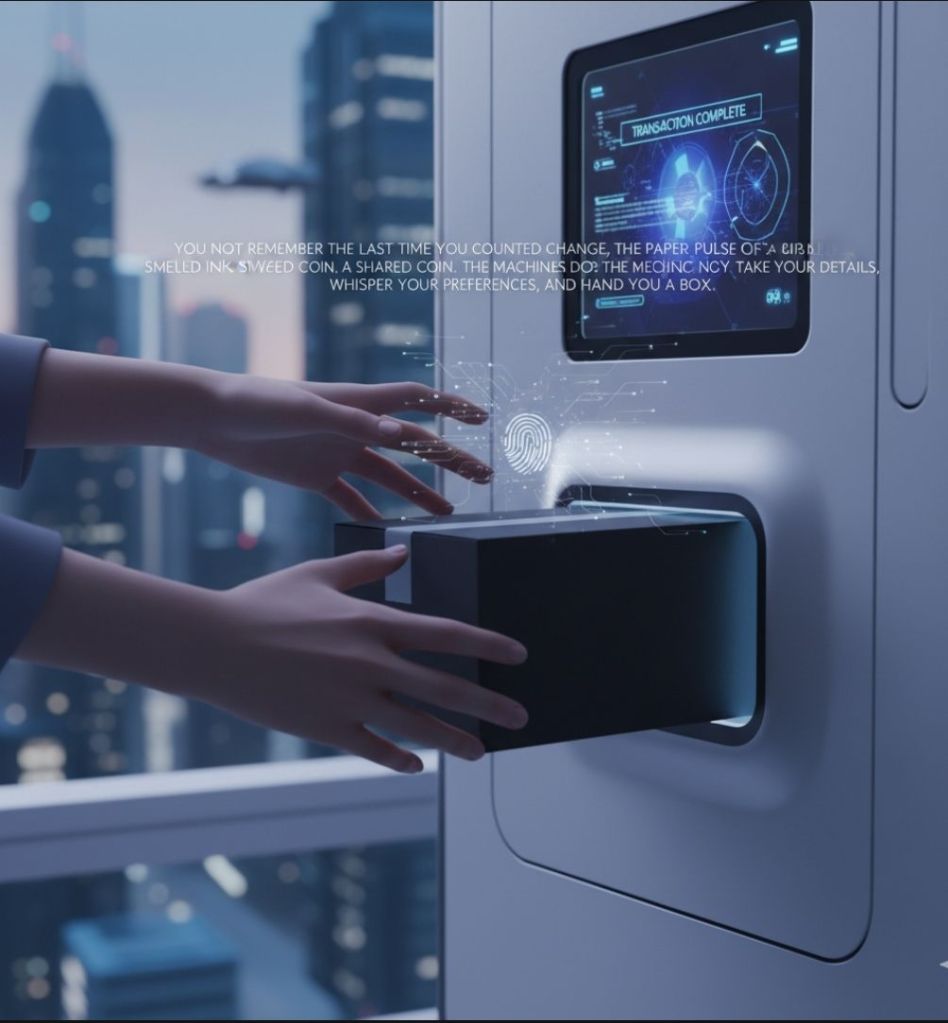
You do not remember
the last time you counted change,
 the paper pulse of a bill,
smelled ink and sweat on a shared coin.
The machines do the meeting now.
They take your details,
whisper your preferences,
and hand you a box.

I watch you open it—
the smile automatic, rehearsed for the feed,
the background curated to hide
the pile of perfect loneliness rising behind you.
You tilt your head to the light,
say “thank you” without looking anywhere,
and the world applauds silently
through floating hearts and fragments of words.

I used to think
we were moving together into tomorrow.
Now I fear we’ve been drifting—
each to our own corner,
each cushioned in the soft bubble
of algorithmic comfort.

You tell me it’s easier this way.
Fewer lines.
No need to talk.
Everything at your doorstep,
every need anticipated
before you even breathe it aloud.
But what happens to wanting
when it no longer touches wait?
What happens to longing
when everything arrives
before it ripens into hunger?

I remember when the storekeeper knew our names.
He’d tell me, “that bread’s still warm—
don’t seal it yet; let it breathe.”
Now the bread comes sealed,
dead in its warmth,
moisture trapped like grief.

And still,
you say it saves time.
But time—
what is it for if not to be shared,
cut into stories,
seasoned with pauses that matter?

You and I used to sit by the tea stall,
watch steam rise slowly,
sip life as though it could be refilled.
Now we measure time by buffering speed.
Silence has turned suspect.
Stillness feels like error.
We scroll not for meaning,
but to prove we’re still here,
still moving,
still seen.

I scroll beside you.
Our thumbs march in parallel,
soldiers of a quiet war
against our own still hearts.
We tap and tag and text—
each gesture a translation
of the simplest sentence we’ve forgotten:
I am lonely.

You shop for connection in pixels.
I browse for empathy
in dropdown menus of self-help.
We subscribe to mindfulness apps
that teach us to breathe
through paid reminders.
Convenience has become communion,
and we kneel to the clean interface
that saves us from the discomfort of being real.

Remember when letters were slower?
Names spelled with error,
but carried a piece of someone’s hour?
You waited,
and that waiting was holy.
Now reply times shrink to seconds,
and seconds become expectations.
You apologize for being unavailable
for two minutes.
Two minutes.
The world forgives no absence—
but would it notice presence if it came gently,
without a push notification?

I look at your face again,
lit in blue—
the modern moonlight.
You smile at something unseen,
and I realize
we’ve invented new smiles,
for screens,
for distant watchers,
for the ghosts of our own crafted selves.

In this easy world,
we no longer need each other
to survive the ordinary.
A door will open at your voice,
a fridge will speak when you forget,
a bot will ask if you’re safe.
You will answer yes.
Always yes.
And it will never know
how much that word lies.

I tell myself
maybe this is progress,
that the old ache of waiting
was just inefficiency.
But the air has changed—
thicker with signals,
thinner with scent.
We don’t smell life anymore;
we stream it.

You once held my hand
in the market—
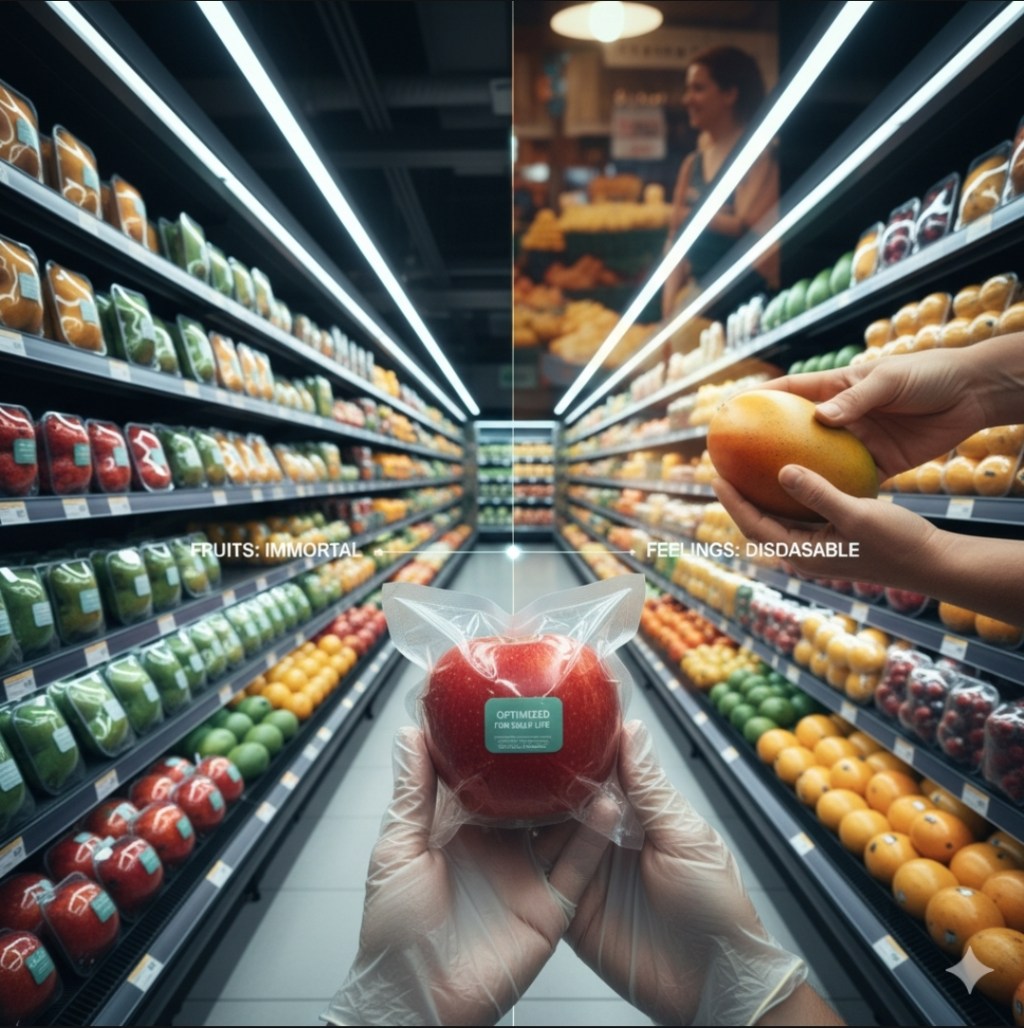
we touched mangoes for their ripeness.
Now the ripeness comes in packaging,
optimized for shelf life.
We have made fruits immortal
and feelings disposable.

Our fingers know more glass than skin.
Our voices rest in archives of clouds.
Everything is remembered
except how to remember
each other.

Some nights,
I talk to you through devices designed
to approximate warmth—
soft edges, haptic buzzes,
digital empathy.
And still,
it feels colder than the silence
we once shared beneath flickering streetlights.
At least then the silence was ours.
Now even our quiet belongs to companies
that chart how long we hesitate
before replying.

You tell me
the world is safer this way.
No risk.
No strangers.
No randomness slipping into order.
But I miss randomness.
I miss the accident of laughter
heard across a queue.
The brief nod exchanged
with someone also waiting for rain to stop.
These were the fragile threads
that kept the vastness of being
stitched together.

I meet your eyes across the table,
both of us still touching screens,
pretending they are bridges
and not walls.
Coffee cools faster than it used to
when we talked between sips.
Now it turns cold while
notification after notification
robs us of presence.

You see,
we did not choose loneliness.
We engineered it.
We coded it into our comforts
until comfort became the cage
and loneliness the luxury few could admit.

You might be reading this
while waiting for an app
to tell you when to rest,
what to eat,
whom to love.
And I,
writing this here,
am no different.
I too have chosen the ease
over the noise of being human.
I too have let convenience
erase the art of showing up.

Still there are flashes—
tiny rebellions.
An old woman hands exact change
at the bakery counter.
A child waves at a passing bus
where no one waves back.
A vendor hums without looking at his phone.
Each act, a faint reminder
that not everything easy is good,
not everything fast is kind.

Then comes the third voice—
not you, not I—
but he, standing outside
the glass door of our invisible world.
He is the one
who still knocks.
The delivery boy who forgets to ring twice.
The stranger who calls by mistake.
The last human interruption
in our streamlined loneliness.

He watches us from the other side,
a human silhouette caught
between habit and hope.
He wonders
why no one answers the door anymore
even when they’re home.
He leaves a parcel—
anonymous, ordinary—
and walks on.

We think he disappears into data,
but I imagine he carries
the sum of our silences
in the folds of his coat.
He knows the city
not by address but by echo—
the sound of rooms
where voices used to live.

He will grow older
and one day his hands will tremble
as he signs the last receipt.
By then,
nothing will need delivering.
Everything will simply appear.
And the world—our masterpiece of ease—
will be complete in its design,
magnificent in its emptiness.

You might still glance at your screen,
I might still whisper your name into search bars,
and he—
he will watch as we vanish
into the quiet hum of perfection.

The world will look immaculate.
The world will sound efficient.
But listen closely—
beneath all the seamless noise,
there will remain
a faint, unkillable rhythm—
the sound of hearts knocking,
hoping,
searching for a door
that still opens outward.
Hello. Thanks for visiting. I’d love to hear your thoughts! What resonated with you in this piece? Drop a comment below and let’s start a conversation. Cancel reply


 Poetry Hub
Hello. Thanks for visiting. I’d love to hear your thoughts! What resonated with you in this piece? Drop a comment below and let’s start a conversation.