
It begins in the smallest movement:
a palm turning toward another,
a slight hesitation between warmth and air,
the skin humming with invisible language.
We never speak it aloud—
this quiet physics of need and nearness—
yet it carries the weight of centuries.

I have held hands in silence,
in laughter, in fear.
Once beneath a storm,
once in the back of a dimly lit theater,
once beside a hospital bed,
where every pulse felt like prayer.

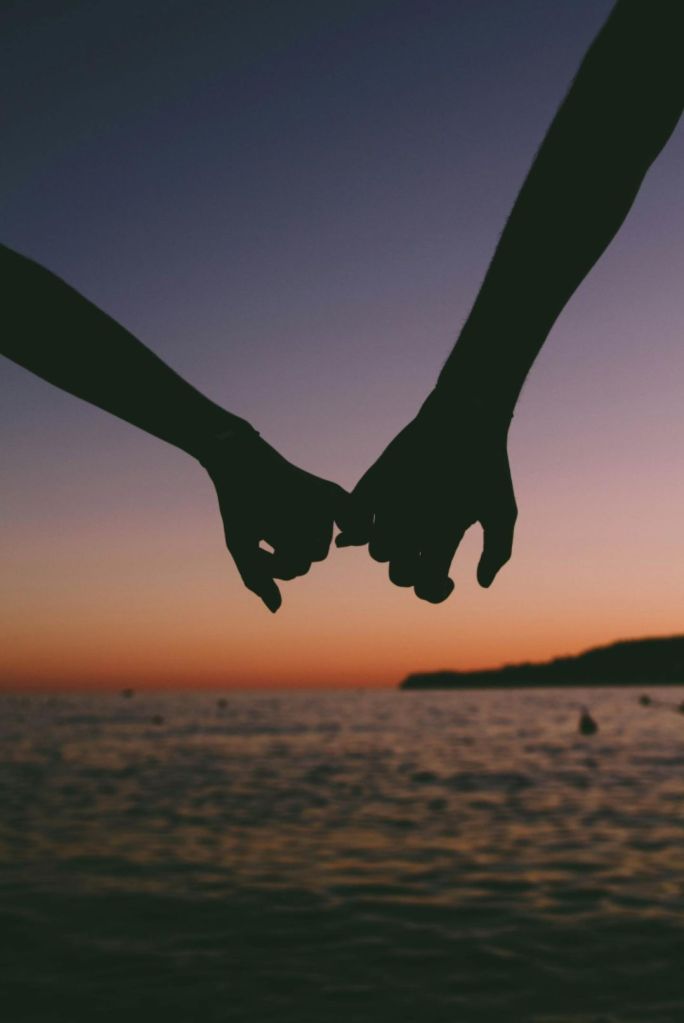
Holding hands isn’t possession.
It’s not a cage,
not an enclosing wall of flesh declaring
“mine.”
It’s a bridge.
A breathing tether between two worlds
that remain, always, a little apart.

It’s saying:
stay with me, just for this moment,
before the tide changes,
before the next train departs,
before we forget that we are not alone.

Some people think love is clutching.
They call it attachment,
but what they often mean is ownership—
to label, to anchor, to claim.
I learned, painfully,
that every fist wrapped around another heart
leaves bruises that never fade.

But holding hands—open palms, interlaced fingers—
is the opposite of taking.
It is sharing.
It says, “Walk with me, not behind me.
Don’t vanish yet.”
It says, “Your warmth is a language I understand.”

I remember the first hand I ever held.
It was my mother’s:
rough from work,
the creases smelling faintly of turmeric and soap.
I didn’t know then why children reach back
even when they can already walk alone.
Maybe it’s instinct,
the body’s way of saying,
“This world is loud,
but here—this touch—
is home.”

Years later,
I held the hand of someone who said
he couldn’t stay.
We didn’t speak,
but our fingertips trembled
like ghost wings brushing truth.
Every squeeze was a plea:
stay, a little longer,
until the goodbye stops aching.

In that soft war between holding on and letting go,
I learned that hands can both anchor and release.
I learned that love often means
not pressing harder,
but knowing when to slowly unwind the grip
and leave the space open for return.

Still,
I keep remembering how your thumb traced circles
over the back of my palm
as if rewriting some memory
I didn’t yet know I needed.
The gesture said more than words ever could:
stay, just here, just now.

People pass by us daily—
parents with children,
lovers, old friends,
strangers guiding strangers across busy streets.
And if you watch closely,
you can read their stories in those joined hands.
A father’s trembling grasp around a daughter’s curiosity.
An old woman’s fingers folded around time itself.
A lover’s quick squeeze saying “I see you”
in a crowd that doesn’t.

Holding hands isn’t about power.
It’s about proximity.
It’s a vow without ceremony.
It whispers,
I will walk beside you,
through the parking lots and poems,
through night markets and lonely airports.

In winter cafes,
I’ve seen people warm their hands
on each other instead of cups.
And somehow, the world outside—
cold, mechanical, unfeeling—
feels softer then.

Somewhere between the spaces between fingers
is the hidden architecture of comfort.
That space isn’t emptiness—
it’s breath.
It’s the quiet agreement
that what exists between us
is not a border but a current.

I once loved someone who feared touch.
Not because they didn’t care,
but because their past had turned every grasp
into a question of control.
With them, I learned patience.
We built trust fingertip by fingertip,
until one day they reached for my hand first.
No words—just a trembling hello
from skin that remembered its right to belong.

So when I say holding hands isn’t possession,
I mean this:
It’s choosing closeness
without consuming.
It’s the art of being near
without devouring what makes another person free.

Often love is confused for merger,
as if two people must dissolve to prove devotion.
But I have learned that we are oceans—
meeting only at the surface,
trading salt and shimmer,
keeping our depths intact.

Holding hands,
we become tide and moonlight,
two orbits briefly syncing.
We know the pull,
we sense the letting go.

Walking through city streets,
your hand in mine,
we created small silence amid the noise.
Buses sighed, vendors called out,
headlights broke on puddles—
yet none of it mattered.
The world became a pulse
that matched our joined rhythm.

I think of the tenderness of strangers—
how a nurse steadies a patient,
how a rescuer pulls a survivor from wreckage,
how two protestors link arms
against fear itself.
There, too,
the hand says stay,
even when the voices tremble.

Sometimes,
I walk without anyone beside me.
My fingers still curve,
half-expecting connection.
The memory of holding remains
long after the warmth fades.
It’s muscle memory,
this habit of hope.

And in that hope lives something sacred:
not the demand for return,
but gratitude for having once touched life
with life.

There were nights when
loneliness felt like a locked door.
I sat watching the streetlamps bend through rain,
thinking how even shadows reach.
And I recalled, quietly,
how your hand once found mine
without words,
as if the universe had bent a rule temporarily
to let us exist in stillness.

That stillness is the truest connection—
no fireworks, no possession, no promises,
only breathing together in the same rhythm,
acknowledging:
you are here, so am I.

Even now,
when I write,
I feel the ghost of those gestures—
hands entwined across days,
across lifetimes maybe.
They remind me:
every story weeped or whispered
began with someone reaching out.

In childhood,
teachers taught us to join hands during prayer,
as though faith needed community to complete the circuit.
Later in life,
I realized humanity itself is an unfinished prayer,
searching for touch between syllables of chaos.

When we hold hands,
we tell the universe quietly:
we may be fragile,
but we are not isolated.
Every palm is a map of connection.
Every line a road toward empathy.

I think of lovers separated by trains.
They hold hands until the last second,
their fingers sliding into absence like melting wax.
Even then,
their parting is not ownership lost—
it’s love transforming into memory.

When time takes away hands,
what remains is the ache shaped like a gesture—
the echo of skin remembering skin.
We keep holding on
through recollection,
through letters,
through the muscle of longing.

There’s a phrase I once read:
“The body keeps the score.”
Maybe it keeps the story too.
In every fold of palm lies past warmth,
past courage, past comfort.
When I clench my fist now,
I feel faint traces
of every “stay” I ever whispered without sound.

This poem is not only for lovers.
It’s for every fleeting touch that steadied a soul.
The friend who reached across a table mid-tears,
the sibling dragging your trembling hand
away from the dark,
the stranger who offered support
in the rush of disaster.

Holding hands—
that simple, ancient gesture—
is civilization’s softest rebellion
against loneliness.
Against indifference.
Against decay.

And yet,
it remains gentle,
humble,
wordless.

When I take your hand now,
I do not own you.
I only align the heartbeat’s tempo,
so we remember how to be human together.

Stay with me, this breath,
this step,
this ordinary day
that becomes extraordinary through the act of closeness.

But go if you must.
Because holding hands also means
honoring freedom.
It says: I would walk with you forever,
but even if you leave,
the touch remains faithful
in memory’s garden.

Maybe that’s what love truly is—
a quiet plea that needs no obedience,
a prayer that asks
not for chains but for presence.

So each time our fingers meet,
there’s no contract,
just understanding:
Don’t go yet.
Not because I command it,
but because, in this instant,
you and I
are the same pulse in two bodies—
whole, fleeting, alive.

And when I release your hand,
I hope it carries warmth into your next moment—
so when you reach for another,
they feel the inheritance of kindness
passed palm to palm
like fire in the dark.

Because this is what it’s always meant:
Holding hands is not possession.
It is connection.
It is breath made visible.
It is a whispered stay—
spoken not for control,
but for love’s simplest truth:
I see you.
I am here.
Don’t go,
not yet.

Stay.

 Poetry Hub
Hello. Thanks for visiting. I’d love to hear your thoughts! What resonated with you in this piece? Drop a comment below and let’s start a conversation.