
Describe a man who has positively impacted your life.
He did not come wrapped in thunder,
no burning bush marked his arrival,
only the soft gravity of calmness—
that quiet way some stars
teach the night how to glow
without noise, without demand.
You could mistake him for ordinary.
He wore his humanness like old corduroy,
faded at the elbows, honest in its threads,
carrying small stains from afternoons
of work that never made headlines.
But his eyes—
they had learned the art of seeing
without judgment.
And his voice,
a low river that never rushed,
taught patience to every listener.
I met him at a time when silence
was loud enough to unspool my insides.
I was all unsteady edges and brittle hope.
He noticed without asking questions,
as though he’d seen this kind of storm before—
someone drowning in their own thinking.
He did not rescue me.
He never believed in grand gestures.
Instead, he became a mirror
that showed me I still had shape,
that my story wasn’t made of
broken glass, only fractures
catching light in new ways.
He believed before I learned how.
And belief, when spoken gently,
has the weight of mountains.
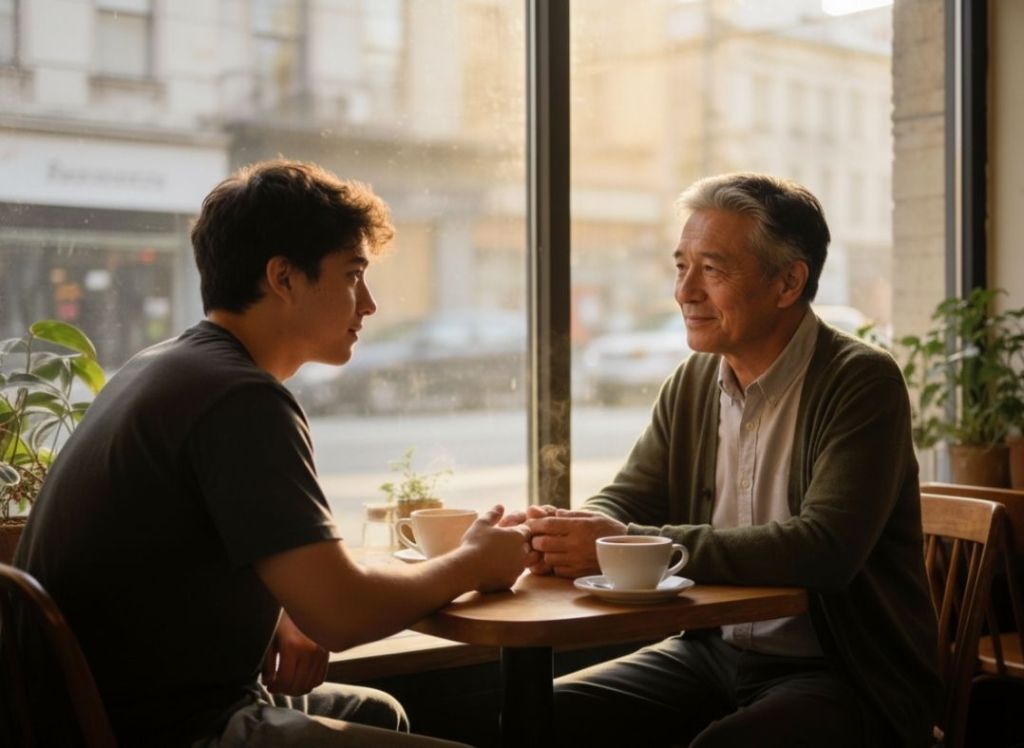
There was a morning at the old café,
before the city woke properly—
sunlight sketching thin gold lines
over empty tabletops.
We sat across from each other,
and he asked nothing
except how I took my coffee.
I told him “Black, no sugar.”
He smiled—
“Then you will one day like your own soul too.”
I laughed it off,
not knowing wisdom often wears humor
like a loose shirt, easy and unannounced.
It was that day I saw
how conversation, when sincere,
can open rooms inside the heart
you didn’t know you’d locked.
He never rushed to fill silences.
He let breath do its work.
Every word he spoke
was an anchor set calmly in water.
He worked deliberately,
his hands roughened by decades of making—
not art, not machines,
but possibilities.
Whatever he touched
learned to function with quiet grace.
He fixed clocks, instruments,
the hinges of people’s doubts.
Sometimes I think he repaired time itself
just by refusing to waste it.
There was poetry in the way
he folded his day—
like origami shaped from light routines.
He would rise before dawn,
brew tea, and watch the horizon
crack open.
He said if you look long enough,
you can see the Earth wake
like a slow memory returning.
And somehow, that taught me gratitude—
that mornings are never owed,
they are gifted.
He was never rich—
at least not in coins or signatures.
But he held a wealth of stillness,
a currency that bought peace
for everyone who shared his presence.
His laughter was never loud
but always complete—
a sound that disarmed even cynicism.
I saw him listen to children
like they were philosophers
in smaller bodies.
He once told one,
“You remind me the world is repairable.”
The child beamed,
and perhaps that was the repair in motion.
With him, faith wasn’t a sermon.
It was the way he looked at rain
as if heaven were simply cleansing itself
for another attempt at kindness.
Years later, I realized:
He carried an old grief
like a secret folded into his smile.
Sometimes his eyes
would travel distances mid-conversation,
toward faces unseen—
those who no longer waited at windows.
He spoke of loss not as a wound,
but as a collaborator in his becoming.
“Pain,” he once said,
“is the universe’s inconvenient way
of re-teaching tenderness.”
And I think about that during my own storms—
how easily I reach for anger,
how rarely I remember to reach for grace.
But his lesson lingers,
a quiet nudge beneath rage:
Let go and see what remains.
When I failed—spectacularly,
publicly,
in ways that left me brittle—
he arrived not with platitudes,
but perspective.
He said,
“You mistake falling for finishing. But look closer—
the wind is teaching you angles.”
I didn’t understand then.
Now, I do.
Failure is practice in humility’s script.
Humility is the doorway to wonder.
He was not my father, nor a prophet,
just a man who’d learned to live
as though the soul had infinite drafts.
Always rewriting.
Seeking better words for being human.
There are countless small things
I learned by observing him:
- The way he always paused before answering,
as if giving truth time to breathe. - The soft ritual of tea shared without agenda.
- The understanding that courage
isn’t shouting your convictions—
it’s living them quietly when no one watches. - The practice of walking slowly,
not from fatigue,
but in respect for the journey itself.
Every habit of his
became a meditation in disguise.
Every silence held more teaching
than entire libraries.
He was a scripture written
not in verse but in example.
Once, after my mother passed,
I closed myself into the ache of sleeplessness.
He visited with no condolences, no flowers.
He only placed his hand on my shoulder
and said,
“When love changes form,
your duty is not to chase it,
but to keep the space it leaves clean.”
I cried harder—
because truth often sounds cruel
until you grow into it.
Later, I understood—
grief is sacred maintenance.
He kept teaching me
not to run from discomfort,
but to listen to what it asks of you.
Some nights,
I still hear his voice echo—
not words, just presence,
and I settle.
He aged like certain kinds of oak—
each wrinkle a testament to purpose.
Not erosion, but engraving.
When illness found him,
he greeted it with curiosity.
“Ah,” he said,
“So this is how the body teaches impermanence.”
Even pain did not make him bitter.
It made him precise—
aware of the privilege in breath,
the miracle of an unbroken morning.
He spent his last years tending a small garden.
He said flowers speak the most honest theology.
They bloom, they wilt, and yet they trust spring.
When he passed,
there was no great spectacle—
only light moving across empty walls,
the faint sound of a kettle cooling.
At the funeral,
I read one of his old notes:
“Do not memorialize me.
Live what I tried to mean.”
And that line became my north star.
Now, when people ask
who most changed my life,
I resist naming him in full.
He would dislike the attention.
But I describe him like this:
A man who believed goodness
was a verb, not a virtue.
A man who showed that power
is the ability to remain kind.
A man who left no empire
except the quiet revolution
of everyone he met becoming
slightly more human.
He taught me
that legacy is not marble or memory,
but how many souls feel safer
because yours once existed.
And in the whisper of every dawn,
in the stillness that follows loss,
in the laughter that rebuilds despair
into a kind of music—
I feel his light stretch beneath my skin.
No monument.
Just continuity.
No halo.
Just honesty.
And I,
forever student of that man,
keep trying
to live like love
had hands.


 Poetry Hub
Hello. Thanks for visiting. I’d love to hear your thoughts! What resonated with you in this piece? Drop a comment below and let’s start a conversation.