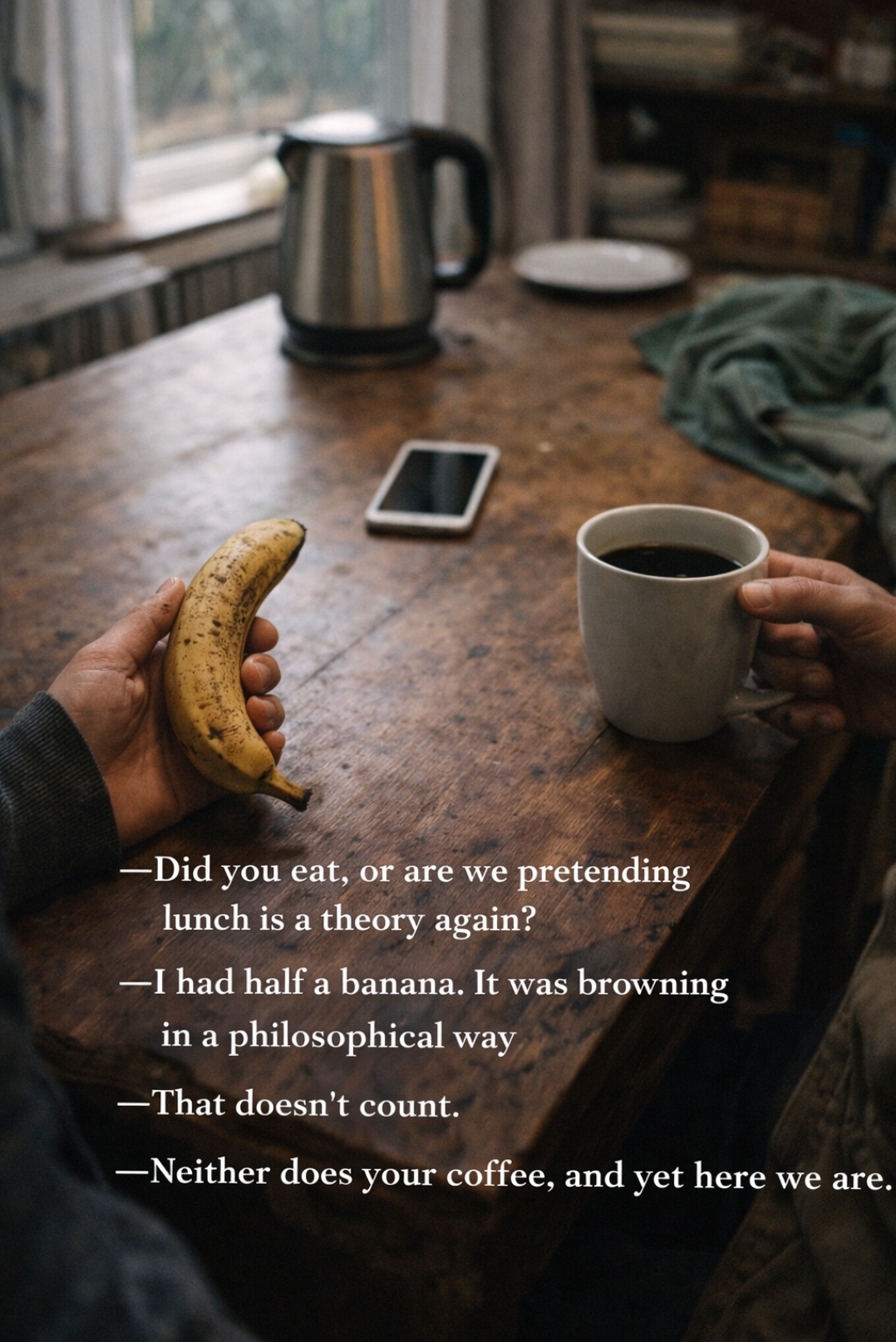
This poem begins before it begins—inside the soft static of an ordinary moment where nothing urgent happens, yet everything feels slightly weighted. It lives in the space of almost-decisions: a room where the kettle has already boiled, a phone screen glowing without resolve, a day hovering between movement and staying put. Inspired by Frank O’Hara’s looseness—not his bravado but his permission—the poem lets conversation be the action. No plot advances. No conclusion is demanded.
Here, talk replaces certainty. Language circles itself, doubles back, stalls. The voices do not argue so much as feel their way around one another, using small, domestic details as handholds: a banana going brown, a jacket on a chair, a bus that may or may not arrive. These details are not symbols in the grand sense; they are proof of life happening quietly while no one decides what comes next.
This is a poem about delay—not laziness, but the intimate pause where relationships often live. The place where care is evident precisely because nothing is resolved. Where hesitation becomes a kind of shared weather.
Typing…
—Did you eat, or are we pretending lunch is a theory again?
—I had half a banana. It was browning in a philosophical way.
—That doesn’t count.
—Neither does your coffee, and yet here we are.
—I’m just saying, if we leave now we might still catch the light.
—You always say that when you don’t want to decide.
—Look, the bus app says “arriving,” which could mean anything.
—Like us. Or like last winter when it never came.
—I can hear a siren. Or maybe it’s the kettle.
—The kettle’s been quiet for ten minutes.
—So have you.
—I was thinking about your jacket on the chair.
—I wasn’t done with it.
—I know. I didn’t move it.
—We could stay in.
—We could step out for one minute.
—One minute turns into explanations.
—Explanations turn into weather.
—It’s starting to rain, I think.
—Or maybe that’s just the neighbor watering plants.

The poem ends where it must: not with a choice, but with uncertainty misidentified as something else. Rain or sprinklers—both are plausible, both acceptable. The voices never step outside the room, yet the room subtly changes because of them. Silence stretches. Attention sharpens. What matters is not whether they leave or stay, but that they are still speaking, still listening, still careful with each other’s unfinished thoughts.
In refusing resolution, the poem honors a quieter truth: that much of human connection exists in the unresolved. We live more often in parentheses than in periods. Plans dissolve into observations; observations turn into shared pauses. The drama is not what happens next, but how long two people are willing to remain inside the not-yet.
Nothing is decided here. But something has been held—gently, briefly, and without explanation.


Leave a Reply