
There are days
when the weight of living
leans its full body against your chest,
as if gravity has forgotten restraint,
as if the world has decided
to test how much silence
a heart can hold
without cracking.
On such days,
even light feels conditional.
Morning arrives late,
hesitant,
filtering through curtains
like an apology that doesn’t know
what it’s sorry for.
You sit with your breath,
counting it not as meditation
but as proof—
one more inhale,
one more exhale,
one more small contract
with staying.
The mind, faithful archivist of pain,
opens its drawers without permission.
It pulls out unfinished conversations,
doors that slammed too hard,
names that now live only
in the echo chamber of memory.
It asks its favorite question:
What if this is all there is?
A bad day stretching into a bad month,
a bad month masquerading as a bad year,
until even the word life
starts to taste like something spoiled.
But pause—
just for the length of a heartbeat.
Notice how the body,
even when exhausted,
refuses to quit quietly.
Your blood keeps its ancient rhythm.
Your cells perform their small miracles
without applause.
Somewhere inside you,
a stubborn animal instinct
still believes in dawn,
even when the night argues otherwise.
Hard moments are loud.
They dominate the room
like thunderstorms that demand attention,
shaking windows,
knocking pictures off walls.
But storms, for all their drama,
are visitors.
They do not own the sky.
They arrive, unload their grief,
and eventually—
inevitably—
move on.
What they leave behind
is often overlooked:
the washed air,
the soil softened enough
for roots to breathe again,
the quiet resilience of trees
that bent but did not break.
You are more like those trees
than you give yourself credit for.
Think of the ocean—
how it holds both wreckage and wonder
in the same vast body.
Ships sink, yes,
but tides still rise with devotion,
moon-pulled, faithful,
never once asking
whether yesterday’s waves failed.
The ocean does not define itself
by the storms it survives.
It defines itself by its staying.
So why do you?
Why do you look at one difficult season
and decide it speaks
for the whole climate of your life?
Why does pain get the final word,
when joy has whispered to you before—
in the warmth of a shared laugh,
in the comfort of a familiar song,
in the way sunlight once touched your face
and you, for a brief moment,
forgot to be afraid?
Even now,
beneath the ache,
there are quiet reasons to remain.
They may not shine;
they may flicker,
like stars struggling through city haze.
But remember—
stars do not stop burning
just because clouds pass in front of them.
Their work is patient,
measured in centuries,
not in sleepless nights
or spiraling thoughts.
You are allowed
to be tired.
You are allowed
to name the hurt
without romanticizing it,
without pretending strength means
never feeling broken.
Strength, more often than not,
is simply the decision
to rise again
without knowing
if today will be gentler.
Some mornings,
getting out of bed
is an act of quiet rebellion.
Some days,
moving forward looks like inching,
like dragging hope behind you
with scraped knees
and trembling hands.
But movement, however small,
still alters the map.
The universe understands this.
It has been expanding
since the beginning—
not in leaps,
but in relentless persistence.
Galaxies drift apart,
stars collapse and are reborn,
black holes tear and teach at once.
Nothing stays pristine,
yet nothing is wasted.
Your pain, too,
is not the end of the story.
It is material—
dense, heavy,
capable of shaping you
into someone
who recognizes light
when it finally arrives.
And it will arrive.
Not as fireworks,
not as sudden salvation,
but as something subtler:
a moment when breathing feels easier,
when laughter doesn’t surprise you,
when the future stops feeling
like a locked door
and starts feeling
like a window cracked open.
Maybe not today.
Maybe not tomorrow.
But soon—
in the way seasons turn
without consulting our impatience.
Spring never rushes,
yet it always comes,
threading green through soil
that once looked lifeless.
One day,
you will look back
at this version of yourself—
the one surviving on fragments,
the one doubting their worth—
and you will see
what you couldn’t then:
how much courage it took
just to continue.
How many times
you chose to stay
when leaving would have been easier.
How your strength,
quiet and uncelebrated,
carried you across terrain
you never thought you’d cross.
That realization will not erase the pain,
but it will place it
in proper scale—
as one chapter,
not the whole book;
as weather,
not the sky.
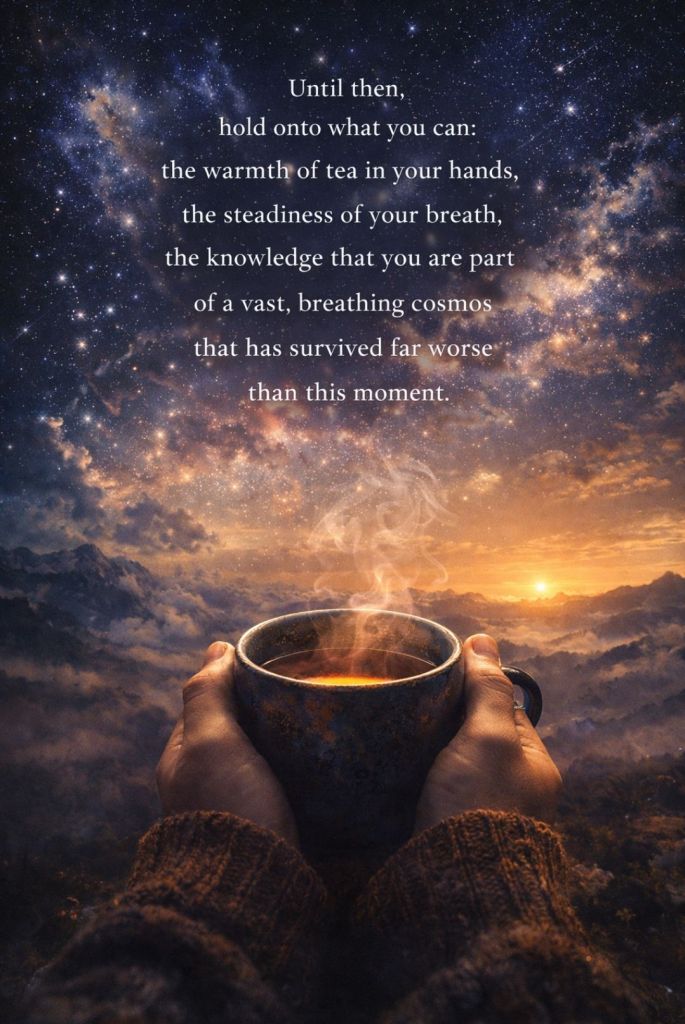
Until then,
hold onto what you can:
the warmth of tea in your hands,
the steadiness of your breath,
the knowledge that you are part
of a vast, breathing cosmos
that has survived far worse
than this moment.
Keep getting back up.
Keep moving forward,
even when forward feels imaginary.
The universe is patient,
and so are you—
even when you forget.
This pain is not the end.
It is a crossing.
And beyond it,
light is already practicing your name.

 Poetry Hub
Hello. Thanks for visiting. I’d love to hear your thoughts! What resonated with you in this piece? Drop a comment below and let’s start a conversation.