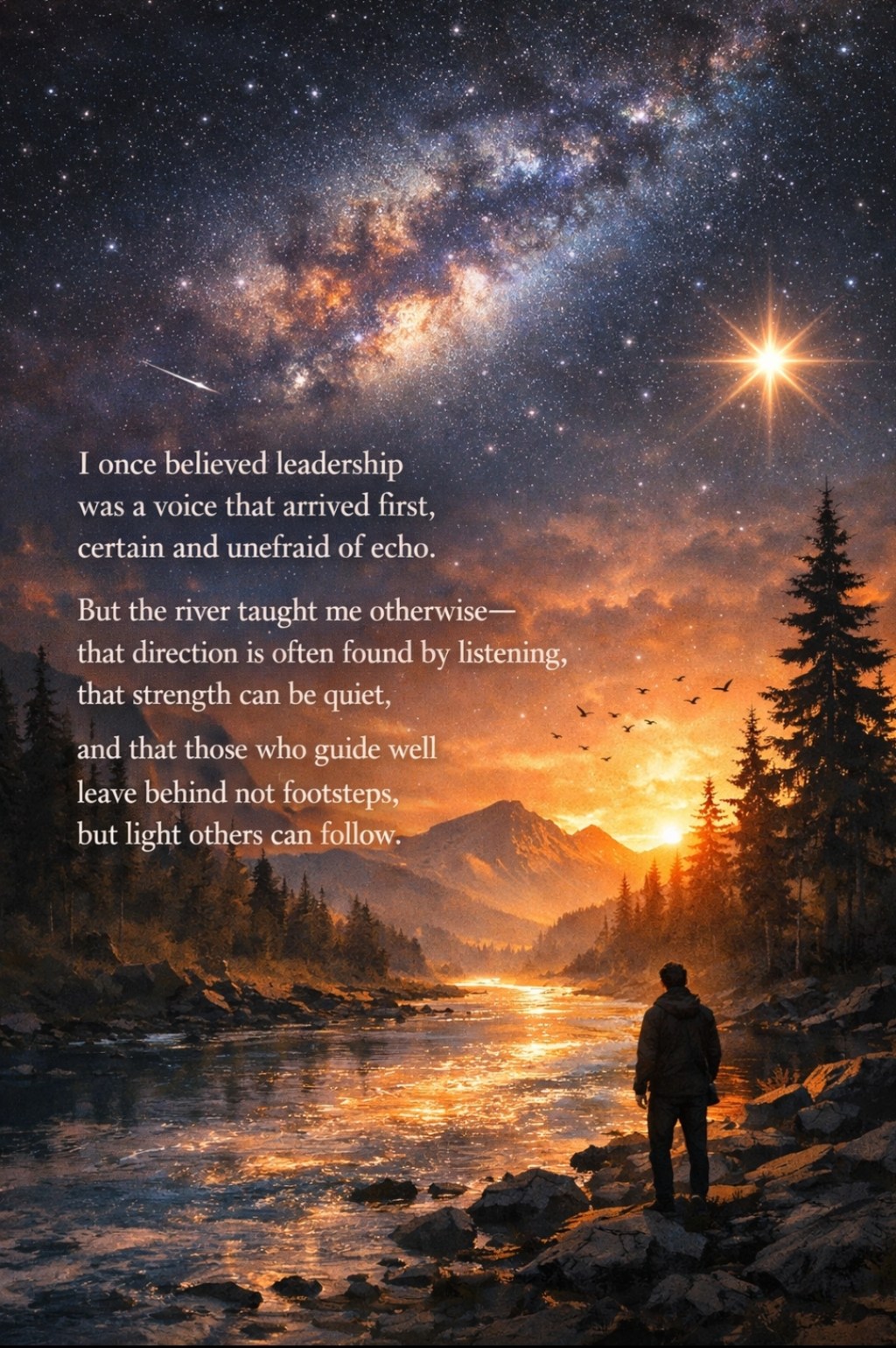
What makes a good leader?
I used to think leadership
was a voice that arrived before others,
a hand raised higher,
a certainty sharpened like a flag
against the wind.
I imagined it standing on ridgelines,
outlined by sun,
issuing directions to valleys below—
left, right, forward—
as if the world were a map
that only needed confident fingers.
But the first lesson
did not come from a crowd.
It came quietly,
like moss learning stone.
It came when I noticed
how the river does not argue with its banks.
It listens.
It curves.
It remembers the mountain
without announcing it.
A good leader, I am learning,
begins here—
in the uncelebrated act of listening,
in the patience of water
finding its way through darkness.
Before the title,
before the applause,
before the weight of being watched,
there is a private reckoning.
A room inside the self
where excuses are not allowed,
where fear is named without decoration,
where ambition sits
and is asked
why it wants to run so fast.
Leadership starts
when one can sit alone
without needing to win the silence.
I think of trees
that grow for decades
before they dare to fruit.
Their roots practice humility underground,
learning the language of stone and worm,
learning how to hold
before learning how to rise.
A good leader grows roots
where no one is clapping.
They learn the terrain of their own shadows.
They study impatience,
ego,
the quick hunger to be right.
Not to erase these things,
but to know their names
so they do not secretly rule.
Because unexamined power
always leaks.
It seeps into decisions,
into tone,
into the careless use of authority
that bruises without noticing.
I have seen leaders
who mistake speed for clarity,
volume for truth,
certainty for wisdom.
They burn bright and brief,
like meteors—
spectacular,
but leaving little behind
except a scar in the sky.
Good leadership, I am learning,
moves more like the moon.
It does not shout to the ocean.
It pulls.
It understands rhythm.
That people, like tides,
advance and retreat.
That rest is not failure,
that cycles matter,
that forcing a tide
only breaks boats.
A leader knows when to wait.
This is not indecision.
This is respect
for timing larger than the self.
There is courage in restraint.
There is strength
in not speaking immediately,
in letting the room breathe,
in allowing others
to hear themselves think.
I once believed leaders
must always know the way.
Now I believe
a good leader knows
how to say
“I don’t know”
without collapsing.
They understand that clarity
often arrives
after humility.
Look at the night sky.
Most of what matters
is invisible.
Dark matter holds galaxies together
without ever announcing its presence.
Gravity does not ask for credit.
It simply keeps things from flying apart.
A good leader
is often felt more than seen.
You notice their absence
before you notice their presence.
Things fall apart less.
Conversations deepen.
People grow taller inside themselves
without knowing why.
This is not magic.
It is attention.
Attention to the quiet voice
at the edge of the table.
Attention to the unasked question.
Attention to the fatigue
hidden behind competence.
A leader does not harvest
without first watering.
They understand
that people are not resources.
They are weather systems—
complex, changing,
capable of storms and miracles.
To lead well
is to read the sky
without pretending to control it.
There is also grief in leadership.
This is rarely spoken of.
The grief of choosing
one path and closing another.
The grief of being misunderstood.
The grief of carrying consequences
that cannot be shared.
A good leader does not outsource this grief.
They hold it carefully,
like a bowl of water
that must not spill
onto those already carrying enough.
They develop a spine
without growing armor.
Because armor dulls touch.
And leadership, at its best,
is tactile—
felt in the way trust is handled,
in how mistakes are met,
in whether failure becomes
a funeral or a classroom.
I have learned to watch
how a leader treats error.
Do they look for a scapegoat
or a pattern?
Do they shrink the room
with blame
or expand it with curiosity?
The answer tells you
everything.
In forests,
when one tree falls,
it does not end the ecosystem.
It feeds it.
Decay becomes nourishment.
Loss becomes soil.
Nothing is wasted.
A good leader understands this ecology.
They compost failure
into learning.
They do not shame the fallen tree.
They ask what light
is now available.
And then there is service—
the most misunderstood word
in leadership.
Service is not self-erasure.
It is alignment.
Like planets agreeing
to orbit a shared center
instead of colliding.
A leader serves the purpose,
not their reflection in glass buildings,
not the echo of their own name.
They know the work
is larger than the worker.
This is why they plan
for succession.
Why they build systems
that can survive their departure.
A good leader
is preparing to be unnecessary.
This, too, is love.
Love not as sentiment,
but as stewardship.
The kind of love
that asks:
How do I leave this place
more capable
than I found it?
How do I return power
to where it belongs?
In the end,
leadership becomes less about direction
and more about orientation.
Not where to go,
but how to face the world.
With honesty.
With steadiness.
With a willingness
to be changed by what is encountered.
The journey widens here.
You realize leadership
is not confined to boardrooms,
or titles,
or crowds.
It lives in kitchens,
classrooms,
hospital corridors,
bus stops at dawn.
It lives in how one carries themselves
through uncertainty.
The cosmos offers a final lesson.
Stars burn by giving themselves away.
Their light travels
long after they are gone,
touching eyes
they will never meet.
A good leader understands
this kind of generosity.
They burn,
but not to consume.
They burn
to illuminate.
And when they are gone,
what remains
is not a monument,
but a sky
where others can navigate
by the light
they left behind.

 Poetry Hub
Hello. Thanks for visiting. I’d love to hear your thoughts! What resonated with you in this piece? Drop a comment below and let’s start a conversation.