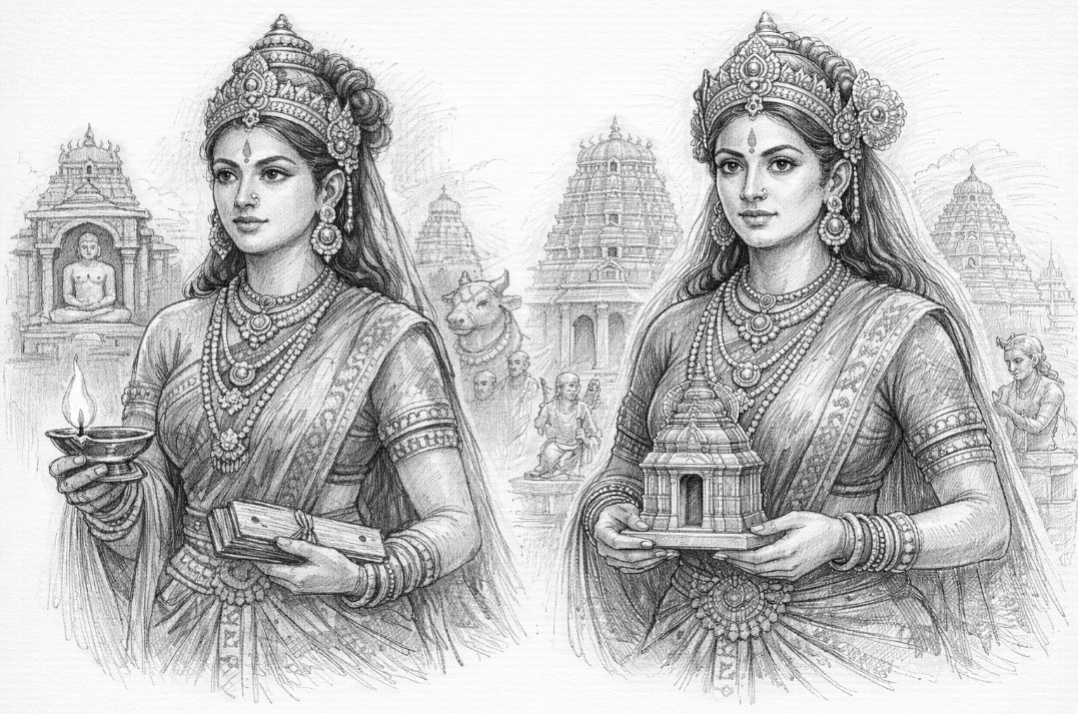
Princess Kundavai and Sembiyan Mahadevi: A Comparative Essay on Faith, Power, and Memory in Chola India
History often compresses women of power into archetypes—the pious queen, the political strategist, the patron of temples. But the Chola period resists such simplification, especially when we place Princess Kundavai Pirattiyar and Queen Sembiyan Mahadevi side by side.
They belonged to different generations.
They inhabited different emotional landscapes.
And yet, together, they shaped the religious grammar of medieval South India.
If Kundavai practiced faith as careful administration, Sembiyan Mahadevi embodied it as architectural remembrance. Their approaches reveal two distinct ways of holding the sacred—both legitimate, both transformative.
Temporal Distance, Spiritual Context
Sembiyan Mahadevi lived earlier—active mainly between the late 9th and early 10th centuries. She was the widow of Gandaraditya Chola and mother of Uttama Chola. Her religious life unfolded in a period of Shaiva consolidation, when the Chola state was still regional, not imperial.
Kundavai, by contrast, belonged to the age of imperial confidence. Born into a dynasty already expanding through war and administration, she inherited a religious world that was plural but fragile.
This difference in historical moment shaped everything.
- Sembiyan Mahadevi worked to restore and monumentalize
- Kundavai worked to sustain and stabilize
Architecture vs. Infrastructure
Sembiyan Mahadevi is remembered above all as a builder.
She commissioned or renovated more than fifty stone temples across the Kaveri delta. Her patronage marked a decisive shift from brick and timber to granite—a technological and devotional leap. These temples were overtly Shaiva, iconographically dense, and publicly visible.
Her faith left form.
Kundavai’s legacy, by contrast, is often invisible to the casual eye.
She funded lamps, food cycles, ritual calendars, salaries for priests and monks, manuscript copying, and land endowments. Many of her contributions are embedded in inscriptions rather than architecture.
Her faith left function.
One built sacred spaces.
The other ensured they did not fall silent.
Sectarian Focus and Pluralism
Sembiyan Mahadevi’s devotion was almost exclusively Shaiva. This was not narrow-mindedness but context. Her era demanded consolidation—reasserting Shaiva identity after periods of Jain and Buddhist influence.
Her temples are assertive.
Their iconography is didactic.
Their theology is unambiguous.
Kundavai lived in a different world.
By her time, Shaivism had state backing. Her task was not assertion but balance. This is why her patronage extends to:
- Jain institutions
- Vaishnava temples
- Buddhist vihara support
- Advaita and non-sectarian mutts
Kundavai did not dilute Shaivism; she protected plurality within its dominance.
Personal Grief vs. Administrative Devotion
There is a profound emotional difference between the two women.
Sembiyan Mahadevi’s religious life was shaped by widowhood. Her devotion is often read—rightly—as grief transmuted into stone. The repetition of Shiva icons, the emphasis on permanence, the refusal of ephemerality—all speak to loss.
Her temples are acts of mourning.
Kundavai’s devotion carries a different emotional temperature. She did not build from grief but from responsibility. As sister to Rajaraja Chola and aunt to Rajendra, she stood at the intersection of family, empire, and belief.
Her faith is managerial, deliberate, almost restrained.
If Sembiyan Mahadevi’s devotion is vertical (reaching upward),
Kundavai’s is horizontal (spreading outward).
Visibility and Memory
Today, Sembiyan Mahadevi is easier to remember.
Her temples stand.
Her name appears in stone.
Her iconography is unmistakable.
Kundavai is harder to “see.”
Her contributions survive in:
- Inscription lines
- Temple account books
- Ritual continuities
- Sectarian survivals
This difference raises an uncomfortable truth:
History remembers builders more readily than sustainers.
Yet without sustainers, builders are forgotten too.
Two Models of Sacred Power
Together, they offer two enduring models of religious authority:
- Sembiyan Mahadevi teaches us that faith can anchor grief, memory, and identity through creation.
- Princess Kundavai teaches us that faith can be ethical administration—quiet, plural, and deeply political without being coercive.
One shaped how gods were housed.
The other shaped how they were served.
Why This Comparison Matters Now
In an age obsessed with spectacle—grand gestures, loud devotion, monumental claims—both women offer counter-lessons.
Sembiyan Mahadevi reminds us that beauty can be discipline.
Kundavai reminds us that care can be power.
Together, they tell us something radical for any century:
Faith is not only what we build.
It is what we choose to preserve.
Deeper Reflections: Where Their Paths Quietly Diverge
The contrast between Princess Kundavai and Sembiyan Mahadevi becomes even sharper when we step away from monumental outcomes and examine how each woman related to time itself—to continuity, interruption, and legacy.
Sembiyan Mahadevi’s religious world was shaped by rupture. Widowhood, political uncertainty, and a fragile dynastic phase created a spiritual urgency. Her turn toward stone was not only devotional but temporal: granite resists decay. In commissioning temples that would outlive kings and conflicts, she effectively arrested time. Her faith sought permanence in an unstable world.
Kundavai, however, lived in a moment of relative confidence. The Chola state was expanding, administratively mature, and secure. Her concern was not how to endure collapse, but how to manage abundance without erasure. This difference explains why her religious patronage focused less on permanence of form and more on durability of practice.
Stone survives centuries.
Ritual survives only if someone keeps returning.
Ritual Labor and the Question of Care
Another deep divergence lies in how each woman understood ritual labor.
Sembiyan Mahadevi’s patronage elevated the artisan, the sthapati, the sculptor. Her inscriptions speak of stone-cutters, icon-makers, and temple builders. These were highly visible forms of sacred labor, celebrated and named.
Kundavai’s religious economy privileged different workers:
- Lamp-lighters who arrived before dawn
- Temple cooks preparing daily offerings
- Account keepers maintaining donor records
- Monks and priests dependent on regular sustenance
This labor was repetitive, feminized, and largely invisible. It required consistency rather than brilliance. By funding these roles, Kundavai anchored religion in everyday care rather than episodic grandeur.
This distinction matters deeply for how we interpret religious power. One form dazzles. The other endures.
Political Power Without Performative Devotion
Neither woman was naïve about power, yet they expressed it differently.
Sembiyan Mahadevi’s temples made clear statements: Shaivism was ascendant, legitimate, and sanctioned by royalty. Her devotion aligned visibly with state ideology. This alignment strengthened both temple and throne.
Kundavai, in contrast, practiced what might be called non-performative authority. Her name appears in inscriptions not as a queen asserting supremacy, but as an administrator ensuring continuity. She did not use religion to announce dominance; she used it to prevent fragmentation.
This explains why her patronage crossed sectarian lines. In an empire expanding across linguistic and cultural zones, plural religious support was not sentiment—it was strategy tempered by conviction.
Memory, Gender, and the Shape of Historical Narratives
The way these two women are remembered also exposes how history privileges certain kinds of devotion.
Sembiyan Mahadevi fits comfortably into the traditional historical gaze. She builds. She leaves monuments. She occupies space. Her legacy can be photographed, catalogued, and restored.
Kundavai resists this gaze. Her work exists in administrative margins, inscriptional footnotes, and ritual survivals. This makes her easier to romanticize—but also easier to misunderstand.
Gender plays a role here. Monumental building has long been coded as masculine power, even when undertaken by women. Care, maintenance, and negotiation—domains Kundavai mastered—are more easily overlooked.
Yet without these, monuments fall silent.

Sacred Time: Festivals Versus Daily Worship
Sembiyan Mahadevi’s religious imagination emphasized ritual moments—consecrations, icon installations, festival cycles tied to cosmological events. These moments gathered communities and affirmed collective identity.
Kundavai’s patronage, however, gravitated toward ordinary sacred time:
- Daily lamps
- Regular food offerings
- Monthly stipends
- Annual cloth distributions
These acts lack drama, but they shape spiritual habit. They train communities in continuity rather than anticipation. Over decades, such practices form the invisible spine of religious life.
If Sembiyan Mahadevi sanctified the extraordinary,
Kundavai safeguarded the ordinary.
The Ethics of Religious Survival
Perhaps the deepest divergence lies in their ethical orientation.
Sembiyan Mahadevi’s faith sought clarity—clear iconography, clear theology, clear allegiance. In times of uncertainty, clarity is stabilizing.
Kundavai’s faith accepted ambiguity. By supporting multiple traditions, she allowed difference to persist without forcing resolution. This was not relativism, but confidence that coexistence did not weaken belief.
This ethic feels strikingly modern.
In an era when religious identity is often defended through exclusion, Kundavai’s model suggests another path: strengthen your faith by ensuring others are not erased.
What Their Lives Teach Us Together
Read separately, Sembiyan Mahadevi and Princess Kundavai appear as contrasting figures. Read together, they form a complete grammar of sacred power.
One shows us how faith can be built.
The other shows us how faith can be kept alive.
One anchors belief in stone.
The other anchors it in time.
And perhaps the Chola religious world endured as long as it did precisely because it was shaped by both.
A Closing Reflection for the Present
Today, we are surrounded by grand gestures of belief—monuments, declarations, spectacles. What we often lack is the quieter work: maintaining institutions, funding continuity, protecting plurality.
In that sense, Princess Kundavai may be the more challenging figure for our time. Her legacy asks not what we are willing to build, but what we are willing to care for, repeatedly, without recognition.
Sembiyan Mahadevi teaches us the beauty of devotion made visible.
Kundavai teaches us the courage of devotion made durable.
History needs both.
So does faith.

Leave a Reply