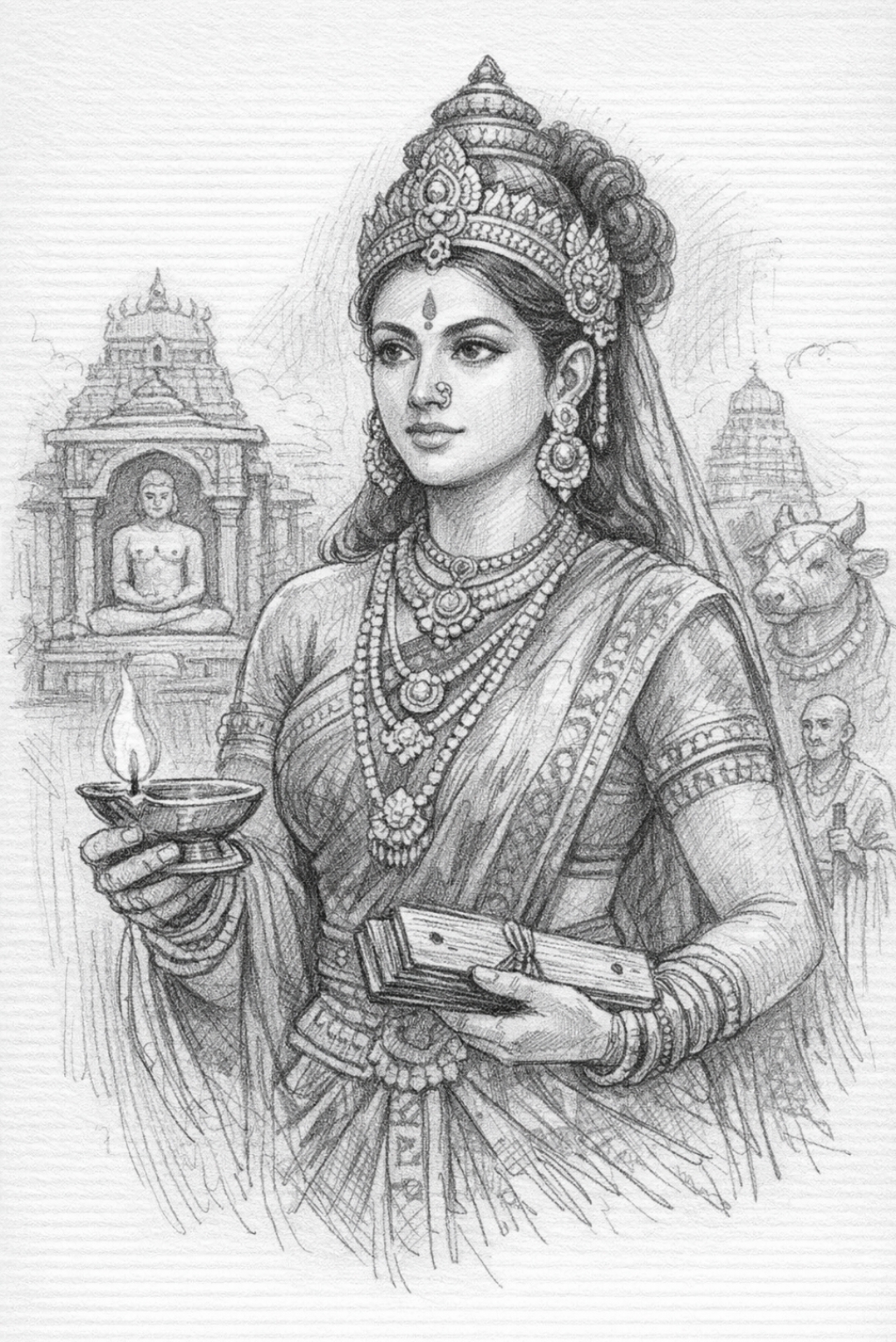
Princess Kundavai’s Lesser-Known Religious Patronage and Her Micro-Journey Through Faith
Imagine walking through the sun-washed courtyards of tenth-century Pazhayarai. The air smells of oil lamps and river water. Bronze bells tremble faintly in the wind. This is not a battlefield, nor a coronation hall—but a space where belief quietly shapes empire.
At the centre of this world stands Princess Kundavai Pirattiyar of the Chola dynasty.
History remembers her as Rajaraja Chola’s formidable sister, a political anchor and strategist. Popular culture casts her as regal and sharp. But beneath these narratives lies a subtler truth: Kundavai was one of the most deliberate religious patrons of early medieval South India, shaping spiritual institutions at a micro level—through land grants, ritual funding, daily worship logistics, and cross-sectarian protection.
This is not a story of dramatic conversions or temple building alone.
This is a story of how faith was practiced administratively, personally, and patiently—one lamp, one endowment, one conversation at a time.
Growing Up Among Many Gods (c. 946–965 CE)
Princess Kundavai was born around 946 CE in Pazhayarai, the secondary capital of the Cholas. Unlike later imperial centres, Pazhayarai was intimate—densely ritualistic rather than monumental. Shaiva temples stood close to Vaishnava shrines. Jain basadis survived quietly. Buddhist memory had not fully faded.
This pluralism was not abstract. It shaped daily life.
Copper-plate inscriptions from the mid-tenth century already refer to Kundavai as Ilaiya Piratti—a title not merely ceremonial. It implied responsibility over household temples, palace shrines, and endowments. Girls of her rank were trained to understand ritual economies: who lit lamps, who cleaned sanctums, who received cooked rice, and who was excluded.
Her education included:
- Agamic Shaiva ritual texts
- Vaishnava Pancharatra traditions
- Jain ethical philosophy, particularly karma and ahimsa
- Classical Tamil devotional poetry (early Tevaram hymns)
This mattered. Religious patronage in Chola times was not emotional generosity—it was technical governance.
By her mid-teens, inscriptions indicate that Kundavai personally redirected the tax yield of a small village near Pazhayarai to sustain perpetual temple lamps. These lamps were not symbolic. If the oil stopped, worship stopped. Her earliest patronage focused not on construction, but continuity.
Why Jainism Mattered to Her (970–985 CE)
By the late tenth century, Shaivism dominated Chola royal ideology. Yet Jainism still held intellectual prestige, especially among merchants, scribes, and ethical philosophers. Its decline was political, not devotional.
Kundavai understood this.
Around 973 CE, she sponsored the Kundavai Jinalaya at Tirumalai, near modern-day Nagapattinam. Inscriptions record:
- Gold endowments measured in kalanjus
- Agricultural land assigned solely for lamp oil
- Annual cloth and food allowances for Jain monks
What makes this remarkable is timing. Jain institutions were already vulnerable. Kundavai’s intervention stabilized them.
Micro-details matter here:
- Annual audits were mandated to ensure funds were not diverted
- Temple caretakers were appointed directly by royal writ, bypassing local hostility
- Sculptural elements subtly incorporated royal symbols—asserting protection without aggression
Later Jain texts recall her as a dharmika rakshika—a protector through dharma, not decree.
This was not rebellion against Shaivism. It was containment of religious erasure.
Walking the Stone: Devotion Beyond Decree
One of the most revealing aspects of Kundavai’s religious life is how often she physically appeared at sites.
Literary references and inscriptions note her presence during:
- Granite polishing at Darasuram
- Mandapa extensions for Jain discourse halls
- Consecration rehearsals before major Shaiva festivals
She did not merely issue orders from Pazhayarai. She walked. She inspected. She debated monks and priests.
A Jain narrative records her walking barefoot from Pazhayarai to a temple site during renovations—a gesture not of humility theatre, but ritual alignment. Bare feet acknowledged the sanctity of stone. It was how donors demonstrated submission to space, not authority over it.
These gestures earned trust across sects.
The Brihadeeswarar Temple: Her Invisible Architecture (985–1010 CE)
When Rajaraja Chola began the Brihadeeswarar Temple at Thanjavur, history crowned him its builder. But inscriptions etched into the temple walls tell a more distributed story.
Kundavai’s name appears repeatedly.
She funded:
- Specific vertical segments of the vimana
- Pearl and gemstone fittings, particularly for ritual icons
- Feeding programs for hundreds of temple personnel
She also structured festivals—deciding which hymns were sung, which days lamps burned longer, which communities were included in processions.
One lesser-known inscription records a private nocturnal worship chamber, reserved for royal women. Kundavai is named as its primary ritual sponsor. These midnight pujas followed older Shaiva traditions focused on inward devotion rather than spectacle.
Her contribution was ritual rhythm, not visual dominance.
Vaishnava Threads That Never Snapped
Despite Shaiva political ascendancy, Kundavai maintained consistent Vaishnava support.
At Srirangam, she donated a golden kavacham (protective covering) for the deity. Temple chronicles describe it as unusually intricate—layered, not ornamental. This mattered. Armor symbolized guardianship.
She also patronized Vaishnava teachers who predated Ramanuja, encouraging philosophical discussion without sectarian competition. These interactions helped preserve dialogue during an era when schools increasingly hardened.
Beyond Hinduism: Buddhism and Quiet Survival
Nagapattinam’s Chudamani Vihara, a Buddhist institution supported by overseas trade networks, received Chola patronage during Rajaraja’s reign. Kundavai’s role was indirect but real.
Records show allocations for:
- Monk sustenance
- Roof repairs
- Palm-leaf manuscript copying
Her approach to Buddhism mirrors her Jain strategy: stabilize, don’t dominate.
How She Paid for Faith
Kundavai’s patronage was not symbolic charity.
Funding sources included:
- Personal jewelry converted into liquid gold
- War tribute redirected into ritual trust funds
- Agricultural villages assigned solely to temple upkeep
- Pearl yields from maritime trade
Each transaction was documented on copper plates. Transparency protected institutions after her death.

A Life Measured in Lamps, Not Legends (1010–1023 CE)
After Rajaraja’s death, Kundavai withdrew from public politics but intensified private devotion. Inscriptions show increased lamp endowments, not grand constructions.
Her final recorded acts focus on:
- Ensuring rituals continued after royal transitions
- Naming caretakers who would outlive her
- Binding funds legally so successors could not revoke them
She died around 1023 CE.
No temple bears her towering statue.
No cult worshipped her as a goddess.
And yet, her influence endures in lit lamps that never went out.
Why Princess Kundavai Still Matters
In an age obsessed with spectacle, Kundavai teaches us something quieter:
Faith is infrastructure.
Devotion is maintenance.
Pluralism survives through administration, not slogans.
She did not ask which god was supreme.
She asked who would still be worshipped tomorrow.
For the Reader Today
- Visit Tirumalai not as a tourist, but as a listener
- Read inscriptions slowly—they are voices, not data
- Practice micro-patronage: sustain something small, daily, faithfully
Princess Kundavai did not build belief.
She kept it alive.
This article draws upon Chola-period inscriptions published by the Archaeological Survey of India, copper plate grants, temple records from Thanjavur and Srirangam, and modern scholarship by historians such as K.A. Nilakanta Sastri, Y. Subbarayalu, Burton Stein, and Noboru Karashima. Interpretive reconstructions are based on established religious and administrative practices of early medieval South India.

Leave a Reply