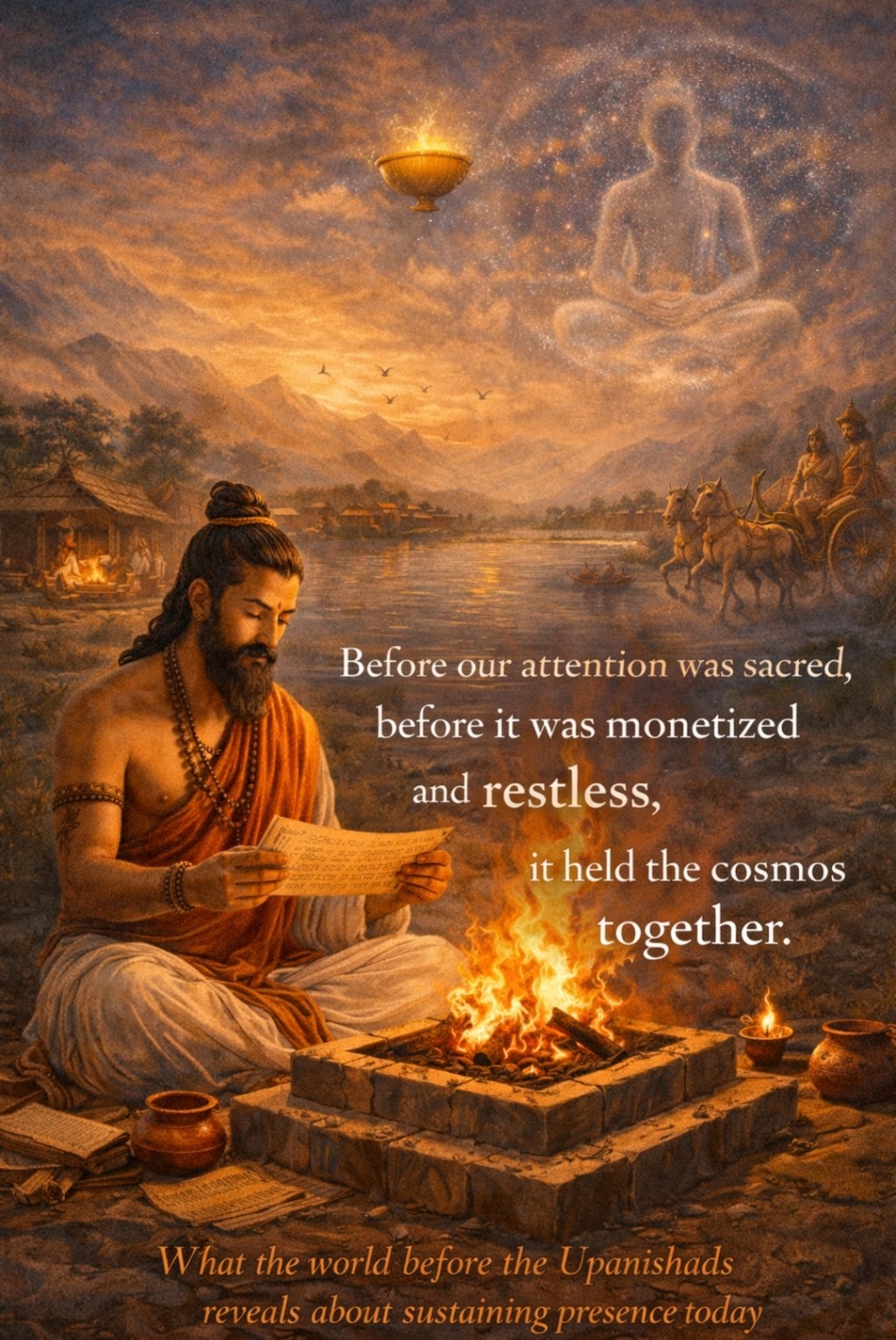
There was a time when attention was not something you lost.
It was something you offered.
Before it became a productivity problem, before it was monetized, fragmented, measured in seconds and scroll depth, attention was treated as a cosmic act—a force capable of sustaining worlds.
The people of the pre-Upanishadic age did not speak of “mindfulness.” They did not speak of “focus.” They did not speak of “meaning” as a personal crisis. And yet, their entire world revolved around a single question we are once again asking, in quieter and more desperate ways:
What deserves our attention?
To step into the world before the Upanishads is to step into a civilization that understood something we have almost forgotten:
that attention is not merely psychological—it is ontological.
It shapes what exists.
1. A World That Did Not Look Inward—Yet Knew How to See
The pre-Upanishadic world was not introspective in the modern sense. It did not ask, “Who am I, really?” It asked something far more unsettling:
How do we keep the world from falling apart?
Reality, as imagined by early Vedic thinkers, was not guaranteed. Order—ṛta—was fragile. Seasons could fail. Rivers could dry. Speech could lose its power. Gods could turn away.
Nothing worked automatically.
And so attention was not optional.
A ritual done carelessly did not merely “fail.” It risked cosmic imbalance. A syllable mispronounced was not a personal error—it was a tear in reality’s fabric.
This is difficult for us to grasp today, living as we do in systems that promise continuity regardless of our inner state. Electricity flows whether we are present or distracted. Food arrives whether we are grateful or numb.
The pre-Upanishadic world had no such buffers.
To live was to participate.
2. Ritual as a Technology of Attention
Modern people often misunderstand ritual as repetition without thought.
In the early Vedic world, ritual was repetition with absolute attention.
A fire altar was not symbolic decoration. It was a carefully measured geometry, aligned with cosmic directions, built brick by brick with awareness. The act of lighting the fire—Agnyādheya—was not routine. It was the formal invitation of Agni, the mediator between realms.
Ritual demanded:
- Stillness of body
- Precision of speech
- Memory across generations
- Collective synchronization
In other words, ritual was a training system for attention.
Today, we use apps to “build focus.” They used fire, chant, rhythm, and community.
And the goal was not self-improvement.
The goal was cosmic continuity.
3. The Collapse of Shared Attention
One of the quiet tragedies of modern life is not that we lack intelligence, information, or tools.
It is that we no longer attend together.
The Vedic sacrifice required many people—priests, patrons, singers, listeners—each holding a distinct role. Attention was distributed, layered, and coordinated. No one could perform the ritual alone.
Contrast this with modern attention:
- Fragmented
- Isolated
- Algorithmically hijacked
- Largely private
We sit together, but attend separately.
We share spaces, but not rhythms.
We experience events, but rarely meaning.
In losing shared attention, we have lost something deeper than ritual. We have lost collective significance.
4. Productivity Without Absorption
The pre-Upanishadic world would not understand our idea of “busy.”
They knew exhaustion. They knew labor. They knew survival pressure.
What they did not know was distraction disguised as importance.
Modern work keeps us active but rarely absorbed. We are productive without being present, efficient without being engaged. Tasks multiply, but meaning thins.
In the Vedic worldview, a task done without attention was not just ineffective—it was dangerous. A ritual performed mechanically was worse than no ritual at all.
Today, we invert this logic. We reward output, not absorption. Speed, not presence. Volume, not depth.
And then we wonder why work feels hollow.
5. Sound, Silence, and the Lost Power of Speech
For the early Vedic thinkers, speech (vāc) was not a tool—it was a force. Words did not describe reality; they shaped it.
This is why hymns were memorized with terrifying precision. Why metres mattered. Why sound itself was sacred.
Today, words flood us constantly:
- Notifications
- Opinions
- Content
- Commentary
But speech has lost weight.
We speak more and mean less. We hear more and remember nothing. Language has become ambient noise—present everywhere, significant nowhere.
The pre-Upanishadic world teaches us a difficult lesson here:
Speech without attention is decay.
Silence was not absence. It was preparation.
6. Before Meaning Became Personal
One of the defining features of modern life is the belief that meaning is something you must “find for yourself.”
This idea would have baffled the early Vedic mind.
Meaning was not personal. It was cosmic.
You did not ask, “Is this meaningful to me?”
You asked, “Does this sustain order?”
Fulfilment was not an inner emotion—it was alignment.
Only later, with the Upanishads, does meaning begin its inward turn. Only later does liberation become personal, psychological, existential.
Before that, meaning lived outside the self—in seasons, rituals, lineage, speech, fire.
And perhaps this is why modern meaning feels so fragile. We have placed it entirely inside ourselves, while dismantling the outer structures that once held it.
7. The Price of Endless Choice
Pre-Upanishadic life was constrained—by tradition, by ritual, by inherited roles.
Modern life is defined by choice.
And yet, choice has not delivered clarity. It has delivered anxiety.
Without shared rituals, without common rhythms, every decision becomes existential. Every failure feels personal. Every distraction feels like a moral weakness.
The Vedic world limited choice deliberately—not to suppress individuality, but to protect attention.
When fewer things demand your focus, what remains becomes sacred by default.
8. Fire as a Metaphor We Still Need
Fire was the center of Vedic life—not just materially, but symbolically.
Fire transforms. Fire consumes attention. Fire demands presence.
You cannot half-watch a fire.
You cannot scroll beside it.
You cannot rush it.
In a world without fire at the center, we have replaced it with screens—flickering, consuming, endless. But unlike fire, screens ask for attention without offering transformation.
They heat nothing. They cook nothing. They bind nothing.
Fire gathered people. Screens isolate them.
The loss of fire is not technological—it is ritual.
9. When the Upanishads Turned Inward—and We Forgot the Balance
The Upanishads emerged as a necessary correction. They questioned excess ritual. They redirected attention inward. They asked whether truth could be known without fire, without offering, without hierarchy.
They were right.
But modernity took this turn too far.
We internalized meaning, introspection, selfhood—while discarding the outer disciplines that once anchored them.
The result is a world full of inwardness, but little grounding.
Reflection without rhythm.
Insight without integration.
The pre-Upanishadic world reminds us that inward awareness must be trained, not merely encouraged.
10. Attention as an Ethical Act
Perhaps the most radical idea the early Vedic world offers us is this:
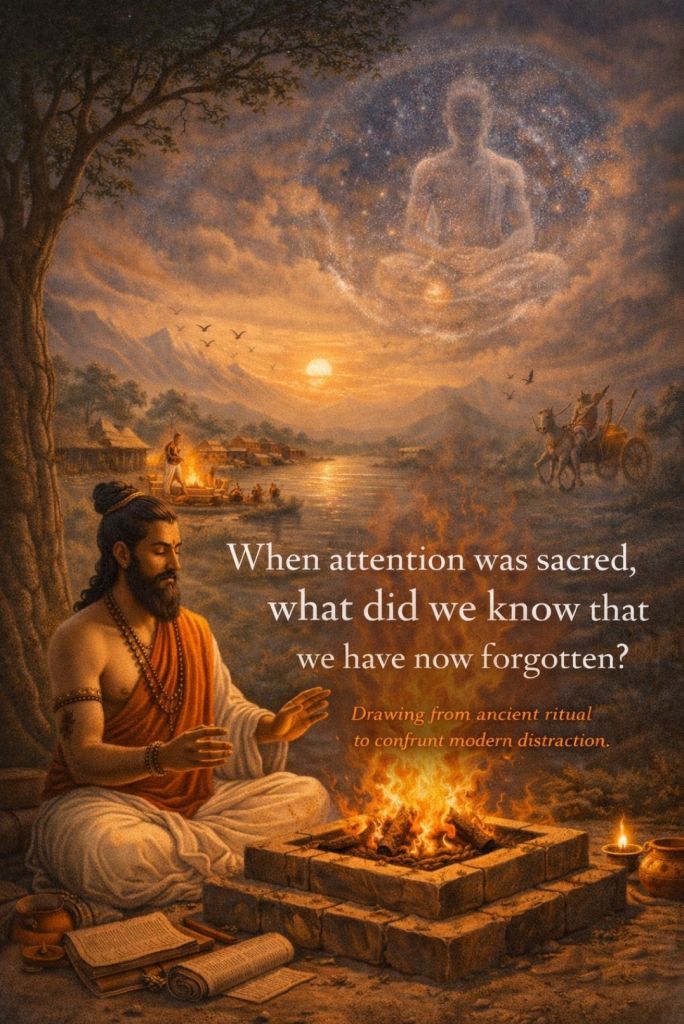
Attention is moral.
Where you place it matters—not just psychologically, but socially, ecologically, cosmically.
To attend to fire was to sustain life.
To attend to speech was to preserve truth.
To attend together was to create meaning larger than the self.
Today, attention is treated as neutral—until it is exploited.
But what if we treated attention as a responsibility?
What if we asked, daily:
- What am I feeding with my attention?
- What grows when I look away?
- What dies when I scroll past?
11. Relearning Ritual Without Repeating the Past
This is not a call to return to ancient sacrifices, nor to romanticize the past.
It is a call to remember what ritual was for.
Ritual was not belief enforcement.
It was attention training.
It was rhythm creation.
It was shared meaning in motion.
Modern life desperately needs new rituals—not religious replicas, but structures of presence:
- Shared meals without devices
- Work done in deep, uninterrupted blocks
- Language used sparingly and precisely
- Silence that is intentional, not empty
12. The Quiet Question That Still Remains
The pre-Upanishadic world lived with a quiet terror:
that order could collapse if attention failed.
Modern life lives with a quieter terror:
that nothing matters even if attention succeeds.
Between these two fears lies a forgotten truth.
Meaning is not found by looking harder inside ourselves.
It is created by attending rightly—together, repeatedly, patiently.
Before silence learned to speak,
before philosophy turned inward,
before meaning became personal—
attention was sacred.
And perhaps, if we listen carefully enough,
it still is.


 Poetry Hub
Hello. Thanks for visiting. I’d love to hear your thoughts! What resonated with you in this piece? Drop a comment below and let’s start a conversation.