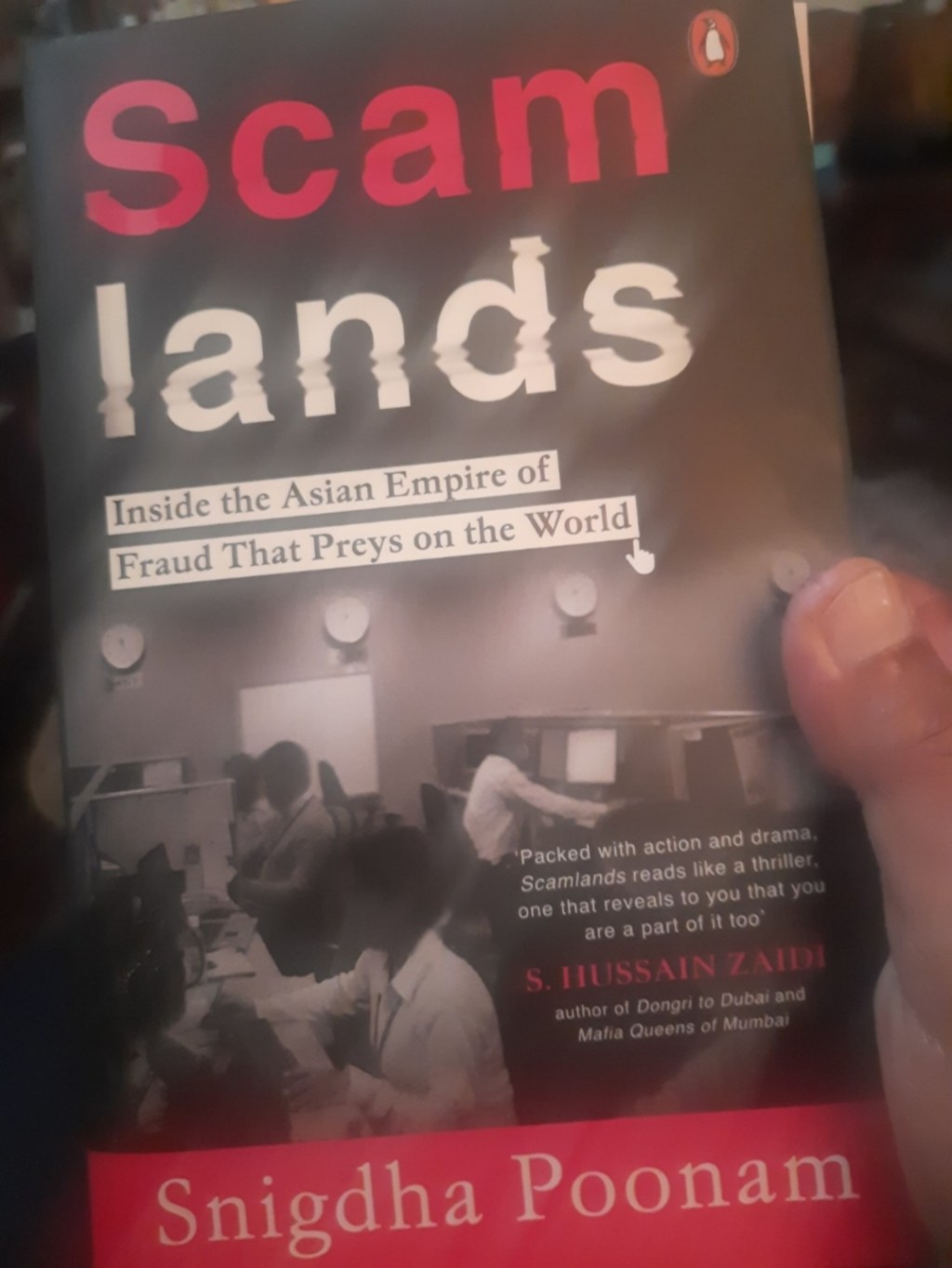
Scamlands: Inside the Asian Empire of Fraud That Preys on the World
Author: Snigdha Poonam
Publisher: Penguin Random House India, 2023
ISBN: 978-0-670-09554-4 | Pages: ~286
You start reading Scamlands the way you start many nonfiction books. Casually. One chapter before bed. But a few pages in, the casual posture disappears.
You sit up.
The room grows quieter.
The book starts to feel uncomfortably close.
This isn’t distant crime journalism. It feels like someone pulling back a curtain you didn’t know you were standing behind.
What Is Scamlands Really About?
Short answer: Scamlands investigates the industrial-scale fraud ecosystems operating across Asia and feeding the global economy of deception.
But that description undersells its ambition. This is not a catalogue of scams. It is a study of how fraud becomes infrastructure — social, economic, and psychological.
Poonam shows that scams are not side effects of modernity. They are products of it.
Does Scamlands Deliver on Its Promise?
Yes — powerfully and unsettlingly.
The book exposes scale, systems, and human cost with clarity and restraint.
Rather than chasing spectacle, Poonam builds her case patiently. She walks readers through call-centre floors, recruitment pipelines, borderless money flows, and moral grey zones.
The result is a book that reads like investigative journalism but lands like social diagnosis.
“Packed with action and drama, Scamlands reads like a thriller — one that reveals that you are part of it too.”
That final clause matters. This book refuses safe distance.
What Makes the Reporting Stand Out?
Short answer: Immersion, access, and ethical restraint.
Poonam’s greatest strength is being present without being performative. She enters spaces most reporting never reaches — not just scam victims, but scam workers.
She listens without excusing.
She observes without simplifying.
Reporting Techniques at Work
- On-the-ground immersion in scam hubs across Asia
- First-person observation without self-centering
- Careful anonymisation that protects sources
- Contextual layering of economics, migration, and technology
This is journalism that understands systems produce behavior, not just villains.
Is This a Book About Criminals or Capitalism?
Both — but capitalism is the real subject.
Scammers here are not cartoon antagonists. Many are young, displaced, underpaid, or trapped. Poonam repeatedly asks the harder question:
What kind of economy makes fraud one of the most rational career paths available?
Core Themes
- Precarity and aspiration in emerging economies
- Digital anonymity as moral camouflage
- Outsourced guilt in global capitalism
- Victimhood without innocence
This thematic depth elevates Scamlands beyond exposé into serious social commentary.
How Does the Book Handle Its “Characters”?
Short answer: With complexity, not comfort.
The people in Scamlands are not heroes or monsters. They are workers, migrants, hustlers, managers, and intermediaries.
Some moments linger long after reading:
- A young man proud of his English accent, used daily to deceive strangers.
- A recruiter who speaks of quotas with chilling normalcy.
- A victim who realises too late that trust was the real currency stolen.
Poonam never tells you how to feel. She lets the discomfort do the work.
What Is the Book’s Writing Style Like?
Short answer: Clear, controlled, and quietly devastating.
The prose avoids melodrama. Sentences are tight. Scenes are economical. When emotion appears, it lands harder because it is earned.
Stylistic Choices
- Short paragraphs that maintain momentum
- Minimal jargon, maximum clarity
- Scene-driven chapters over abstract theory
- Repetition used as thematic echo
The book trusts readers. It doesn’t overexplain. It doesn’t shout.
Where Does Scamlands Feel Most Powerful?
Short answer: When it connects fraud to everyday digital life.
This is not a book about “other places.” It implicates:
- Online marketplaces
- Customer service systems
- Data economies
- Everyday convenience
The unsettling realisation emerges slowly: modern life runs on invisible moral compromises.
You are not accused.
You are included.
Analysis Snapshot
Dimension Assessment Investigative depth Exceptionally strong Narrative control Precise and disciplined Ethical framing Nuanced, non-sensational Accessibility High for serious readers Emotional impact Slow-burning, lasting
Key Strengths
- Systemic vision without abstraction
- Humanisation without romanticising
- Global relevance rooted in local reporting
- Moral seriousness without preaching
Potential Pitfalls
- Readers seeking quick answers may find it demanding
- The refusal to offer neat solutions may frustrate some
- Its discomfort is intentional — not everyone welcomes that
These are not flaws so much as editorial commitments.
Frequently Asked Questions
Is Scamlands a true-crime book?
Not exactly. It’s closer to social investigation than crime narrative.
Do I need financial or tech expertise?
No. Concepts are explained through lived experience.
Scamlands does not end with a warning or a call to action. It ends with awareness.
Does the book focus only on Asia?
Geographically, yes. Structurally, it is global.
Is it pessimistic?
It is realistic. Any hope offered is implicit, not promised.
Who will benefit most from reading it?
Readers interested in journalism, technology, labour, and ethics.
How to Read Scamlands Thoughtfully
- Read slowly. This book rewards attention.
- Pause after chapters. Let implications settle.
- Notice how often “efficiency” appears as justification.
- Reflect on your own digital interactions.
- Discuss with others. It sharpens insight.
- Revisit key sections. Meanings deepen on return.
- Pair it with news stories on cybercrime and labour.
Final Reflection
That may be its most honest achievement.
Snigdha Poonam doesn’t ask you to fear scams. She asks you to understand the world that makes them inevitable — and profitable.
Once you see that world clearly, looking away becomes harder.


 Poetry Hub
Hello. Thanks for visiting. I’d love to hear your thoughts! What resonated with you in this piece? Drop a comment below and let’s start a conversation.