There are years that arrive gently, almost apologetically, asking to be understood slowly.
And then there are years that gallop.
2026 belongs unmistakably to the second kind.
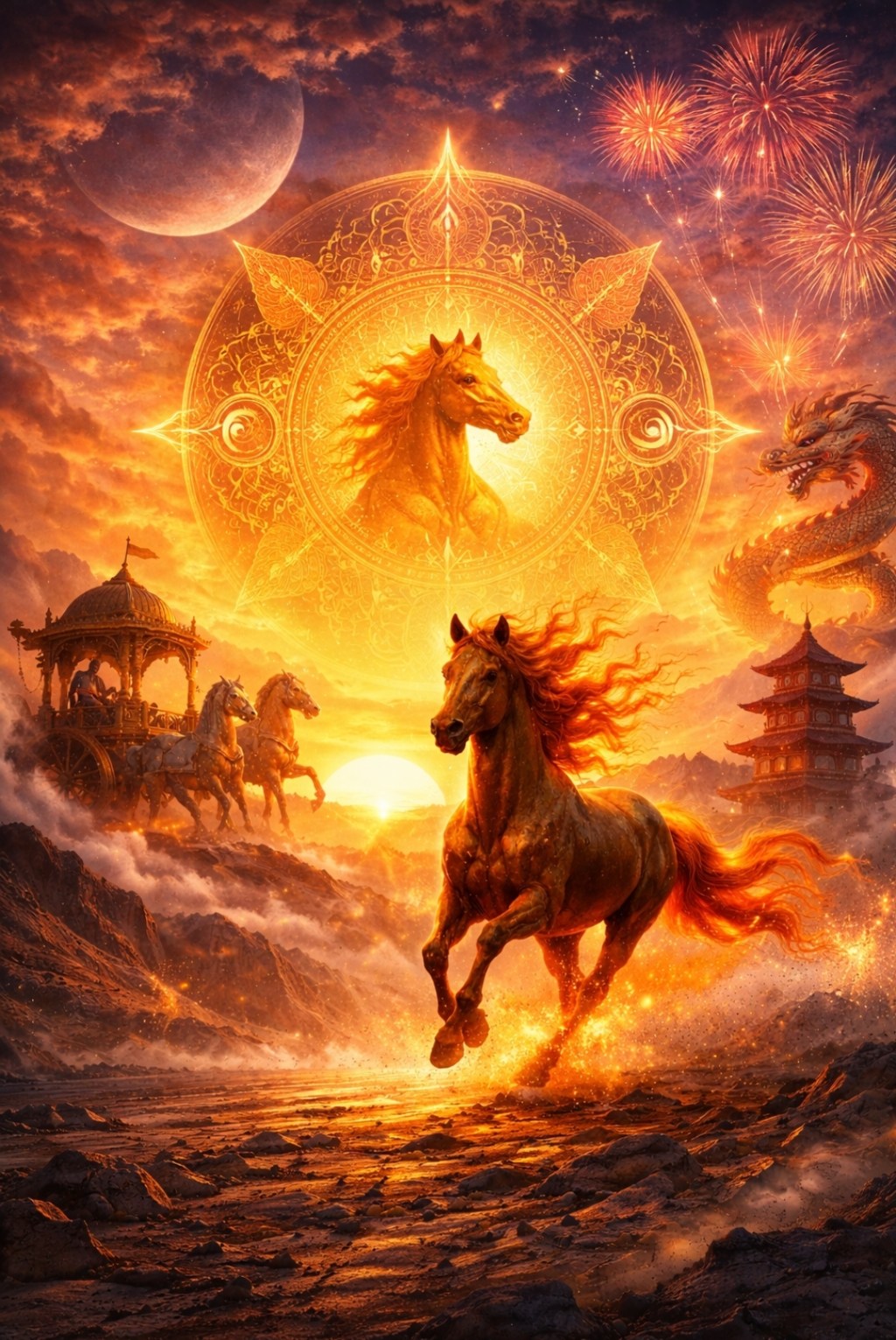
Across much of the world, it is being welcomed as the Year of the Fire Horse—a symbol that instantly evokes speed, restlessness, courage, and an almost reckless vitality. Streets glow red, drums thunder, dragons coil and uncoil in ritual motion. But beneath this visible celebration lies a quieter, older rhythm—one that does not belong to any single culture.
In the Vedic imagination, this rhythm has a name: Ashwini.
The convergence of the Fire Horse and Ashwini Nakshatra in 2026 is not merely an astrological curiosity. It is a reminder that human civilizations, separated by geography, often arrive at the same symbols when contemplating time, beginnings, and the raw force of becoming.
This is not a year that asks us to wait.
It is a year that asks: What will you initiate?
The Horse as a Civilisational Archetype
The horse appears in human myth not as an animal of leisure, but of thresholds.
It arrives when something must be crossed: distance, danger, darkness, inertia.
In Chinese cosmology, the Horse represents independence, motion, charisma, and the refusal to remain confined. When combined with the Fire element, that motion becomes incandescent—fast, visible, and transformative. Fire Horse years are remembered not for subtlety, but for acceleration. They are years that compress decades of intention into moments of action.
The Vedic worldview approaches the horse differently, yet arrives at a strikingly similar conclusion.
Ashwini Nakshatra—the first lunar mansion—opens the zodiac. It does not refine or complete; it begins. Its symbol, the horse’s head, is not decorative. It is anatomical, directional, alert. It points forward.
Ashwini is the moment just before dawn breaks, when the world has not yet changed, but can no longer remain the same.
Ashwini: The Energy That Cannot Wait
In Vedic thought, Ashwini is ruled by the Ashwini Kumaras—twin deities who heal not through prolonged rituals, but through immediate intervention. They arrive swiftly, restore vitality, and vanish just as quickly.
This is not slow medicine.
This is emergency medicine for stagnating souls.
Ashwini’s power is the power to initiate movement. It governs the first spark of recovery, the first step after paralysis, the sudden insight that ends prolonged confusion. Where later nakshatras refine and stabilise, Ashwini disrupts inertia.
Its planetary ruler, Ketu, adds a paradoxical dimension. Ketu cuts attachments. It does not linger in outcomes. As a result, Ashwini energy is intensely action-oriented but oddly detached from results. It begins things without guarantees.
This is why Ashwini is often uncomfortable for those who crave certainty. It offers motion, not assurance.
Fire Horse and Ashwini: When Speed Meets Fire
When the Fire Horse archetype meets Ashwini energy, something remarkable happens.
Speed acquires purpose.
Fire is already present in both systems. The Horse belongs to a fire-oriented temperament. Ashwini sits in Aries, the fire sign of beginnings, ruled by Mars—the planet of action, courage, and heat. There is no passive quality here.
But fire behaves differently depending on context.
- Uncontained fire burns recklessly.
- Directed fire forges.
2026 presents both possibilities.
This is a year where ideas will move faster than institutions. Technologies will outpace ethics. Personal decisions will outrun long-term planning. At the same time, extraordinary breakthroughs—creative, medical, spiritual—become possible precisely because hesitation dissolves.
The question is not whether change will occur.
The question is whether we will consciously ride it.
Time as a Spiral, Not a Line
One of the quiet fascinations of astrology—both Eastern and Vedic—is its cyclical understanding of time. The Fire Horse returns roughly every sixty years. Ashwini, too, marks the recurring reset point of the lunar zodiac.
When cycles overlap, they do not repeat history. They echo it.
The last Fire Horse era was remembered for upheaval, rebellion, and rapid social transformation. But cycles do not demand imitation. They demand response.
In 2026, the echo is not asking us to recreate the past. It is asking us to confront a similar threshold: a world moving faster than its emotional maturity.
Ashwini’s role here is subtle but vital. It reminds us that initiation without healing leads to fracture. Speed without integration becomes exhaustion.
The Inner Fire Horse
Astrology often gets trapped in prediction. PebbleGalaxy has always leaned toward reflection instead.
So what does this convergence mean inwardly?
It suggests that many people will feel an unusual impatience—not with others, but with their own delay. Projects postponed for years suddenly feel intolerable. Conversations avoided demand expression. Creative impulses long suppressed begin knocking loudly.
Ashwini does not whisper.
It arrives.
This can be exhilarating or overwhelming, depending on how deeply one listens.
The invitation of 2026 is not to chase everything, but to recognise the one thing that cannot wait any longer. The Fire Horse gives courage. Ashwini gives clarity. Together, they offer momentum with instinct.
Healing as Motion, Not Stillness
One of Ashwini’s most overlooked teachings is its definition of healing.
Healing here is not rest.
Healing is restoration of flow.
In a year charged with fire and speed, many will mistake burnout for failure. Ashwini offers a different perspective: stagnation, not motion, is the greater illness.
This does not mean reckless overwork. It means intuitive movement—knowing when to act swiftly and when to withdraw just as quickly. The Ashwini Kumaras heal, but they do not stay.
Modern life struggles with this rhythm. We cling to outcomes, identities, roles. Ashwini teaches the art of intervention without possession.
Civilisations at a Crossroads
On a collective level, Fire Horse years often coincide with shifts that feel abrupt in retrospect but inevitable in hindsight.
Institutions feel strained. Old narratives lose credibility. New frameworks emerge, often imperfect, sometimes chaotic, but undeniably alive.
From a Vedic lens, this reflects Ketu’s influence—dissolving what has outlived its truth. Fire accelerates this dissolution. The Horse carries it forward.
The danger lies in confusing destruction with renewal. Ashwini does not destroy for spectacle. It clears the way so life can resume its natural momentum.
Walking with the Horse, Not Being Dragged by It
There is a quiet discipline hidden inside Ashwini energy: timing.
Because it is the first nakshatra, its power is strongest at beginnings—but weaker if misapplied later. This mirrors the Fire Horse’s lesson: early action matters. Hesitation compounds risk.
Yet timing also means restraint. Not every impulse deserves execution. Ashwini acts when instinct aligns with necessity.
In 2026, discernment becomes a spiritual practice.
A Year That Asks for Initiation
Every year carries a question.
Some ask us to endure.
Some ask us to reflect.
2026 asks us to begin.
Not recklessly. Not blindly. But courageously.
The Fire Horse does not promise comfort. Ashwini does not promise completion. Together, they offer something rarer: the return of inner momentum.
And perhaps that is the real gift of this convergence—not prediction, not spectacle, but permission.
Permission to move.
Permission to start before certainty arrives.
Permission to trust the instinct that says, now.


 Poetry Hub
Hello. Thanks for visiting. I’d love to hear your thoughts! What resonated with you in this piece? Drop a comment below and let’s start a conversation.