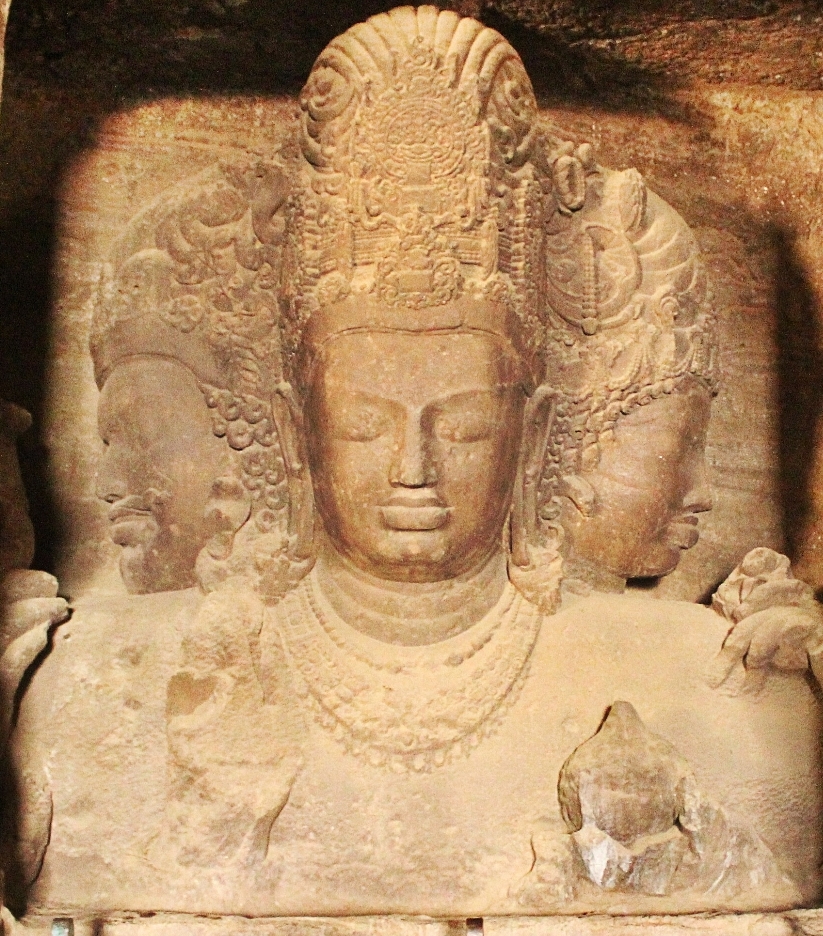
Just as in Every Moment, a Blank Page, where the act of meaningful presence reshapes our sense of time and self, the ancient Vedic principle of TRĪṆI invites us to explore how the sacred triad structures not only cosmic reality but also the inner architecture of consciousness.
There are numbers that count —
and there are numbers that mean.
In Sanskrit, TRĪṆI (त्रीणि) is the neuter plural form of “three.” At first glance, it is grammatical — a declension, a linguistic structure. But in the Vedic imagination, three is never merely arithmetic. It is architecture. It is balance. It is cosmology. It is psychology. It is medicine. It is ritual. It is consciousness mapped into structure.
Across the Rigveda, the Upanishads, the Bhagavad Gita, Ayurveda, Jyotish, and Puranic cosmology, the pattern of three appears with astonishing consistency. The universe, according to Vedic insight, is not chaotic. It is triadic.
This article explores TRĪṆI not just as a word — but as a principle that structures reality.
1. The Linguistic Foundation: What Does TRĪṆI Mean?
In Sanskrit grammar, the word for “three” appears in gendered forms:
- Masculine: trayaḥ
- Feminine: tisraḥ
- Neuter: trīṇi
TRĪṆI is used when referring to neuter nouns — often abstract principles, worlds, elements, fires, qualities, or states of being.
Its linguistic roots trace back to Proto-Indo-European tréyes, which evolved into Proto-Indo-Iranian tráyas before becoming Sanskrit tri. This shared linguistic ancestry links Sanskrit to Greek (treis), Latin (tres), and Old English (þrīe).
But while many cultures use “three,” Vedic civilization elevated it into metaphysical structure.
Three in the Vedic world is completeness.
2. TRĪṆI in the Rigveda: The Earliest Layer
The Rigveda, the oldest surviving Indo-European text, repeatedly invokes triadic symbolism.
In multiple hymns:
- Three fires are invoked.
- Three worlds are referenced.
- Three forms of Agni are described.
- Three strides of Vishnu are celebrated.
- Three dawns, three lights, three realms.
For example, the hymn to Vishnu celebrates his “three strides” — symbolic of cosmic pervasion. These are not literal steps. They represent the threefold division of reality: earthly, atmospheric, celestial.
Agni, too, exists in three forms:
- Terrestrial fire
- Lightning in the mid-space
- Solar fire in the heavens
The Vedic seers were not obsessed with numbers. They were mapping patterns of reality. The repetition of three suggested a structural principle — a minimum unit of balance.
Two creates polarity.
Three creates harmony.
3. The Upanishadic Expansion: Three as Ontological Division
The Upanishads deepen this triadic insight.
In the Brihadaranyaka Upanishad, the cosmic being (Virāj/Prāṇa) divides into three realms. The macrocosm reflects the microcosm: head, torso, and lower body correspond to heaven, mid-space, and earth.
The Chandogya Upanishad describes Brahman symbolically divided into three syllabic aspects. Even sacred sound is triadic.
Consciousness itself is described in three states:
- Waking (Jagrat)
- Dreaming (Svapna)
- Deep sleep (Sushupti)
Later, the Mandukya Upanishad introduces the “fourth” (Turiya) — but only after explaining the triadic base.
Three is the foundation.
Four is transcendence.
4. The Triguna: Psychological Architecture of Reality
Perhaps the most influential triad appears in the Bhagavad Gita, particularly in Chapter 14.
Krishna explains that material nature (Prakriti) operates through three gunas:
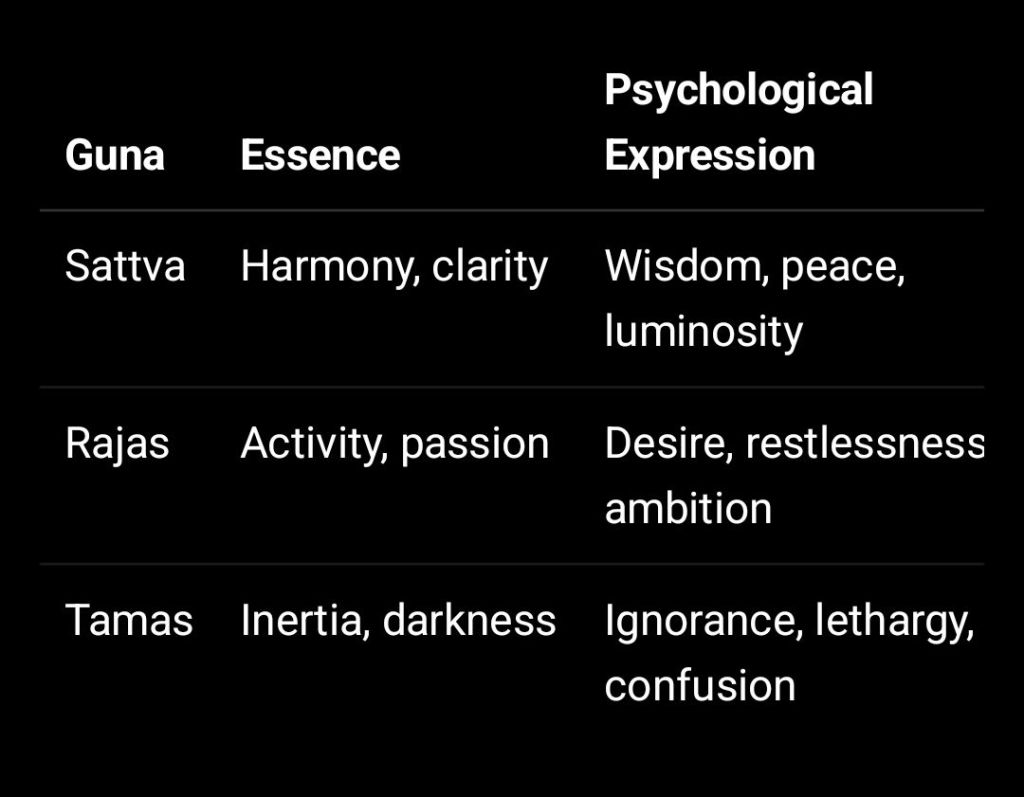
These three qualities bind the soul.
No human personality is free from them.
Every mood, every action, every decision arises from shifting proportions of these three forces.
In Samkhya philosophy, they are the very constituents of primordial matter.
In modern language, one might say:
- Sattva = clarity of cognition
- Rajas = motivational drive
- Tamas = entropic inertia
But unlike Western psychology, the Gita emphasizes transcendence — rising beyond the gunas through awareness and devotion.
The number three here becomes a model of inner balance.
5. The Tridosha: The Medical Triad of Ayurveda
Ayurveda translates cosmic triads into physiology.
The three doshas:
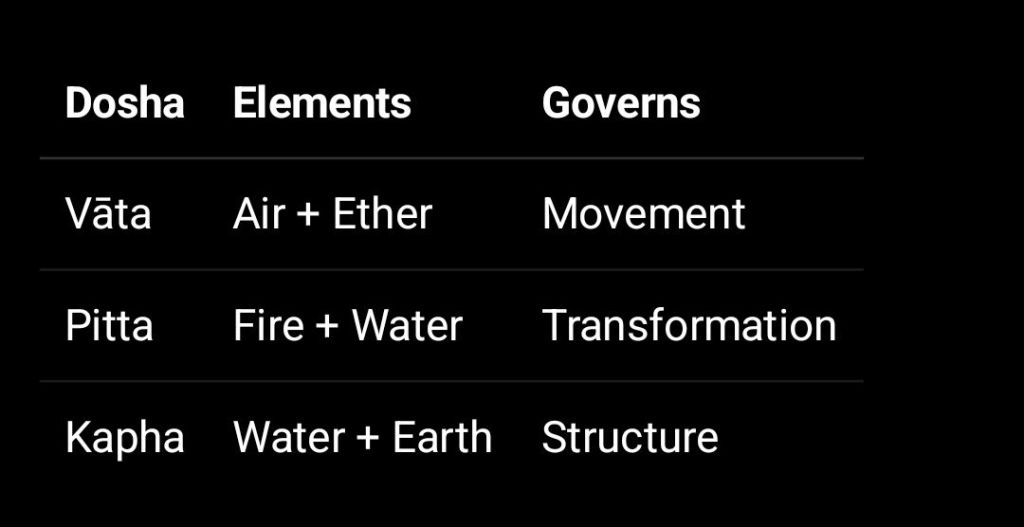
Health exists when these three are in dynamic equilibrium.
The classical texts describe disease as imbalance — excess, deficiency, or disturbance in one of the three.
Unlike modern reductionist medicine, Ayurveda sees the body as a triadic interplay of motion, metabolism, and materiality.
Even Triphala — a famous Ayurvedic formulation — combines three fruits to balance all three doshas.
Again, three is structural completeness.
6. Trimurti: Creation, Preservation, Dissolution
The Puranic imagination personified cosmic processes into the Trimurti:
- Brahma – Creator
- Vishnu – Preserver
- Shiva – Transformer
This is not polytheism in fragmentation. It is metaphysics in personified form.
Every process requires:
- Emergence
- Sustenance
- Dissolution
Even a thought follows this cycle.
In Jyotish (Vedic astrology), these principles map onto planetary energies and life phases.
7. Triloka: The Three Worlds
The cosmos itself is described as three-tiered:
- Svarga (heavenly realm)
- Bhū (earthly realm)
- Pātāla (subterranean realm)
These appear in Vedic and Puranic cosmology as symbolic vertical stratification of consciousness.
Heaven is not just a location.
It is a state of refined experience.
Earth is action.
The lower realm is instinct and unconscious depth.
Again, the triadic pattern repeats.
8. The Three Sacred Fires
Vedic ritual required three sacred fires:
- Gārhapatya – domestic fire
- Dakṣiṇa – southern fire
- Āhavanīya – offering fire
The householder maintained these as sacred responsibilities.
Fire itself becomes triadic:
- Physical flame
- Ritual mediator
- Spiritual transformer
The outer ritual mirrored inner discipline.
9. Triads Beyond Religion: Structural Intelligence
The recurrence of three is not accidental.
Modern systems theory shows stability emerging from triadic balance. A tripod stands. A two-legged structure falls.
In rhetoric, persuasion often uses triads:
- Life, liberty, happiness.
- Past, present, future.
- Body, mind, spirit.
In neuroscience, cognition integrates:
- Sensory input
- Emotional valence
- Executive function
The Vedic seers recognized this pattern intuitively.
10. Why Three? A Philosophical Reflection
Why does reality prefer triads?
Because:
- One is unity.
- Two is polarity.
- Three is relationship.
With three, tension becomes dynamic balance.
In the triguna, rajas mediates between sattva and tamas. In the doshas, pitta transforms between motion and structure. In cosmology, atmosphere mediates heaven and earth.
Three creates movement.
11. Living TRĪṆI Today
For modern seekers — including readers of Pebble Galaxy who explore heritage, psychology, and holistic living — TRĪṆI offers a framework:
- Notice your dominant guna.
- Balance your dosha.
- Recognize cycles of creation, preservation, and letting go.
- Observe waking, dreaming, and deep sleep consciously.
The ancient insight is not superstition. It is structural wisdom.
Conclusion: The Sacred Geometry of Balance
TRĪṆI is not merely “three.”
It is the recognition that reality stabilizes through triplicity.
From the hymns of the Rigveda to the metaphysics of the Gita, from Ayurvedic diagnosis to astrological charts, from ritual fires to psychological states —
Three is the invisible scaffolding of existence.
The Vedic mind did not fragment life into disciplines.
It saw medicine, cosmology, language, ritual, and consciousness as reflections of the same architecture.
And that architecture was triadic.
In a world obsessed with binaries — right/wrong, success/failure, sacred/profane — the wisdom of TRĪṆI invites a third way:
Balance.
Not division.
Not denial.
But integration.

 Poetry Hub
Hello. Thanks for visiting. I’d love to hear your thoughts! What resonated with you in this piece? Drop a comment below and let’s start a conversation.