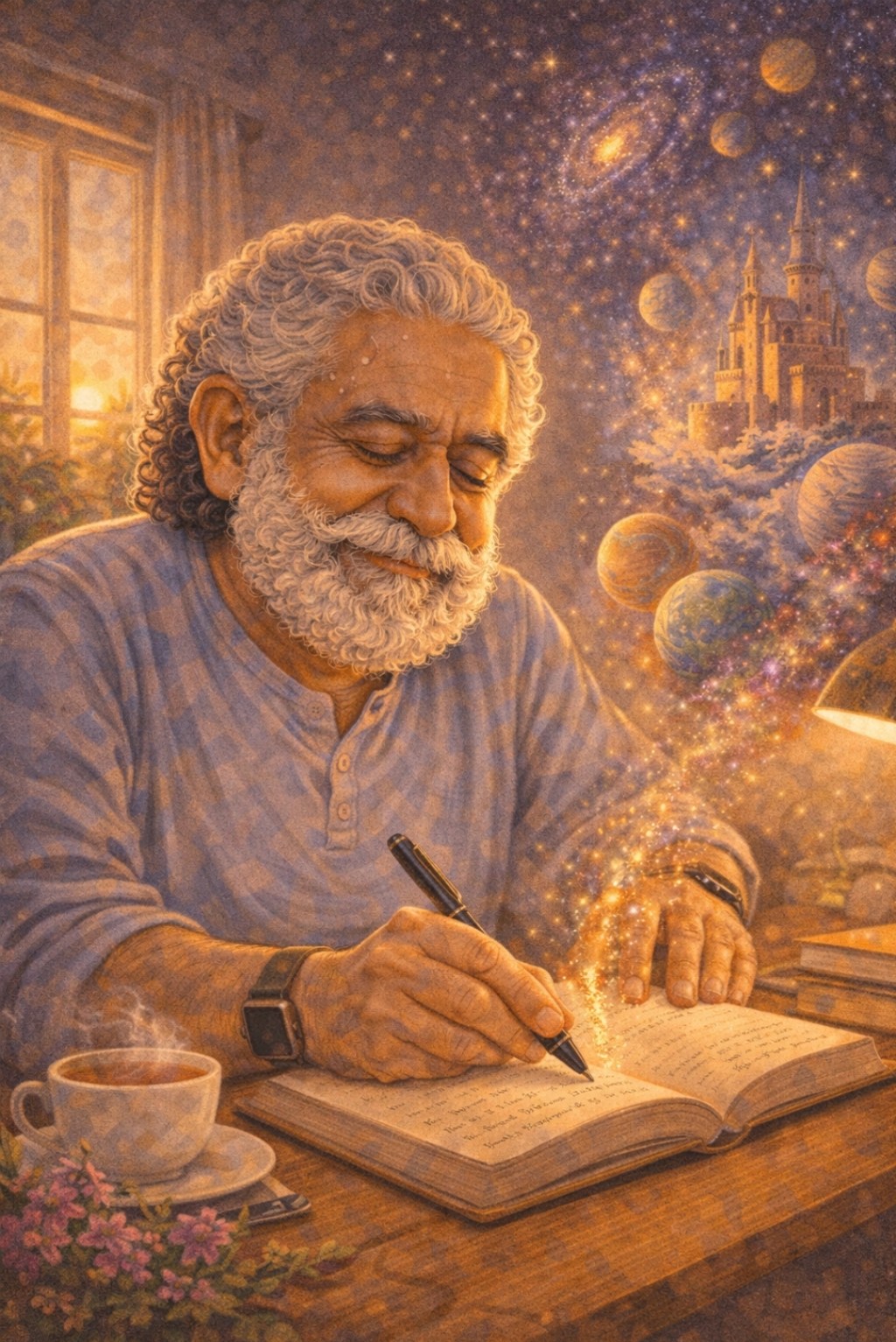
There are things I cannot say
in a room full of breathing bodies.
They turn to vapor
before they reach my mouth,
evaporate like morning mist
lifting off a hesitant river.
But when I sit with a blank page,
when the cursor blinks
like a small, patient lighthouse
in the fog of my doubt,
something in me loosens.
Writing gives me a shoreline
where my thoughts can wash up
without being judged
for the shape they take.
In conversation,
I am a careful gardener,
pruning sentences,
snipping away the wild branches
before they scratch someone’s certainty.
On the page,
I let the forest grow.
Here, my sentences
are not required to behave.
They can wander like deer
through underbrush.
They can circle back,
hoofprints crossing older hoofprints,
until a path appears
where I didn’t know one existed.
Writing gives me
permission to be unfinished.
In life, I am asked for answers.
In writing,
I am allowed to ask better questions.
The kind that open like fissures
in dry earth
after a long summer of pretending.
What am I afraid of?
Why does memory ache
even when it is kind?
What does silence want from me?
I lower these questions
into myself
like a bucket into a well.
Sometimes they come back
with cool, clear water.
Sometimes they rise empty
and I must lean farther in,
risk falling into my own depth.
Writing gives me
the courage to lean.
It is the only place
where I can contradict myself
without apology.
I can say
I am strong
and in the next breath confess
that I am terrified
of losing what I love.
I can admit
that I crave solitude
while aching for a hand
to find mine in the dark.
The page does not flinch.
It does not roll its eyes
or offer solutions.
It receives.
Like soil.
And in that receiving
something germinates.
I have watched
a single word
break open like a seed.
Grief.
Hope.
Mother.
Home.
Each one carrying
an entire climate system inside it—
storms and droughts,
migrations of feeling,
tectonic shifts of identity.
Writing gives me
the weather report of my own interior.
Before I learned to write honestly,
my emotions were like
unmapped constellations.
I knew they were there—
burning, distant,
sometimes collapsing into themselves—
but I could not trace their shapes.
With a pen,
I begin to connect the stars.
This anger
is not just anger.
It is the echo of an old wound,
the way wind whistles
through a cracked window frame.
This joy
is not just joy.
It is the sudden clearing
after monsoon rain,
the sky rinsed of its heaviness,
a heron lifting cleanly
from the surface of a flooded field.
Writing gives me
a telescope
and a microscope
at once.
I can look outward
into the expanding universe
and inward
into the trembling cell
of a single memory.
I can stand
on the edge of a galaxy
and still hear
the faint heartbeat
of a child I once was.
Nothing else
lets me inhabit time
this way.
When I write,
past and present
sit beside each other
like two old friends
who have stopped competing.
The child in me
places her small, ink-stained hand
into the palm
of the person I am becoming.
We speak.
We forgive.
We laugh
at how serious we thought
the world had to be.
Writing gives me
reconciliation.
Not the loud kind
with speeches and grand gestures.
The quiet kind.
Like snow
falling all night
until the jagged edges
of yesterday’s footprints
soften into something
bearable.
I have tried to find
this solace
in other places.
In travel—
standing before mountains
that rise like ancient prayers.
In love—
losing myself in the gravity
of another person’s orbit.
In achievement—
climbing ladders
that promise
a clearer view.
Each of these
has given me beauty,
has widened me.
But writing gives me
belonging.
Not to a place
or a person
or a role.
To myself.
When I write,
I am not performing.
I am not adjusting
my voice
to fit the room.
I am not calculating
how much truth
is safe.
The page does not demand
a version of me
that can be applauded.
It asks only
that I arrive.
Fully.
Even if I arrive
tired,
even if I arrive
ashamed,
even if I arrive
with nothing but a single
trembling sentence.
Writing gives me
a home that travels with me.
I can sit
in a crowded train
or under a neem tree
or in the blue hush
before dawn.
As long as I have words,
I have shelter.
Sometimes,
writing is the only place
where I can hold
what feels unbearable.
There are losses
that cannot be explained
without shrinking them.
There are fears
that sound irrational
when spoken aloud.
But on the page,
they expand
to their true proportions.
Grief becomes
an ocean.
Fear becomes
a forest at night.
And I am no longer ashamed
of drowning
or of trembling.
Because here,
in ink and breath,
I can swim.
I can walk
among the trees
and name
each shadow.
Writing gives me
a way through.
Not a shortcut.
Not an escape.
A way through.
Line by line,
like stepping stones
across a river
in flood.
And sometimes,
when I have written long enough,
when the small, human concerns
have poured themselves out—
the deadlines,
the misunderstandings,
the fragile negotiations of the day—
something shifts.
The voice grows quieter.
Wider.
I begin to sense
that the “I” who is writing
is not as fixed
as I once believed.
The boundaries blur
like the horizon at dusk.
I am the river
and the bank.
I am the question
and the echo.
I am the hand
moving across the page
and the field
receiving the rain of ink.
Writing gives me
this dissolving.
This gentle undoing
of the tight knot
I call myself.
In those moments,
I feel connected
to something older
than language.
As if words are only
the surface ripples
of a deeper current
that runs through all things.
I think of stars
forging elements
in their burning cores—
carbon, oxygen, iron—
the very materials
of my blood and bone.
I think of how
every breath I take
is borrowed from trees.
How every thought
is shaped by voices
I have loved
and lost.
Writing becomes
a conversation
with the cosmos.
Not in grand declarations.
In whispers.
In the way
a single sentence
can feel like
a small alignment
between inner weather
and outer sky.
When that alignment happens,
I feel less alone.
As if my private ache
is part of a vast
and ongoing symphony.
As if the river
of human longing
has always been flowing
and I have simply
lowered my cup.
Writing gives me
participation.
In something larger
than my lifespan.
When I write,
I am in dialogue
with the ancestors
who scratched symbols
onto cave walls.
With the poets
who watched the same moon
rise over different centuries.
With the future reader
who may find,
in a line I almost deleted,
a mirror.
Nothing else
gives me this braid of time.
This sense
that my small voice
can join
a chorus
without losing
its texture.
And yet,
for all its vastness,
writing remains
intimate.
It begins
with a single breath.
A single word
placed carefully
on the page
like a stone
at the edge of a garden.
It begins
with listening.
To the tremor
beneath my confidence.
To the desire
beneath my ambition.
To the love
beneath my fear.
Writing gives me
attention.
And attention,
I have learned,
is a form of devotion.
When I write,
I am kneeling
before the ordinary—
a cup of tea steaming
in the quiet afternoon,
dust motes
turning in a shaft of light,
the faint hum
of a distant train.
These small things
become luminous
under the steady gaze
of language.
Writing gives me
the ability
to fall in love
with what is already here.
And in doing so,
to forgive
what is not perfect.
If I had to name
what writing gives me
that nothing else does,
I would say this:
It gives me
my own depth.
It gives me
a bridge
between my solitude
and the shared sky.
It gives me
a way to hold
both the fragile
and the infinite
in the same pair of hands.
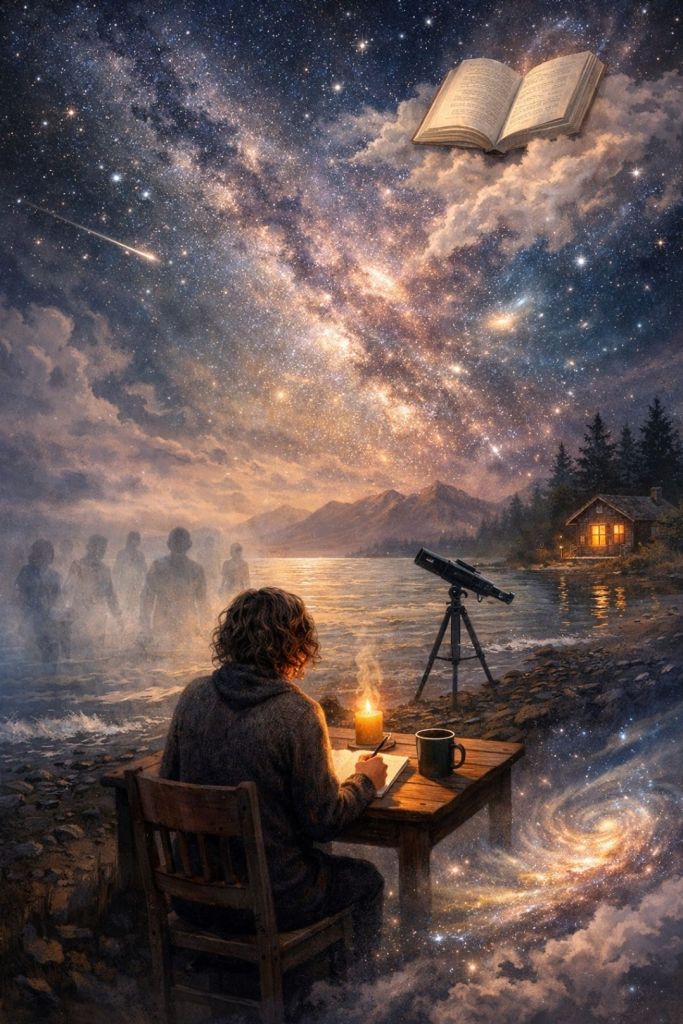
When I close my notebook,
the world is still the world.
The noise returns.
The tasks line up.
The uncertainties remain.
But something in me
has shifted.
Like a tide
that has quietly
rearranged the shore.
I walk back into my life
with sand between my toes
and starlight
caught in my hair.
Writing has given me
not escape,
but expansion.
Not certainty,
but communion.
Not answers,
but a deeper,
steadier way
of asking.
And in that asking,
I find myself—
not as a fixed point,
but as a living,
breathing constellation,
forever forming,
forever opening,
forever lit
from within.

 Poetry Hub
Hello. Thanks for visiting. I’d love to hear your thoughts! What resonated with you in this piece? Drop a comment below and let’s start a conversation.