There are mornings
when the sky wakes with a bruise.
Not the gentle violet of approaching dawn,
but the colour of smoke
folding into itself,
as if the horizon has swallowed
too many unsaid apologies.
Somewhere,
sirens carve the air into sharp pieces.
Somewhere else,
a child learns the grammar of fear
before learning the alphabet of wonder.
And yet
the sun rises.
It does not negotiate with grief.
It does not ask the earth
whether it is ready.
It simply burns —
a steady vow
to begin again.
I stand at my window
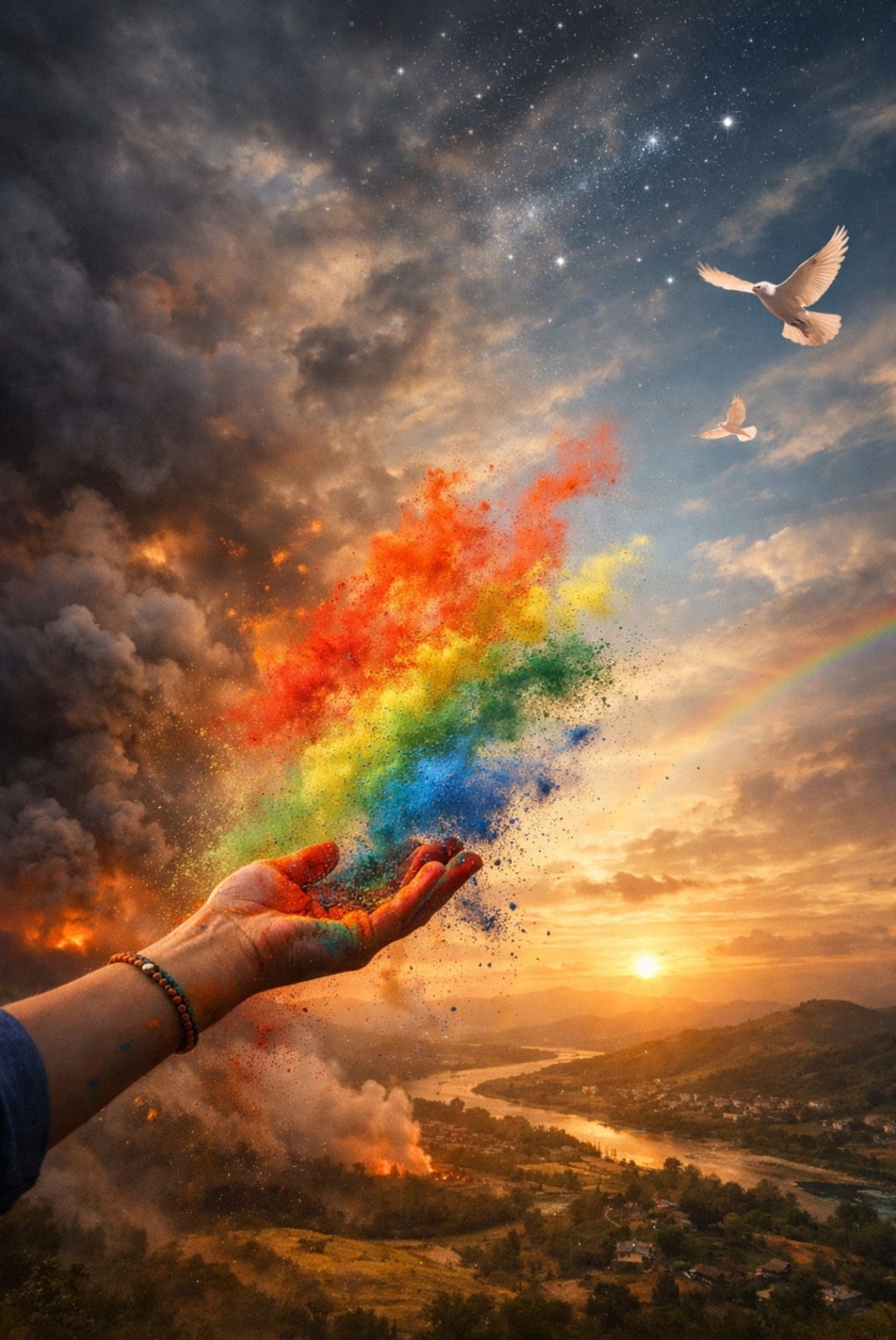
with a fistful of powdered colour,
leftover from a festival
that promised spring.
The packet is torn at the edges.
Red clings to my palm
like a stubborn memory.
Blue has settled into the lines
of my skin
as if trying to become part of me.
While some skies burn,
let us still throw colours into the wind.
Not in celebration alone,
but in prayer
for a peaceful world.
I whisper this
not as a slogan,
but as a confession.
Because it is easier
to scroll past sorrow
than to sit with it.
Easier to harden
than to remain tender
in a season of flames.
The news speaks in numbers.
But the earth speaks in tremors.
I feel them
under the soles of my feet
when I walk across dry ground —
a quiet cracking
like the sound of old faith
splitting open.
What does it mean
to throw colour
when smoke stains the sky?
It means this:
To refuse the monochrome
of hatred.
To remember
that even ash
once knew the language of green.
I close my eyes
and imagine the first dawn
after the first war.
Was it quieter?
Did the birds hesitate
before trusting the air again?
Or did they fly
as they always do,
because flight is their answer
to every wound?
There is a river near my childhood home.
In summer
it shrinks into a thin silver thread,
barely holding itself together.
In monsoon
it swells,
angry and magnificent,
claiming back its forgotten width.
I used to sit on its bank
and throw petals
into its current.
Marigold.
Rose.
Sometimes just leaves
I pretended were boats.
I did not know then
that I was practicing hope.
Now I understand:
Throwing colour
is not denial.
It is defiance.
It is saying —
even if the sky is burning,
my hands will remember
how to release brightness.
The cosmos itself
was born from an explosion.
A violent unfurling
of fire and silence.
And yet
out of that incandescent chaos
came galaxies
spiraling like patient dancers,
came oceans
learning the art of reflection,
came forests
weaving green hymns from dust.
If the universe
could sculpt beauty
from rupture,
surely we
can sculpt kindness
from anger.
Let us choose love.
Let us choose peace.
The words feel fragile
in my mouth.
Like seedlings
in a field
where tanks have passed.
But I have seen
how roots behave.
They do not argue
with stone.
They do not curse the dark.
They simply
persist.
A thin white thread
searching
for water.
In another part of the world
a mother braids her daughter’s hair
while the radio murmurs
about borders and blame.
Her fingers are steady.
The braid is tight,
beautiful,
a pattern of patience.
This too
is throwing colour.
A father teaches his son
to plant coriander
in a cracked balcony pot.
They press seeds
into reluctant soil.
This too
is prayer.
Not the loud kind
that competes with thunder,
but the quiet kind
that listens
for the tremble of a leaf.
I have been angry.
Angry at maps
drawn like scars.
Angry at leaders
who speak of victory
as if it were a clean word.
Angry at myself
for feeling small
in the face of so much ruin.
But anger
is a comet.
It blazes brilliantly
and then it is gone.
What remains
is the long night.
In that night
I have learned
to search for stars.
They do not erase the darkness.
They do not pretend it isn’t there.
They simply exist —
small, persistent declarations
of light.
While some skies burn,
let us still throw colours into the wind.
Let us fling saffron courage
into corridors of doubt.
Let us scatter indigo mercy
over conversations grown brittle.
Let us release green forgiveness
into fields of memory
where old wars still whisper.
Let us send violet listening
into rooms
where no one has truly heard
the other.
And let us not forget white —
not the white of surrender,
but the white of breath
between heartbeats.
The pause
before reaction.
The silence
that makes space
for understanding.
I think of astronauts
looking back at earth
from the edge of orbit.
They do not see
our arguments.
They do not see
the headlines.
They see
a blue sphere
suspended in velvet black —
fragile
as a soap bubble
on a child’s fingertip.
All our fires
from that distance
are invisible.
All our borders
are imaginary lines
drawn in sand.
If we could borrow
that perspective
for even a moment,
would we not soften?
Would we not hesitate
before lighting another match?
The wind outside my window
has begun to stir.
It carries the smell
of distant rain.
Clouds gather
not as threat,
but as promise.
I step outside
into the open.
My neighbours are there too,
some sweeping courtyards,
some watering plants,
some simply watching the sky.
We are strangers
stitched together
by proximity.
I open my palm.
The red powder
glows like a captured sunset.
The blue
like a fragment of ocean.
I toss them upward.
For a second
they hover —
tiny constellations
in morning light.
Then the wind
takes them.
They drift
over fences,
over roofs,
over the quiet street.
A child laughs.
An old man
wipes a smudge
from his sleeve
and smiles despite himself.
Colour settles
where it will.
On concrete.
On leaves.
On skin.
Not everyone understands
the gesture.
Not everyone agrees.
But the wind
does not ask for consensus.
It carries
what it is given.
This is what love does.
It does not wait
for perfect conditions.
It does not demand
that the sky be clear.
It moves anyway.
Peace is not passive.
It is an action —
a daily choreography
of restraint and courage.
It is choosing
not to forward
the message that fuels division.
Choosing
to ask one more question
before judging.
Choosing
to forgive
even when pride resists.
These are small things.
But galaxies
are made of small things.
Atoms
leaning toward each other
in trust.
While some skies burn,
let us still throw colours into the wind
not in celebration alone,
but in prayer
for a peaceful world.
Let the act be imperfect.
Let it be misunderstood.
Let it be a whisper
against the roar.
Because whispers
have a way
of traveling
through cracks
where shouts cannot enter.
I imagine a future
where children
study this era
in quiet classrooms.
They will read about the fires.
They will read about the fear.
But I hope
they will also read
about the colours.
About ordinary people
who chose
not to surrender
their tenderness.
About communities
who planted trees
while bombs fell elsewhere.
About artists
who painted murals
over walls of hate.
About neighbours
who shared water
across lines
once considered sacred.
And perhaps
they will understand
that peace
is not the absence of burning skies.
It is the presence
of those
who refuse
to become fire.
Let us choose love.
Not the fragile kind
that dissolves
at the first disagreement,
but the resilient kind
that bends
without breaking.
Let us choose peace.
Not the convenient kind
that ignores injustice,
but the courageous kind
that confronts harm
without becoming harm.
The sky above me
is still streaked
with smoke from somewhere far away.
But through it
a single shaft of light
breaks.
It touches the edge
of a rooftop,
turning dull cement
into something briefly golden.
Even now,
beauty insists.
I gather the last of the colour
from my palm.
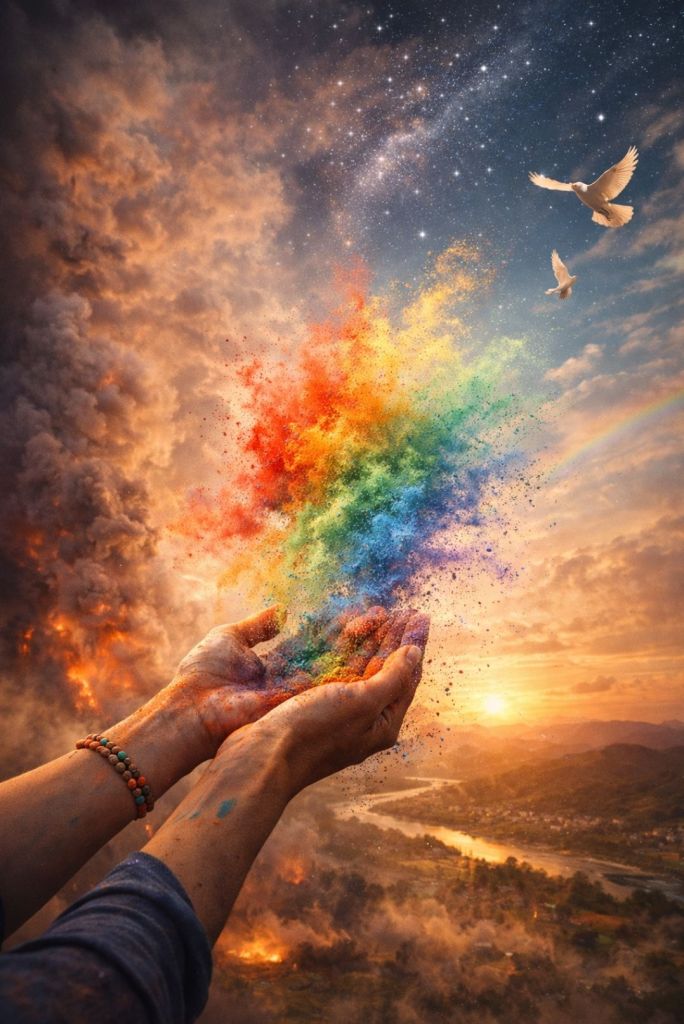
There is not much left.
Just a faint tint
clinging to skin.
I press my hand
against my heart.
The colour transfers
invisibly.
Perhaps this
is where it must begin —
not in the sky,
not in the street,
but in the quiet chamber
where intention is born.
While some skies burn,
let us still throw colours into the wind.
Let us choose love.
Let us choose peace.
And let the universe,
vast and listening,
feel the shift —
a subtle recalibration
of human gravity,
away from flame,
toward light.

 Poetry Hub
Hello. Thanks for visiting. I’d love to hear your thoughts! What resonated with you in this piece? Drop a comment below and let’s start a conversation.