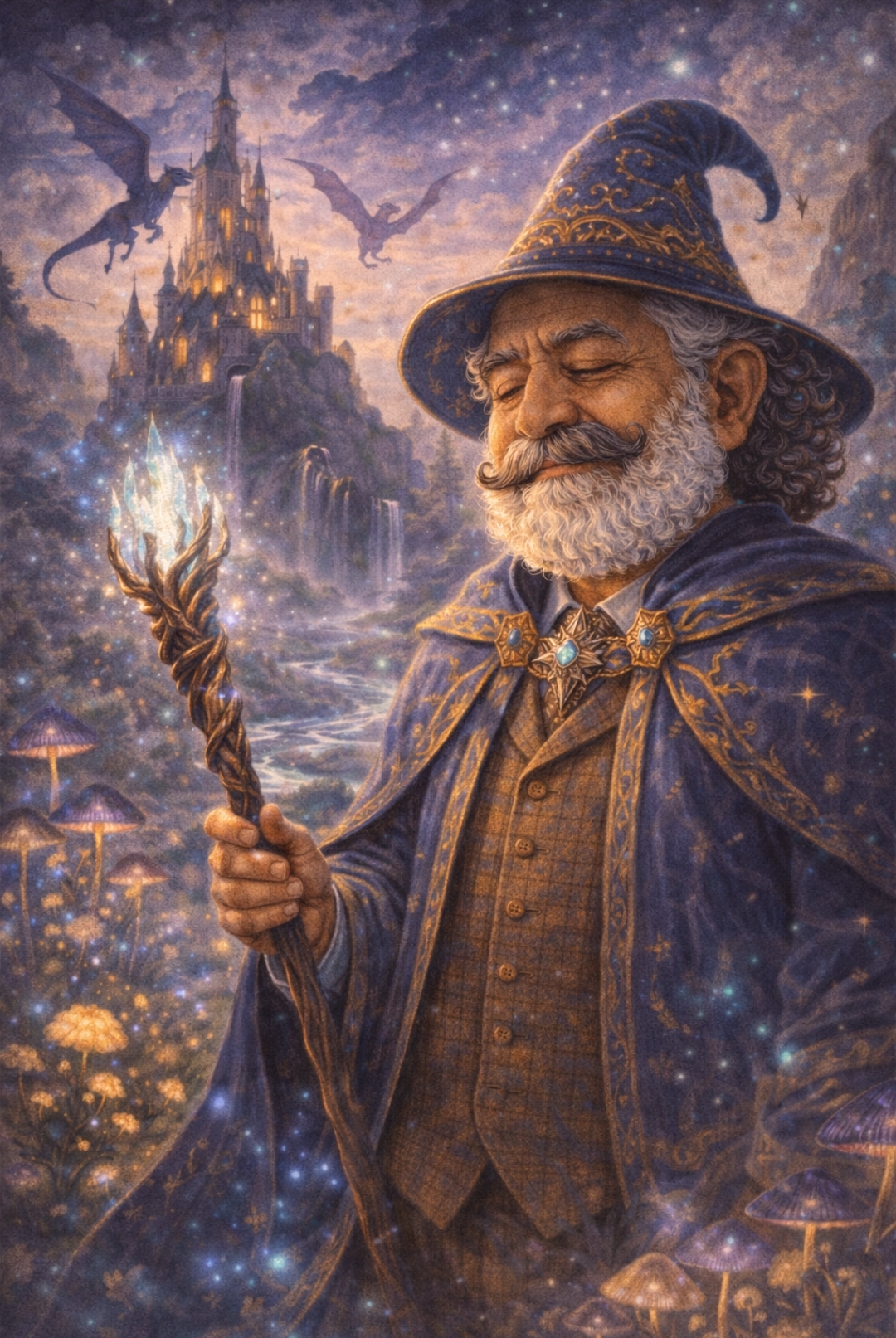
There is a particular silence that accompanies the opening of a fantasy story. It is the silence before the world expands.
A page turns, and suddenly the familiar ground of ordinary life gives way to distant mountains, ancient forests, forgotten kingdoms, and roads that vanish into mist. Dragons may circle the sky. Magic may stir in hidden places. Travelers may leave their homes carrying little more than courage and uncertainty.
Yet beneath all these wonders, something quieter begins to unfold.
We begin to recognize ourselves.
Fantasy worlds, for all their enchantment and spectacle, are rarely about escape from reality. They are about returning to reality in a different language. They are landscapes of the moral imagination — places where the ethical struggles of human life appear in vivid symbolic form.
In the ordinary world, moral choices are rarely clear. They arrive quietly, wrapped in circumstance, compromise, and uncertainty. Motives blur together. Consequences unfold slowly. Even our own intentions remain partly hidden from us.
Reality does not announce its moral drama with trumpets.
But fantasy does something remarkable. It illuminates the moral landscape. It brings invisible forces into view.
Darkness may take the form of a tyrant spreading shadow across the land. Temptation may appear as an enchanted ring whispering promises of power. Courage may belong not to a king but to a traveler who never intended to change the fate of the world.
Through symbols, fantasy allows us to see what everyday life often conceals.
The mountains, forests, and distant realms of these stories are not merely imaginative settings. They are reflections of inner terrain — the landscapes through which every human being must travel.
A dark forest represents the uncertainty of difficult choices.
A long road represents the slow passage toward maturity.
A hidden kingdom represents hope waiting to be rediscovered.
These worlds feel strangely familiar because they are built from the architecture of human experience.
One of the most enduring features of fantasy storytelling is its choice of hero. Unlike the heroes of epic conquest or political power, fantasy often places the fate of the world in the hands of someone ordinary.
A farmer’s child.
A wandering apprentice.
A quiet dreamer who never asked for responsibility.
At first glance, this seems improbable. Why should the destiny of kingdoms depend upon someone so small?
Yet the moral imagination of fantasy recognizes something profound about human life: moral courage rarely begins in positions of power.
Power often belongs to those who seek it. But courage often belongs to those who simply refuse to turn away.
The ordinary hero of fantasy stories embodies this quiet strength. They do not possess overwhelming power. They possess something more difficult — the willingness to act when fear would be easier.
Their journey begins not with confidence but with hesitation. They step forward uncertainly, guided by loyalty, friendship, or a sense that something precious must be protected.
In this way, fantasy tells a truth that history repeatedly confirms: great changes often begin with small acts of integrity.
The moral weight of these stories does not lie in battles alone. It lies in the choices characters make along the way.
Equally powerful within fantasy narratives is the theme of temptation. Again and again, these worlds introduce objects of immense power — rings, crowns, spells, relics that promise mastery over others or control over destiny.
At first, these artifacts appear helpful. They offer solutions to impossible problems. They promise protection, victory, even justice.
But slowly, something shifts.
The object begins to shape the person who holds it.
What began as a tool becomes a burden. What began as protection becomes domination. What began as hope becomes obsession.
Fantasy often dramatizes this transformation with haunting clarity. Characters who begin with noble intentions gradually lose themselves in the pursuit of power.
The magical artifact becomes a mirror reflecting the human relationship with authority, ambition, and desire.
This theme resonates deeply because it mirrors a central dilemma of real life. The capacity to influence others — whether through knowledge, wealth, authority, or technology — always carries both possibility and danger.
Power can protect the vulnerable. It can also distort judgment and erode humility.
Fantasy externalizes this struggle so we can see it clearly. It allows us to observe the slow transformation that occurs when power replaces wisdom.
Yet even in the presence of such dangers, fantasy rarely portrays the journey as one of isolation.
Companionship appears again and again as a crucial force within these stories.
Rarely does the hero walk alone.
There are friends who offer courage when despair grows heavy. There are guides who provide wisdom when the path becomes uncertain. There are companions whose humor lightens the darkest moments.
Together they form something larger than themselves — a fellowship.
This fellowship reflects a quiet truth about human moral life. Courage becomes stronger when shared.
When individuals stand together, the weight of responsibility becomes lighter. Fear diminishes. Hope becomes possible again.
Friendship becomes a moral force.
The presence of companionship in fantasy stories reminds us that ethical life is rarely a solitary endeavor. We learn courage through example. We sustain hope through community. We rediscover purpose through the trust of others.
The journey becomes not only a path across landscapes but a bond between travelers.
And the journey itself is rarely easy.
Fantasy quests lead through hardship. Travelers cross desolate lands. They endure betrayal, loss, and moments when the road ahead seems impossible.
These trials are not merely obstacles placed for dramatic effect. They serve a deeper purpose.
They transform the traveler.
The person who sets out from home is rarely the same person who returns. Experience reshapes them. Their understanding of courage deepens. Their awareness of sacrifice becomes more real.
The external journey mirrors an internal awakening.
This pattern reflects a truth about human existence itself. Life unfolds through a series of crossings — moments where familiar ground disappears and uncertainty replaces it.
We leave childhood behind. We confront responsibility. We encounter loss. We discover resilience we did not know we possessed.
Fantasy narratives translate these experiences into symbolic form.
The dragon guarding treasure becomes the fear guarding growth.
The long road becomes the passage toward wisdom.
The distant mountain becomes the challenge that calls forth courage.
These symbols resonate because they describe something universal.
Perhaps this explains why fantasy continues to captivate readers across generations and cultures. Beneath the enchantment lies something ancient and deeply human.
Long before novels and modern storytelling emerged, myths and legends served similar purposes. They used narrative and symbol to explore moral questions that could not easily be answered through argument alone.
What is courage?
What corrupts power?
What does loyalty require?
Fantasy literature continues this ancient tradition. It does not present moral philosophy as abstract theory. It presents it as lived experience within imagined worlds.
Readers encounter ethical dilemmas through characters who must choose — sometimes wisely, sometimes tragically.
Through these stories we are invited to reflect on our own choices.
And perhaps this is the deepest function of the moral imagination.
Imagination allows us to explore possibilities before we encounter them in reality. It allows us to test values, examine temptations, and consider consequences within the safe distance of narrative.
Stories become laboratories of the soul.
Within their pages we rehearse decisions. We witness courage and failure. We rediscover the quiet importance of integrity.
Fantasy does something else as well — something subtle but powerful.
It restores wonder to the moral life.
In modern society, ethics often appears as a system of rules, regulations, and procedures. Moral language becomes technical, administrative, and impersonal.
Fantasy returns morality to the realm of story.
It reminds us that ethical choices shape the fate of worlds — even if those worlds are small and private.
A single act of compassion may not save a kingdom. But it may alter the course of a life. A moment of honesty may not defeat darkness across the land. But it may preserve dignity where it matters most.
These are quiet victories.
Fantasy reminds us that the fate of great realms often turns upon such moments.
In the end, the landscapes of fantasy are not separate from the landscapes of human life. They are reflections seen through the mirror of imagination.
The dragons we face may not breathe fire.
The roads we walk may not appear on ancient maps.
The crowns we resist may not glitter with jewels.
Yet the moral journey remains the same.

Each day offers its own crossroads. Each decision reveals something about who we are becoming.
And perhaps that is why these stories continue to call to us across generations.
Somewhere beyond the mountains of imagination, we recognize the quiet truth they carry.
The greatest magic of fantasy is not found in spells or enchanted swords.
It is found in the reminder that even the smallest traveler can carry light into dark places — and that the journey toward courage begins, as it always has, with a single step onto the road.

Leave a Reply