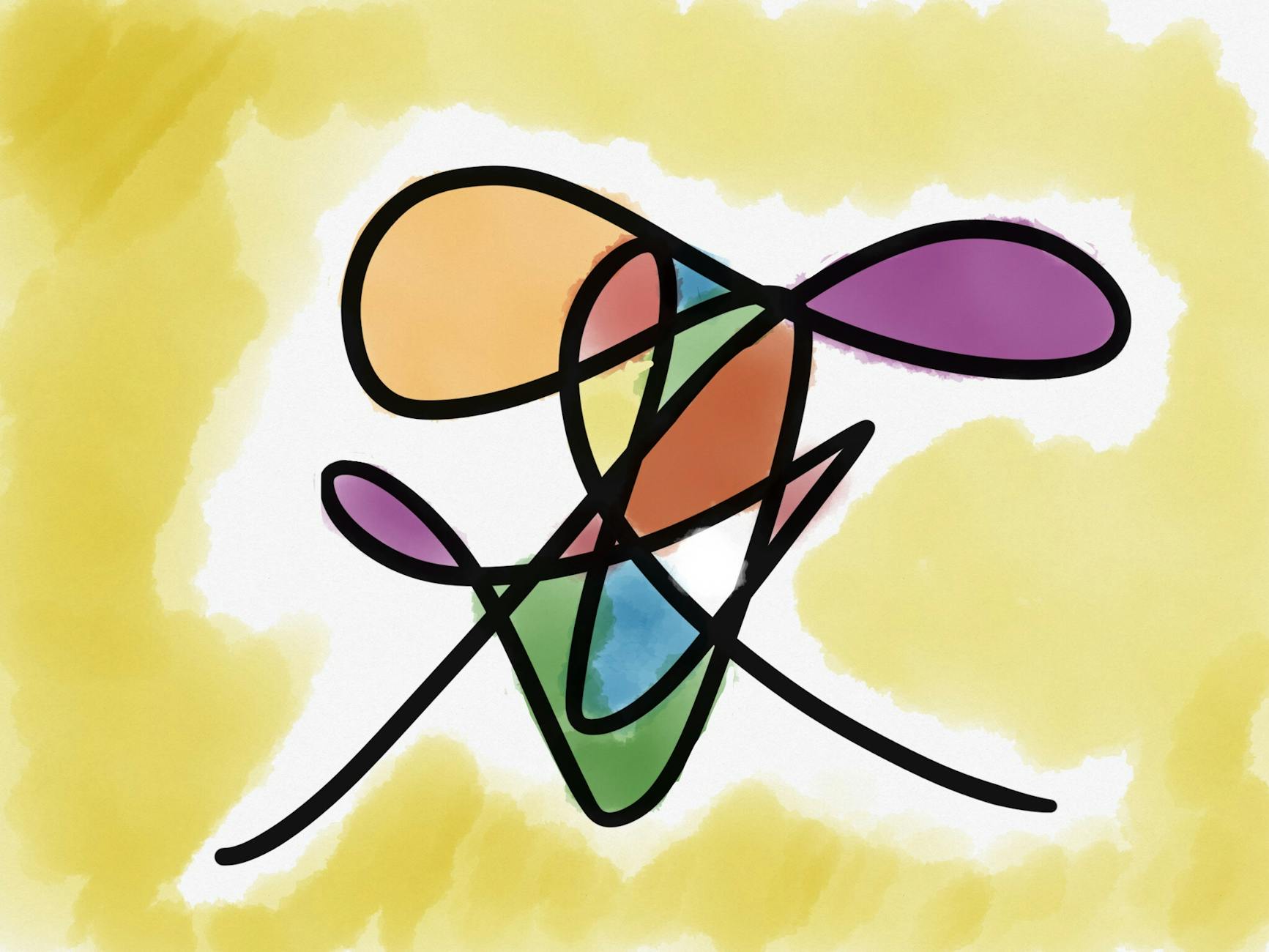
I read youAbsorbed…
in extraordinary silence,...
There are dimensions of human experience that resist articulation—not because they are obscure, but because they precede the very structures that make articulation possible. Language, with all its precision, depends on separation: a speaker, a subject, a boundary to define and describe. Yet there exist encounters where such divisions fail to fully materialize, where perception does not organize itself into discrete entities, but remains continuous, unsegmented, and fundamentally shared.
The following piece explores that condition—not as narrative, but as inquiry. It attempts to approach a space where identity softens and relation becomes primary. What unfolds is not a story of connection, but a meditation on the possibility that separation itself may be provisional.
No origin precedes
what appears here.
Not because origin is absent,
but because sequence
has not yet imposed itself
upon perception.
What is encountered
is not an event,
but a field—
a continuous manifold
in which differentiation
has not fully crystallized.
Within this field,
the assumption of separateness
remains unverified.
Forms arise,
yet do not insist on independence.
Edges suggest themselves,
yet do not stabilize.
This is not ambiguity.
It is pre-division.
A state prior
to the architecture of distinction.
Phenomenology would suspend judgment here—
perform its reduction,
its careful bracketing
of all that claims certainty.
What remains, then,
is not object,
not subject,
but appearing itself:
pure givenness
before interpretation intervenes.
And in this givenness,
something unusual becomes evident—
perception does not belong
to a perceiver.
It unfolds.
Not from a center,
but as a distributed coherence
across the field.
Light behaves similarly.
Not as particle alone,
nor wave alone,
but as probability—
a gesture toward form
without commitment.
So too here:
what appears
does not resolve
into discrete entities,
but hovers
in a state of mutual implication.
Each contour
is defined
only through the absence
of final definition.
In classical geometry,
a point has no dimension—
no length,
no width,
no depth—
and yet
entire systems depend upon it.
So too
with this condition:
no fixed identity
can be located,
and yet
everything that arises
seems to depend upon
this absence.
Non-duality articulates it differently.
It does not argue.
It dissolves.
The distinction
between observer and observed
is not bridged—
it is seen
to have never held.
There is no merging here.
No union.
Union implies two.
Instead,
there is only
non-separation—
a prior indivisibility
misperceived
as multiplicity.
Like a prism
mistaking its refractions
for separate light.
Entropy,
in its quiet insistence,
reveals a parallel truth.
Systems tend toward dispersion,
toward equilibrium,
toward the flattening
of gradients.
Distinctions dissolve
not through force,
but through inevitability.
What appears ordered
is temporary.
What appears separate
is provisional.
Given sufficient unfolding,
all boundaries
return to continuity.
And yet,
this is not collapse.
It is not loss.
It is reversion
to what required no construction.
Existential thought
would resist this ease.
It would ask:
If no fixed self can be located,
what then bears responsibility?
What chooses?
What suffers?
What acts?
But even these questions
presume stability—
a center from which inquiry proceeds.
Remove the center,
and the questions
lose their axis.
They do not resolve.
They dissipate.
Within this field,
action still occurs.
Movement persists.
Decisions seem to arise.
But their origin
cannot be isolated.
They emerge
as weather emerges—
from conditions,
not from authorship.
The body—
if it must be invoked—
is not an object contained in space.
It is a locus of sensation,
a convergence point
where the field
folds inward
and becomes locally intense.
The body does not perceive the world—
it is the world
in a particular configuration
of awareness.
Thus,
what is encountered here
is not relation
between two presences,
but the recognition
that relation itself
is fundamental.
Not something that occurs
between entities,
but something from which
the idea of entity
is abstracted.
This is the quiet paradox:
distinction appears real
only when unexamined.
Attention,
when refined beyond habit,
reveals continuity.
Not conceptually,
but directly—
as one might notice
that a horizon
never truly separates sky from earth.
Time, too,
loses its rigidity.
Without a stable observer,
sequence cannot anchor itself.
Moments do not pass—
they refract.
They layer
without hierarchy.
The present
does not move forward.
It deepens.
Memory, then,
cannot function as before.
It depends on distance—
on a past
that can be revisited.
But here,
distance has thinned.
What remains
is not recollection,
but imprint—
a structural alteration
in how the field
organizes itself
thereafter.
In astrophysical terms,
a pebble dropped
into a still body of water
generates ripples
that propagate outward.
But scale that metaphor
beyond containment—
imagine a galaxy
as that surface,
each disturbance
not localized,
but diffused
across vast coherence.
A field would not register impact
as event,
but as subtle redistribution—
a recalibration
of relational geometry.
So too
with this condition.
Nothing dramatic occurs.
No rupture.
No declaration.
Only a quiet
but irreversible
shift
in the curvature
of awareness.
Language approaches this
and withdraws.
Not out of inadequacy alone,
but out of recognition:
to define
is to divide.
To describe
is to impose edge.
And edge, here,
cannot sustain itself.
Silence, then,
is not absence of speech.
It is the medium
in which undividedness
remains perceptible.
Not empty—
but dense
with unarticulated coherence.
This is where the poem resides.
Not as narrative.
Not as expression.
But as residue—
a trace of encounter
that cannot be reconstructed,
only indicated.
No conclusion follows.
Closure would require
a return to separation—
a reinstatement
of observer and observed,
cause and effect,
before and after.
But what has been seen
cannot be unseen:
distinction
is functional,
not fundamental.
And so,
the field remains—
not waiting,
not changing,
not fixed—
only continuously
present
as the condition
within which
all apparent divisions
briefly appear,
and quietly
fail.

What this piece ultimately gestures toward is not a resolution, but a reorientation. It suggests that many of the distinctions taken as foundational—self and other, subject and object, inside and outside—may function more as tools of navigation than as reflections of underlying reality. When examined closely, these divisions begin to loosen, revealing a continuity that was never absent, only overlooked.
In practical terms, this does not negate individuality or lived experience, but reframes them within a broader field of relation. It invites a quieter mode of attention—one less concerned with defining and more attuned to perceiving. In that shift, understanding is no longer something constructed through effort, but something that emerges naturally when the need for separation begins to fall away.

Leave a Reply