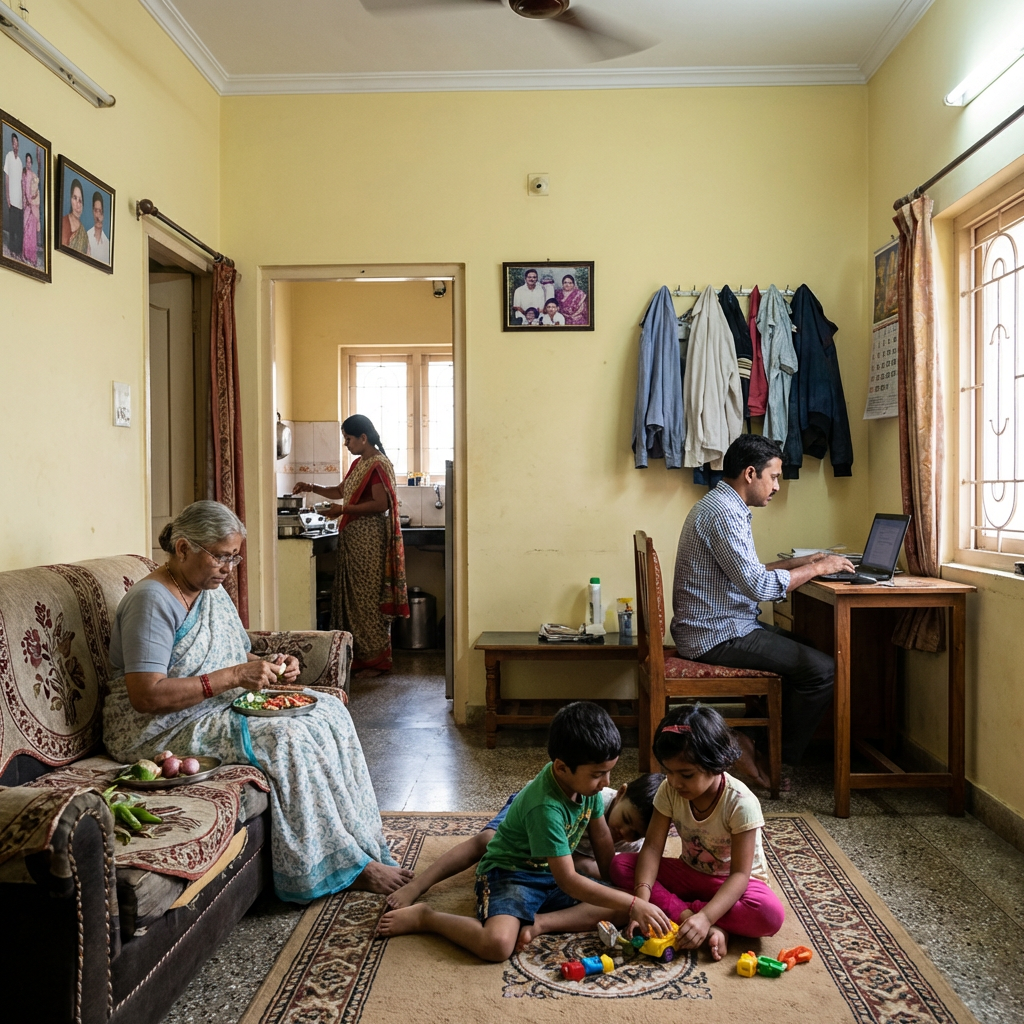
A Morning That Looks Ordinary
The pressure cooker hissed in the kitchen. Steam rose and fogged the small window. Sita lowered the flame and wiped her hands on her saree.
At the table, Rohan scrolled through his phone. His headphones blocked out the room. Still, his posture gave him away. His shoulders felt tight. His eyes looked tired.
Outside, the sky darkened with slow monsoon clouds. Inside, nothing unusual seemed to happen. Yet, everything important already had.
This is how it begins.
Being settled in India means living inside such ordinary moments. No one announces their meaning. Still, they carry weight.
A Pattern Across Homes
Now step outside this house. The same scene repeats in different forms.
In Mumbai, a father checks his son’s return time.
In Jaipur, a grandmother watches who calls on the landline.
Similarly, in Kolkata, neighbors notice who visits and when.
These details seem small. However, together they form a pattern.
Being settled in India means staying connected to a network. This network does not switch off. It observes, supports, and sometimes interferes.
Moreover, stability here is not just financial. It is relational. It depends on continuity. And, it grows through familiarity.
People know your past. They anticipate your future. And they rarely remain neutral.
The System Beneath the Surface
This pattern does not appear randomly. It grows from a system.
Families act as the primary unit. Society reinforces their structure. Economics strengthens their influence.
Parents do not just think about careers. They think about alignment.
They consider reputation, marriage prospects, and long-term security.
As a result, choices rarely stay individual. They pass through multiple filters.
Even when someone earns well, expectations remain. Financial independence does not erase emotional dependence.
Therefore, being settled in India often means fitting into a larger design. It is not imposed loudly. It works quietly, through repetition.
The Inner Weight
This system shapes the mind early.
Rohan feels it but cannot name it. He wants freedom. Yet, he senses limits. Not rules, but presence.
At the same time, Sita carries her own tension. She measures herself constantly. She asks silent questions.
Has she guided him enough?
Has she protected him too much?
Neither speaks these thoughts. Still, both feel them.
In this way, emotional life becomes layered. Care and control merge. Affection and expectation overlap.
Living settled in India means carrying these overlaps daily.
One Evening, Nothing Happens
That evening, rain arrived suddenly. It hit the balcony roof in sharp bursts.
Rohan entered, drenched. He dropped his bag near the door.
Sita looked up. She paused for a second. Then she asked,
“Where were you?”
“Library,” he said.
She watched him closely. “Alone?”
“Yes.” A slight delay. Almost invisible.
She nodded. Then she turned back to the kitchen.
That was all. No argument. No lecture.
Yet, something stayed in the room.
Rohan stood still for a moment. He understood the question behind the question. He also understood her silence.
This is how accountability works here. It does not need volume.
A Quiet Realization
Slowly, a realization forms. It does not arrive as clarity. It settles as awareness.
Being settled in India means living within relationships that do not loosen easily.
These relationships protect. At the same time, they restrict.
They create identity. They also shape decisions.
Freedom exists, but not in isolation. It moves within boundaries. Sometimes gently. Sometimes with friction.
This balance does not resolve. It continues.
The Rhythm Outside
A few days later, Rohan walked through his neighborhood.
The chai seller greeted him without asking his name.
An old man fed stray dogs near the corner.
Children ran home as mothers called from balconies.
Everything moved in rhythm.
Here, private life blends into public space. Everyone participates, knowingly or not.
Being settled in India means becoming part of this rhythm. One cannot fully step out of it.
Even silence becomes visible here.

Night Without Conclusion
That night, rain returned. It tapped steadily against the windows.
Sita sat quietly near the balcony. The house smelled of wet soil and incense.
She thought about the day. Not in detail, but in fragments. Small moments, small pauses.
Rohan stayed in his room. His music played softly.
Nothing dramatic happened. Nothing changed visibly.
Yet, something continued beneath everything.
Being settled in India means holding this continuity. It does not demand attention. It simply remains.
And in that quiet persistence, life moves forward. Not resolved. Not explained. Just lived.
REFLECT FOR A MOMENT:
- When does care begin to feel like control in everyday life?
- How much of your identity comes from silent expectations?
- Can belonging exist without observation?
This post is a part of Blogchatter A2Z Challenge 2026.

Leave a Reply