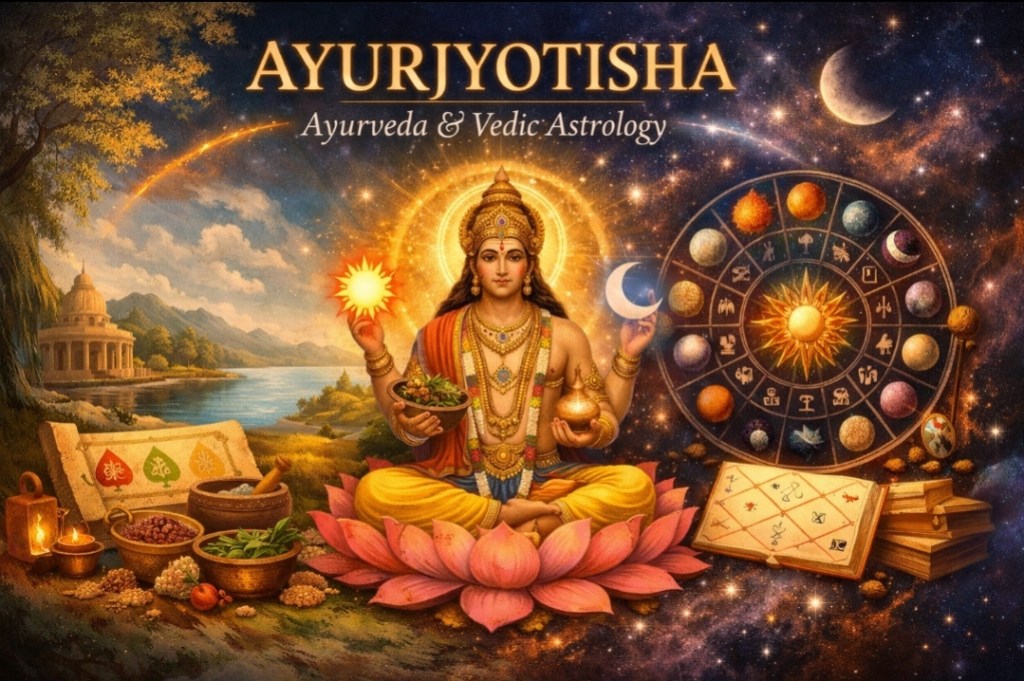
Ayurveda and Vedic astrology (Jyotisha) form an inseparable duo in ancient Indian wisdom, creating Ayurjyotisha—a holistic system where planetary influences guide health, healing, and longevity.
Beginner Foundations: Understanding the Basics
What is Ayurveda?
Ayurveda, meaning science of life, originated over 5,000 years ago in the Vedic era. It posits health as equilibrium among three doshas:
- Vata (movement, air–ether)
- Pitta (transformation, fire–water)
- Kapha (cohesion, earth–water)
Imbalances cause disease and are addressed via diet, herbs, yoga, and lifestyle regulation. Beginners often assess Prakriti (constitution) through simple indicators. For example, dry skin and anxiety suggest Vata dominance.
Introducing Jyotisha (Vedic Astrology)
Jyotisha, or science of light, uses a birth chart (Janma Kundali) to map cosmic energies influencing human life. Unlike Western astrology’s tropical zodiac, Vedic astrology uses sidereal positions and includes:
- 12 Rashis (zodiac signs)
- 12 Bhavas (houses)
- 27 Nakshatras (lunar mansions)
- 9 Grahas (planets and luminaries): Surya (Sun), Chandra (Moon), Mangala (Mars), Budha (Mercury), Guru (Jupiter), Shukra (Venus), Shani (Saturn), Rahu, and Ketu
Grahas influence health and destiny through placements, aspects (Drishti), and planetary periods (Dashas).
The Interconnection: Why Ayurveda Needs Astrology
Classical Ayurvedic texts classify disease causes into improper usage, trauma, time, and fate (Daiva). Planetary influences fall under Daiva, explaining why identical diets or treatments yield different outcomes in different individuals. Planetary positions at birth indicate inherent doshic vulnerabilities. For beginners, a simple rule applies: the Sun governs vitality and Pitta. A weak Sun often correlates with low energy and immunity.
Beginner Quiz: Your Dosha–Graha Profile
- High creativity and irregular sleep patterns often indicate Vata–Saturn influence.
- Fiery temper or acidity suggests Pitta–Mars or Sun dominance.
- Weight gain and lethargy point toward Kapha–Moon or Venus influence.
This cosmic lens personalizes wellness and helps avoid one-size-fits-all health advice.
Intermediate Principles: Building the Bridge
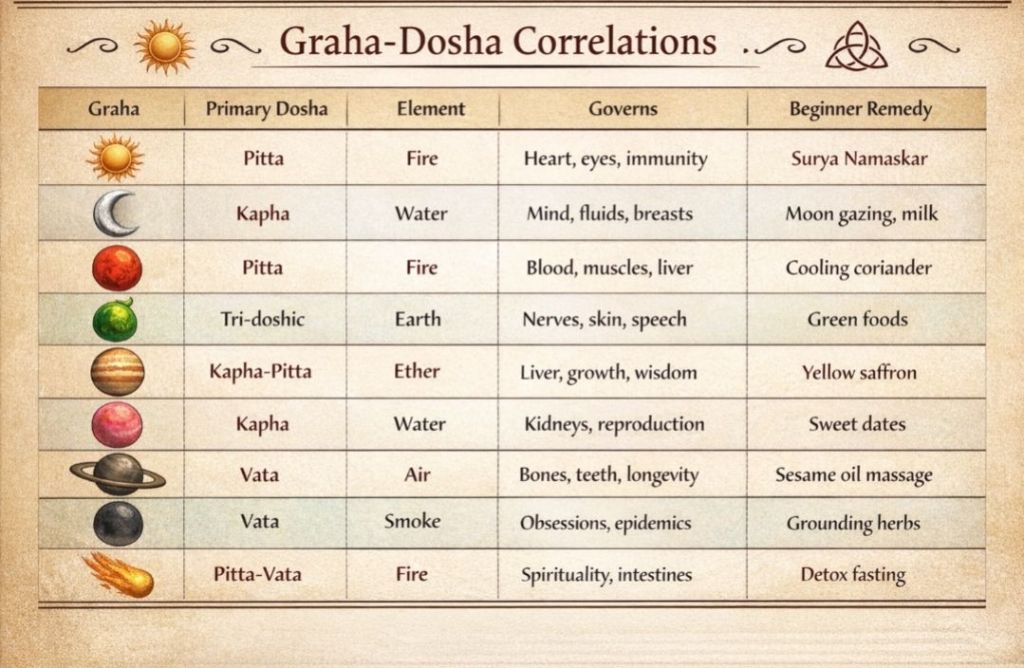
Graha–Dosha Correlations
Each Graha corresponds to specific doshas, elements, and body systems, enabling predictive and preventive health mapping. Graha sequence is – Sun, Moon, Mars, Mercury, Jupiter, Venus, Saturn, Rahu, Ketu.
Reading a Basic Birth Chart for Health
- Lagna (Ascendant): Indicates body type. Aries Lagna amplifies Pitta and Mars energy.
- Sixth House: Represents disease and obstacles. Malefic planets here suggest chronic conditions.
- Moon Sign and Nakshatra: Reveal mental and emotional health patterns.
- Current Dasha: Planetary periods activate specific doshic tendencies.
Example: Moon in Scorpio with Saturn’s aspect often produces emotional intensity and migraine tendencies linked to Pitta–Kapha imbalance.
Disease Prognosis (Ayu Pariksha)
Ayurveda evaluates longevity through multiple factors. Jyotisha refines this using planetary strength (Graha Bala). A strong eighth-house lord supported by Jupiter indicates recovery potential, while severe Saturn afflictions may signal chronicity.
Advanced Diagnostics: Precision Mapping
Nakshatra-Based Therapeutics
Nakshatras offer refined insight through their ruling deities, planets, and associated herbs:
- Ashwini: Rapid healing; Ashwagandha for Vata trauma
- Bharani: Transformation; Licorice for Pitta detoxification
- Rohini: Growth and nourishment; Shatavari for Kapha fertility
Pada (quarter) analysis further sharpens diagnosis. For instance, Rohini Pada two emphasizes emotional stability and Kapha balance.
Divisional Charts (Varga) for Health
- D6 (Shashtamsha): Specific diseases
- D30 (Trimsamsha): Chronic misfortunes and doshic afflictions
- D60 (Shashtyamsa): Karmic roots of Prakriti
Cross-referencing charts enables precise clinical insight.
Gochara (Transits) and Ashtakavarga
Transits reveal timing of illness flare-ups. Saturn transiting the Moon (Sade Sati) typically aggravates Vata-related disorders. Ashtakavarga scoring further quantifies disease severity.
Case Study: Chronic Fatigue
- Virgo Lagna with Saturn Dasha
- Low Sun strength in the first house
- Diagnosis: Vata–Pitta depletion
- Intervention: Abhyanga and solar strengthening remedies
Clinical Integration: Therapeutic Applications
Muhurta Shastra for Treatments
Treatment timing enhances outcomes. Panchakarma performed on Jupiter-dominant days supports Kapha–Pitta balance, while procedures during Rahu periods are avoided for mental therapies.
Daiva Vyapasraya Chikitsa (Astrological Therapies)
- Mantra Therapy: Gayatri mantra for Sun-related vitality
- Gem Therapy: Tested gemstones aligned with Graha afflictions
- Herbal Therapy: Planet-specific medicinal plants
- Ritual and Charity: Donations aligned with planetary days
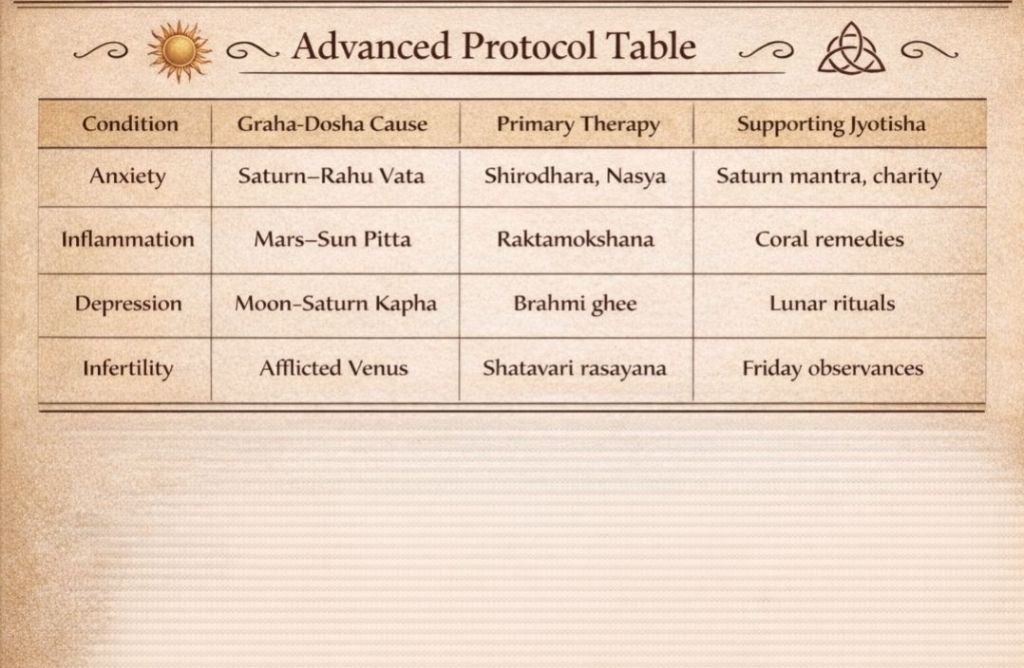
Advanced Protocol Table
Pulse Diagnosis with Jyotisha
Advanced practitioners correlate pulse patterns with planetary periods. A snake-like Vata pulse during Rahu periods confirms nervous system imbalance.
Case Study: Rheumatoid Arthritis
- Capricorn Lagna with Rahu in the sixth house
- Peak Sade Sati phase
- Treatment: Basti therapy, Saturn remedies, and dietary grounding
- Outcome: Significant relief within six months
Expert-Level Synthesis: Karmic and Predictive Models
Panchakosha and Graha Integration
The five sheaths of existence align with planetary influences:
- Annamaya: Saturn and Lagna
- Pranamaya: Sun and Mars
- Manomaya: Moon and Mercury
- Vijnanamaya: Jupiter
- Anandamaya: Ketu and Venus
Vimshottari Dasha Forecasting
The 120-year planetary cycle helps anticipate health phases. Benefic sub-periods offer healing windows, while malefic periods call for preventive care.
Graha Drishti in Depth
- Mars aspects indicate surgical tendencies
- Jupiter aspects protect and heal
- Saturn aspects delay and test endurance
Modern Evidence, Critiques, and 2026 Trends
Scientific research increasingly supports Ayurvedic constitutional theory and time-based interventions. Epigenetics validates Prakriti concepts, while clinical observations suggest improved outcomes when treatments align with biological rhythms. Critics highlight the need for more longitudinal studies linking planetary cycles to health, encouraging integrative research models.
2026 Outlook: AI-powered Ayurjyotisha platforms combine birth charts, wearable health data, and doshic alerts, while urban clinics integrate telemedicine with traditional diagnostics.
Practical Toolkit for Readers
Daily Ayurjyotisha Routine
- Sunrise planetary affirmation
- Weekly fast aligned with a weak Graha
- Monthly self-review of health cycles
Professional Path
- Formal Ayurvedic education with Jyotisha training
- Use of professional charting software
- Ethical practice focused on empowerment, not fear
Conclusion: Embrace the Cosmic Harmony
Ayurjyotisha unites body, mind, and cosmos into a single diagnostic and therapeutic framework. When applied with wisdom and responsibility, it becomes a powerful tool for preventive health, healing, and conscious living.

 Poetry Hub
Hello. Thanks for visiting. I’d love to hear your thoughts! What resonated with you in this piece? Drop a comment below and let’s start a conversation.