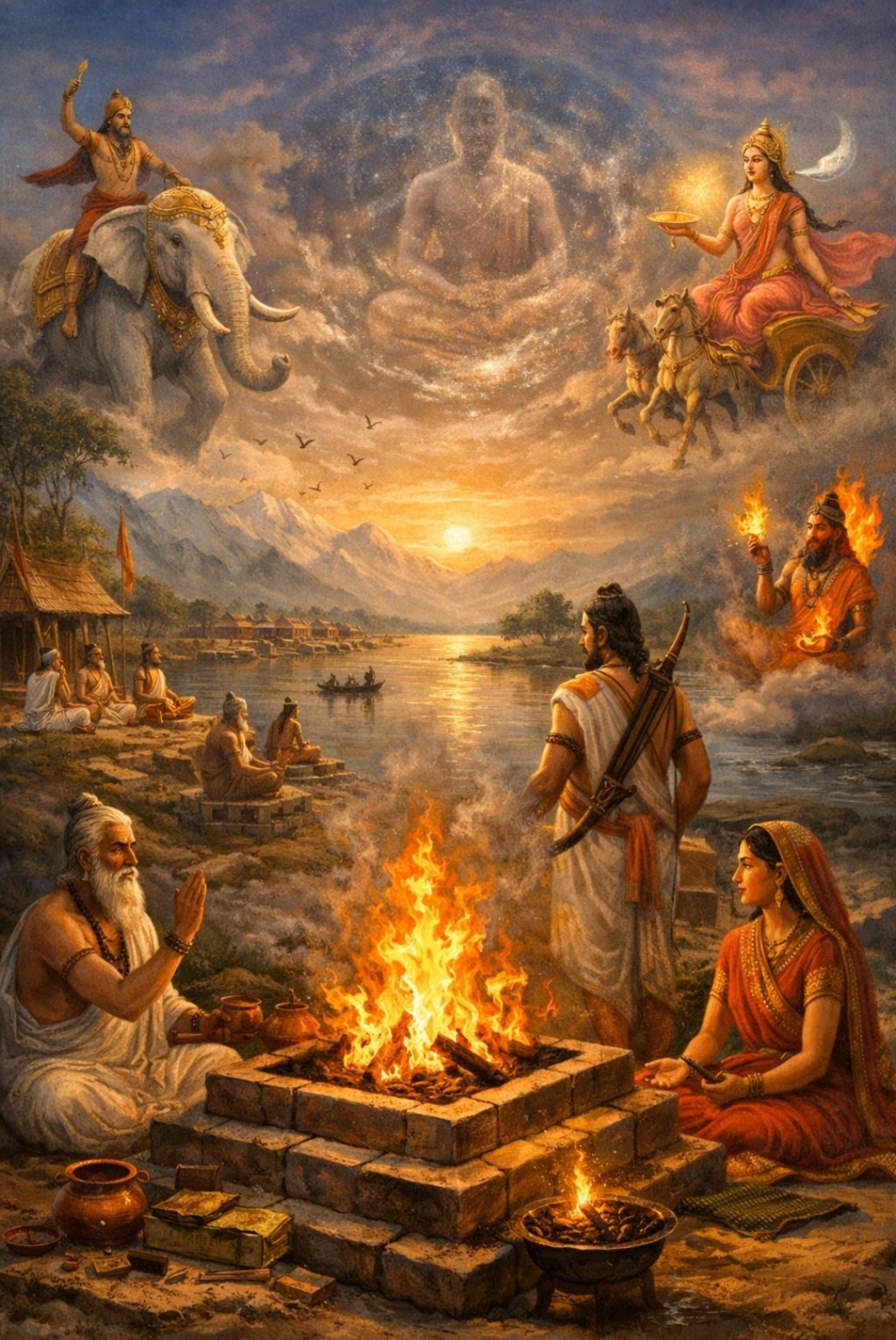
1. Why the World Before the Upanishads Matters
When modern readers encounter Indian philosophy, they often begin with the Upanishads—those profound, inward-turning texts that speak of Ātman, Brahman, and liberation through knowledge. Yet this philosophical flowering did not emerge in a vacuum. It rose from a much older soil: a world that thought not in abstractions, but in fire, sound, rhythm, offering, and cosmic reciprocity.
The era before the Upanishads—roughly the early and middle Vedic period (c. 1500–800 BCE)—was not philosophically naive. It was differently intelligent. It understood reality not as something to be escaped, but as something to be maintained. Its central concern was not liberation, but ṛta—cosmic order.
To understand this world is to understand what the Upanishads later questioned, reworked, and ultimately transcended.
2. Chronology and the Moving Map of Early Vedic Life
The earliest Vedic hymns, preserved in the Rigveda, are generally dated between 1500 and 1200 BCE, with some scholars extending this window slightly earlier or later. These hymns belong to a society still close to pastoral life, where memory, landscape, and ritual were inseparable.
Geography as Memory
- The Rigveda repeatedly names rivers—Sindhu (Indus), Sarasvatī, Vipāś (Beas), Paruṣṇī (Ravi)—indicating a cultural heartland in the Sapta-Sindhu region of north-western South Asia.
- Over centuries, Vedic culture expanded eastward, toward the Ganga–Yamuna doab, especially into the territories later known as Kuru and Pañcāla.
- This gradual movement mirrors a transition from semi-nomadic pastoralism to more settled agrarian life.
The Upanishads appear only much later—around the 7th to 5th centuries BCE—making the vast majority of the Vedic period firmly pre-Upanishadic.
3. Texts Before Philosophy: What Was Being Composed—and Why
The intellectual backbone of this era was not philosophical treatises, but liturgical literature.
The Primary Textual Layers
- Saṃhitās
- Rigveda: 1,028 hymns addressed to deities of nature, war, order, and sacrifice.
- Sāmaveda: Melodic rearrangements of Rigvedic verses for chanting.
- Yajurveda: Procedural formulas for sacrifice.
- Atharvaveda: Hymns dealing with healing, household rites, fears, and everyday anxieties.
- Brāhmaṇas
- Prose texts explaining how rituals work and why they matter.
- Here, ritual becomes a cosmic technology, capable of sustaining the universe itself.
- Āraṇyakas
- Transitional forest texts, less public and more contemplative, but still ritual-focused.
- These form the immediate bridge to the Upanishads.
Crucially, all of this knowledge was oral. Hymns were memorized with astonishing precision using sophisticated recitation systems—padapāṭha, krama-pāṭha, ghana-pāṭha—ensuring near-perfect transmission over centuries without writing.
4. Who Were the Vedic Peoples?
Most scholars associate early Vedic culture with Indo-Aryan–speaking groups who entered or spread across the subcontinent around 1800–1500 BCE. However, this was not a simple invasion, nor a cultural wipe-out.
A Composite Civilization
- These groups likely arrived as pastoralists, skilled in horse-drawn chariots and bronze metallurgy.
- They encountered existing populations—descendants of post-Harappan cultures—and gradually merged with them.
- Language, ritual, and social customs evolved through interaction, not replacement.
The Vedas themselves reflect this complexity: a world deeply rooted in local rivers and landscapes, yet carrying echoes of older Indo-European mythic patterns.
5. Society Without Empires: Politics, Power, and Assembly
Pre-Upanishadic society was not imperial. It was organized around tribes (jana) and clans, led by rājans whose authority depended on persuasion, ritual legitimacy, and success in war.
Key Features
- Political decisions were often discussed in assemblies such as sabha and samiti.
- Wealth was measured largely in cattle, not land.
- Warfare often took the form of cattle raids, not territorial conquest.
This was a world where power was negotiated, not absolute—and where ritual success could legitimize political authority.
6. Varṇa Before It Became Rigid
One of the most misunderstood aspects of early Vedic society is social hierarchy.
- In the earliest Rigvedic hymns, social distinctions are fluid, functional, and not strictly birth-based.
- The four varṇas appear explicitly only in the Puruṣa Sūkta, a late hymn in the Rigveda’s tenth mandala.
- Even there, varṇa is presented symbolically—as parts of a cosmic body—not as a legal or hereditary prison.
Rigid caste stratification is a later historical development, not an original Vedic feature.
7. Women, Voice, and Presence
Contrary to many later norms, the early Vedic world offered women significant ritual and intellectual visibility.
- Women such as Ghoṣā, Apālā, and Lopāmudrā are credited as composers of Rigvedic hymns.
- Women participated in sacrifices, debates, and household rituals.
- Practices like purdah, sati, or enforced child marriage are not evidenced in early Vedic texts.
This does not mean the society was egalitarian—but it was less restrictive than later classical norms.
8. A Religion Without Temples or Idols
Pre-Upanishadic religion was intensely ritualistic, yet strikingly aniconic.
Core Features
- No permanent temples.
- No anthropomorphic idols.
- Worship centered on fire (Agni), spoken word (mantra), and offering (havis).
The universe was maintained through yajña—a reciprocal exchange between humans and gods. When humans offered correctly, the gods sustained rain, fertility, and order.
9. The Gods as Forces, Not Figures
The Vedic gods were not distant creators, but active powers within nature.
- Indra: Storm-warrior, breaker of obstacles.
- Agni: Fire, messenger between worlds.
- Varuṇa: Guardian of cosmic law (ṛta).
- Soma: Deity and substance—intoxication, vitality, mystery.
- Uṣas: Dawn, renewal, moral awakening.
These deities were invoked, not worshipped passively. The relationship was dynamic, contractual, and deeply ethical.
10. Early Philosophy Without Philosophers
Even before the Upanishads, the Vedas ask unsettling questions.
The Nasadiya Sukta wonders:
- Did the universe arise from non-being?
- Did even the gods come after creation?
- Does anyone truly know?
This is not dogma—it is cosmic doubt. The seeds of Indian philosophical inquiry were already present, embedded in poetry rather than prose.
11. Language, Sound, and Sacred Precision
Vedic Sanskrit was not merely a medium—it was a technology of truth.
- Hymns were composed in strict metres: gāyatrī, triṣṭubh, jagatī.
- Sound itself was believed to shape reality.
- A mispronounced syllable could invalidate a ritual—or worse.
This obsession with precision later evolved into Indian traditions of grammar (Vyākaraṇa), phonetics (Śikṣā), and logic.
12. Everyday Life, Medicine, and Proto-Science
The Vedas speak of:
- Houses, clothing, ornaments, chariots.
- Diseases: skin ailments, fevers, parasites.
- Healing through herbs, chants, and ritual purity.
The Atharvaveda in particular preserves early medical thinking that later crystallized into Āyurveda—a holistic system combining observation, ritual, and theory.
13. Archaeology and the Material World
Archaeological cultures such as Painted Grey Ware settlements align broadly with later Vedic phases.
- Small rural communities.
- Fire altars resembling Vedic ritual hearths.
- No monumental architecture—suggesting ritual spaces were temporary, not monumental.
Text and artifact do not map perfectly, but together they sketch a coherent cultural horizon.
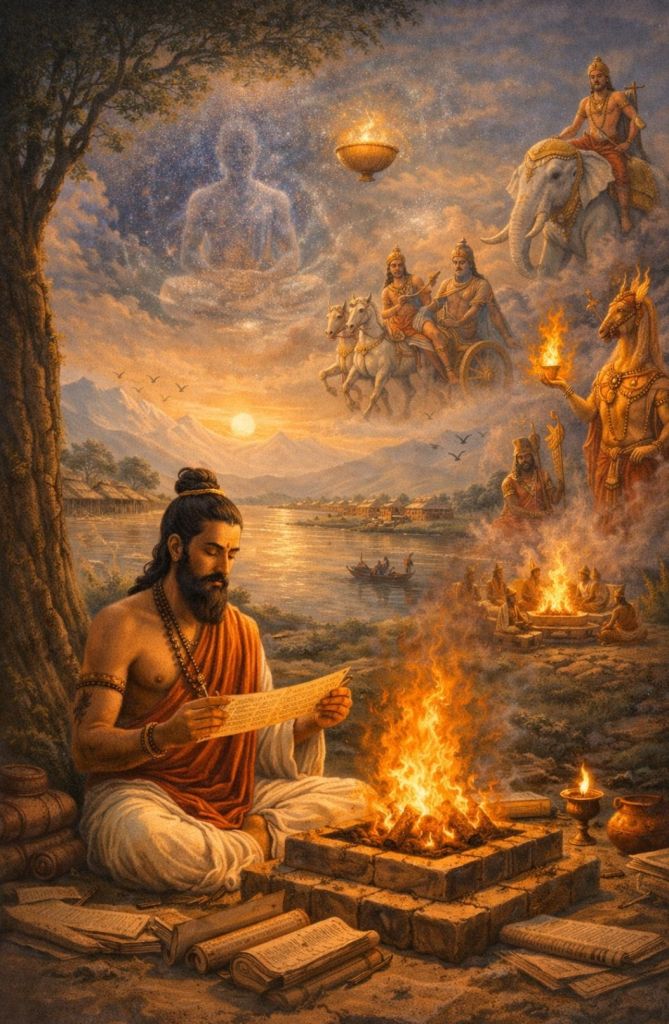
14. The Tension That Gave Birth to the Upanishads
By the late Vedic period:
- Rituals became increasingly complex and exclusive.
- The priestly class gained social dominance.
- Political units grew larger and more stratified.
This very success created spiritual fatigue.
The Upanishads emerge as a response:
- Turning sacrifice inward.
- Redefining yajña as knowledge.
- Asking whether truth lies not in fire, but in awareness.
15. Closing Reflection: A World Still Speaking
The pre-Upanishadic age was not merely a prelude. It was a complete worldview, coherent on its own terms—one that believed the universe could be sung into balance.
Before silence became sacred, sound was salvation.
Before inwardness, fire held the cosmos together.
Before philosophy, there was attention—precise, communal, and cosmic.
To listen to this world again is not to go backward.
It is to remember that thought once began outside the self, in rivers, flames, and shared breath.

 Poetry Hub
Hello. Thanks for visiting. I’d love to hear your thoughts! What resonated with you in this piece? Drop a comment below and let’s start a conversation.