There are questions
that hover over my bed at night
like slow-moving constellations,
refusing to blink out.
They do not shout.
They do not accuse.
They simply exist—
vast and unblinking—
like winter stars over a field
I once walked alone.
In the daylight
I rearrange them
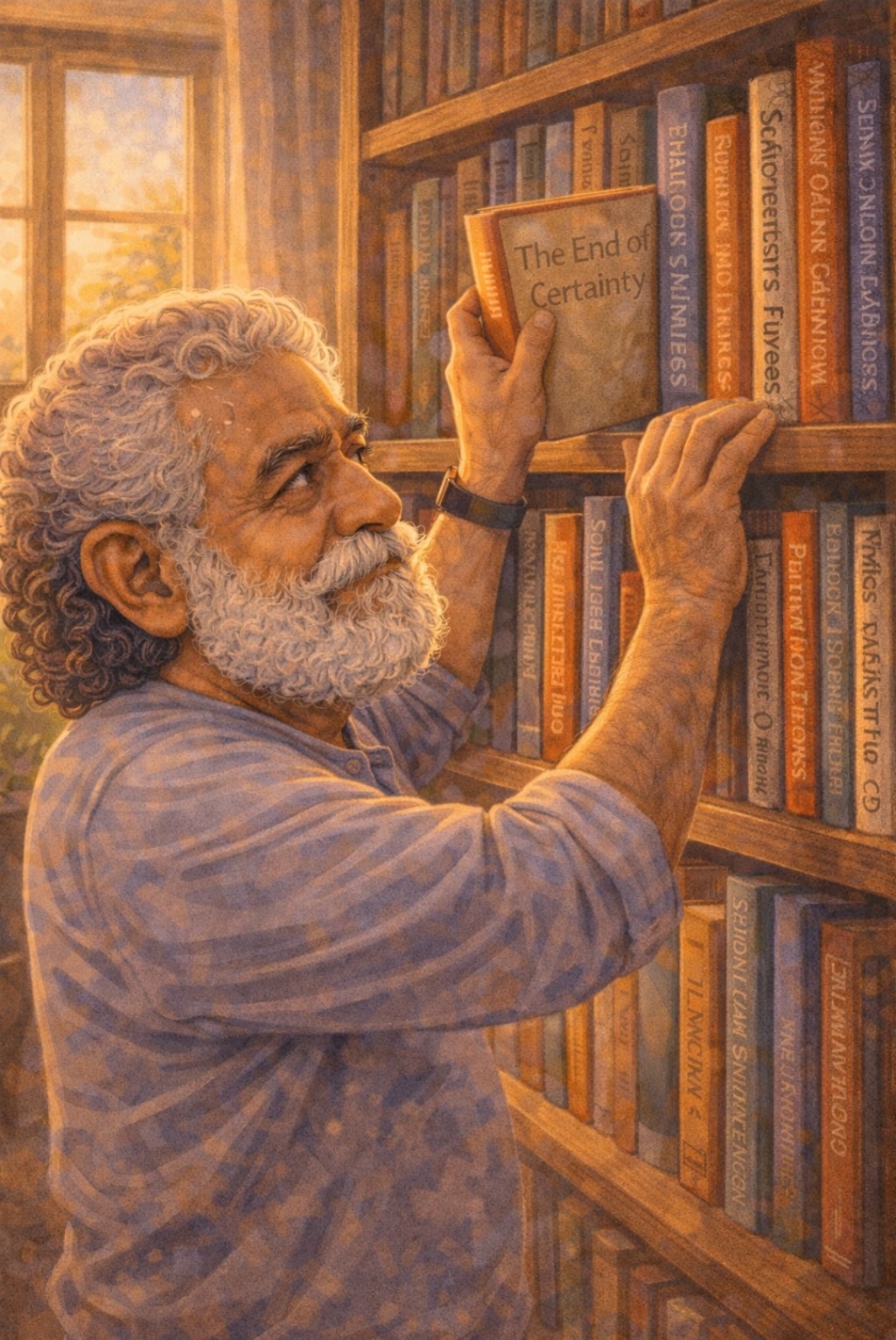
as one might rearrange books on a shelf,
spines outward,
titles visible,
pretending order is the same as understanding.
But at night
they loosen their bindings
and drift.
The first question arrives softly:
Are you living the life you once promised yourself?
It sounds harmless,
almost polite,
like a neighbor asking about the weather.
Yet it presses against my ribs
with the patience of tree roots
splitting stone.
I remember being younger,
standing barefoot on warm earth,
declaring to the sky
that I would be brave.
Brave in love.
Brave in truth.
Brave in choosing a path
even if it meant walking alone.
The sky did not answer then.
It only widened.
Now when I look up,
I feel the weight of that widening—
a silent archive of promises
filed in starlight.
Have I been brave,
or merely careful?
Have I chosen,
or simply drifted
with the tide of what was easier?
The question waits,
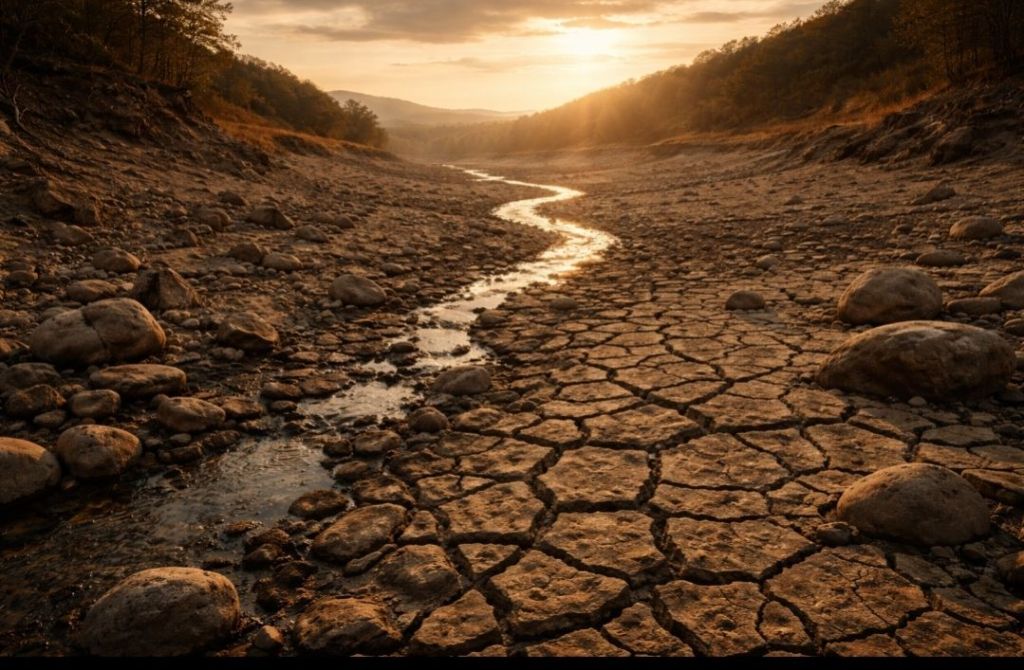
like a river in drought,
holding the memory of its own flood.
Another question comes
with the scent of rain on parched soil:
Who would you be
if no one were watching?
It follows me through crowded rooms
and into the quiet corners
of my own reflection.
I think of the moon—
how it appears whole,
radiant,
assured—
yet is scarred and pitted,
its brightness borrowed.
How much of my glow
is borrowed light?
How often do I soften my edges
so others will not cut themselves
on the truth of me?
There are versions of myself
I keep folded
like unused maps.
The map of the one
who says no
without apology.
The map of the one
who walks away
before resentment takes root.
The map of the one
who speaks the unvarnished word
even if her voice trembles
like a leaf in late autumn.
I am afraid
to unfold these maps.
Afraid the terrain will be too wild.
Afraid I will discover
I have been living
in a well-lit corner
of a much larger wilderness.
Sometimes the questions come
like a storm front.
What are you avoiding?
The sky darkens.
The wind shifts.
The air thickens with unshed rain.
I know this weather.
It gathers
whenever I postpone a conversation
that could shatter a fragile peace.
Whenever I swallow a truth
to keep the surface calm.
I tell myself
it is kindness.
But deep inside,
a tectonic plate moves.
There are fault lines
beneath my silences.
I feel them
when laughter feels too loud,
when joy arrives
with a shadow.
Avoidance is a quiet architect.
It builds walls
from unspoken words,
lays bricks of “later,”
seals windows with “maybe someday.”
From the outside,
the house looks intact.
Inside,
the air grows thin.
Another question sits beside me
like an old friend
who knows too much:
What are you still grieving?
I want to answer quickly—
nothing,
I am strong,
I have moved on.
But grief is not a season
that ends because the calendar insists.
It is more like the ocean.
You can stand on the shore
and claim the storm has passed,
but somewhere beyond the horizon
waves are still rising.
I grieve the versions of myself
I abandoned
to be acceptable.
I grieve the conversations
that ended
before they began.
I grieve the tenderness
I mistook for weakness.
And I grieve the time
I have spent
pretending not to grieve.
These sorrows are not dramatic.
They are small stones
in the pocket of my days.
I carry them without noticing
until I try to run.
There is a question
that feels like standing
at the edge of a cliff:
What if you are wrong?
Wrong about the path.
Wrong about the person.
Wrong about yourself.
The wind is fierce here.
It roars in my ears.
Certainty feels safe—
a solid railing
to grip.
But certainty can also be a cage,
a fence built around a horizon
to keep it from expanding.
To admit I might be wrong
is to loosen the grip
on the story I tell about who I am.
It is to allow the sky
to rearrange itself
without asking my permission.
This question frightens me
because it demands humility—
a kneeling
before the vastness.
And I have grown accustomed
to standing tall
in my own limited clearing.
Some nights
the questions grow cosmic.
They stretch beyond my small biography
and ask:
Why are you here?
Not in the practical sense—
not the job title
or the role I perform in other people’s lives.
But here—
in this flicker of consciousness
on a spinning sphere
suspended in a darkness
so immense
it swallows language.
I step outside sometimes
and look up.
The stars feel close
and impossibly distant
at once.
Each one
a burning answer
to a question
I cannot yet form.
I think of how light
travels for years
just to touch my eyes.
What is the light
I am sending out
into the future?
Will it reach anyone?
Will it matter?
Or am I a brief spark
in an endless night?
The fear in this question
is not insignificance.
It is responsibility.
If I am here
for even a heartbeat
in cosmic time,
what will I do
with this breath?
There are quieter questions too,
barely audible,
like the hum of insects
in tall grass:
Are you kind to yourself?
I pause here.
Because I know
how easily I forgive others.
How quickly I excuse their missteps,
their delays,
their confusion.
Yet when I stumble,
my inner voice sharpens.
It becomes a cold wind
that strips leaves
from an already tired tree.
Why do I demand
perfection
from a being
made of stardust and soil?
Why do I forget
that even galaxies
collide,
fracture,
reform?
Perhaps the question I fear most
is this:
What would change
if you loved yourself
without conditions?
It sounds almost indulgent.
Dangerous.
As if self-compassion
might erode discipline,
might soften the drive
that keeps me moving.
But what if it is the opposite?
What if love
is the gravity
that keeps my scattered pieces
in orbit?
The questions do not seek
to shame me.
I am beginning to understand this.
They are not judges
in a celestial courtroom.
They are lanterns.
Each one
illuminates a different corner
of the landscape I inhabit.
The fear arises
not because the questions are cruel,
but because they reveal.
And revelation
requires change.
If I answer honestly
that I am not living fully,
then I must live differently.
If I admit
I am avoiding truth,
then I must speak.
If I confess
I am still grieving,
then I must allow the tears
to fall
like rain on long-thirsty ground.
Answering is not passive.
It is tectonic.
It shifts continents
inside the chest.
Tonight
I sit with the questions
as one might sit
with a restless sea.
I do not try to calm it.
I let the waves rise
and fall.
I let the moon pull at the tide
of my thoughts.
I realize something subtle:
The questions I fear
are doorways.
Each one opens
into a larger room
than the one before.
At first
the room is small—
my habits,
my choices,
my wounds.
Then it expands—
to relationships,
to purpose,
to legacy.
And finally
it opens into the sky itself.
Into a silence
that is not empty
but brimming.
In that silence
I feel less like a solitary figure
interrogated by the universe
and more like a fragment
of the universe
asking itself
to awaken.
Perhaps the stars are not indifferent.
Perhaps they are mirrors.
Perhaps the questions
are the way the cosmos
leans close
and whispers:
Become.
Not perfect.
Not certain.
Not invulnerable.
Just more fully
what you already are.
I do not have all the answers.
I may never.
But I am beginning
to see that the fear
was never about the questions.
It was about the transformation
their answers would require.
And transformation
is a kind of death—
of old narratives,
old protections,
old illusions.
Yet every forest knows
that decay
feeds new growth.
Every supernova knows
that explosion
scatters the elements
for future stars.
If I am made
of that same matter,
why should I fear
my own becoming?
Tonight
I breathe in the cool dark.
The questions gather
like constellations overhead.
I do not turn away.
I let them shine.
And in their light,
I take one small step
toward answering—
not with words alone,
but with the quiet courage
of living differently
tomorrow.

 Poetry Hub
Hello. Thanks for visiting. I’d love to hear your thoughts! What resonated with you in this piece? Drop a comment below and let’s start a conversation.