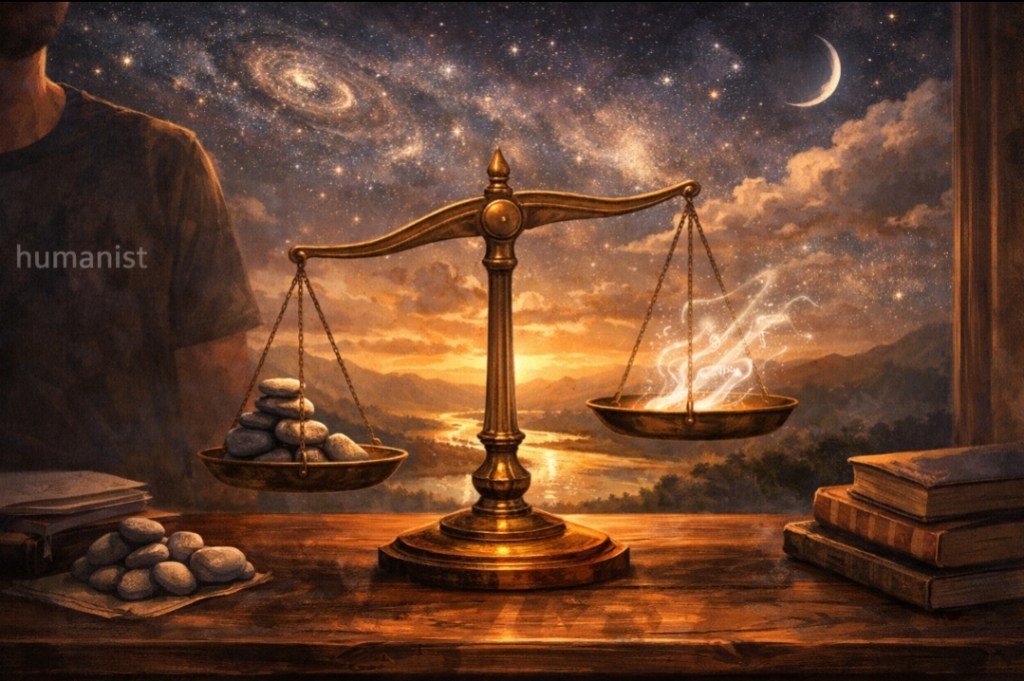

A Sijo his t-shirt reads “humanist” polished brass scales on his desk; stones of one measure stacked nearby convinced, he drops them — ping on ping; the beam tilts against all my words none bear the mark of his name Sijo? A Korean verse form related to haiku and tanka and comprised of three lines of 14-16 syllables each, […]
As inscribed, or: A certain humanism
His T-shirt reads humanist
in lowercase letters,
soft cotton stretched across a chest
that rises and falls
with the calm assurance of someone
certain the air belongs to him.
On his desk,
polished brass scales gleam
like twin suns arrested at dawn,
balanced on a spine of metal
so exact
it seems incapable of mercy.
Beside them
stones of one measure
rest in a small velvet pouch—
their surfaces smoothed by use,
their sameness a quiet doctrine.
He lifts them
one by one,
convinced of their righteousness,
and drops them —
ping on ping —
into the waiting pan.
The sound is bright, metallic,
a small bell announcing judgment.
The beam tilts
against all my words.
None bear the mark of his name.
I watch the scale tip
as if it were a horizon
sliding toward night.
My words are wind-carried seeds,
light as milkweed,
scattered across his desk.
They flutter,
uninvited,
over ledgers and laws.
He weighs them anyway.
Ping.
Ping.
Each stone is a certainty:
data, precedent, tradition,
a paragraph underlined twice
in a book that smells of authority.
I offer him rainwater cupped in my palms,
the salt of an old sorrow,
the breath of a forest at dusk.
He searches for an engraving
at the base of each syllable,
a seal pressed in wax,
a lineage stamped in ink.
None bear the mark of his name.
Outside his window
the neem tree bends in the afternoon heat.
A myna argues with the sky.
Clouds, uncredentialed,
cross the face of the sun
without asking who has measured them.
The river beyond the town
refuses a ruler.
It swells in monsoon,
shrinks in summer,
carries whole villages in its memory
and never once
submits a report.
I think of stones not of one measure—
river stones,
pocked and patient,
their edges softened
by centuries of surrender.
If he weighed those,
they would tilt his beam
in ways his brass could not predict.
His T-shirt reads humanist
as though humanity were a theorem
proved once
and for all.
But I have seen humanity
in the trembling hands
of a farmer counting seeds
before a reluctant rain.
I have seen it
in the cracked lips of a mother
whispering a story
to keep the night from entering
her child’s bones.
These moments resist calibration.
They arrive without citation.
Ping, says the scale.
Ping, replies the stone.
My words hover,
unmeasured breath
between two suns of brass.
There was a time
I too loved the certainty of balance,
the comfort of numbers aligned
like stars in a charted constellation.
I mapped my grief
onto neat coordinates,
named each ache
as if naming were taming.
But the sky does not remain
within the grid.
Orion slips westward
while we argue about his belt.
The moon alters her face
without consulting our textbooks.
In the dark fields beyond the city,
where electric light loosens its grip,
the Milky Way spills itself
like a confession.
No scale can hold it.
No beam can tilt
against its slow, luminous river.
He adjusts the weights again,
frowning at the defiance
of language.
“Evidence,” he says,
as though it were a gate
I have failed to unlock.
I want to tell him
that the earth beneath his chair
is evidence—
its molten heart
still turning with a memory of fire.
That the mountains,
once seabeds,
rose not by permission
but by pressure
from a place unseen.
That the fossils in his paperweight
are not arguments
but ancestors
curled in stone.
Instead I watch the needle quiver,
a thin line
trembling between two verdicts.
If I were braver
I would gather his brass scales
and carry them to the shore
at low tide.
I would place them
where waves breathe in and out,
where crabs sketch brief hieroglyphs
in sand
soon to be erased.
I would ask him
to weigh the horizon.
To drop his uniform stones
into the ocean’s mouth
and listen
as they vanish
without a ping.
To feel how the tide
ignores the symmetry of his desk,
how the moon commands
a gravity older than law.
But I remain here,
across from him,
hands open on the wood.
The desk smells faintly of polish
and old ambition.
The beam tilts
against all my words.
None bear the mark of his name.
And perhaps that is their freedom.
They are not branded cattle
herded into the pen of approval.
They are migratory birds
veering south
on instinct alone.
They are spores riding wind
from forest to forest,
trusting rot
to make room for bloom.
They are photons,
born in the furnace of stars,
traveling years beyond counting
to strike an unguarded eye.
His T-shirt reads humanist
but I begin to wonder
what measure of human
can be contained
between two shallow pans.
Is it the pulse?
The scar?
The forgiveness that arrives
long after logic has left the room?
I think of the desert at night,
its dunes reshaped
by invisible hands of air.
Stand there long enough
and you will hear
the sand sing—
a low, resonant hum
as grains shift
in communal surrender.
No single grain
claims authorship.
No dune signs its name.
Yet the song is unmistakably
of the earth.
The scales gleam still,
faithful to their axis.
He waits for my final argument.
I have none.
Instead I close my eyes
and feel the slow revolution
of the planet
beneath the floorboards.
I feel the tectonic patience
of continents drifting
like thoughts too large
for a single mind.
I feel the blood in my wrists
answering a lunar tug
it does not consciously know.
What mark could I offer him
that would encompass this?
What signature could hold
the weight of galaxies
unfurling in silence?
When I open my eyes,
the beam has settled
in perfect equilibrium.
His stones rest in one pan,
my words in the other—
light as breath,
heavy as night.
For a moment
nothing tilts.
We sit in that narrow stillness
where judgment hesitates,
where brass forgets its shine
and cotton its slogan.
Outside,
the neem leaves shimmer.
The myna has ceased its argument.
Clouds pass unrecorded.
In the vastness above,
stars ignite and extinguish
without applause.
I gather my unmarked words
and carry them inward,
into a sky
no desk can contain.
There,
among nebulae of doubt
and comets of sudden understanding,
I let them drift.
They find their own measure—
not in brass,
not in borrowed stones,
but in the quiet gravity
that binds breath to breath,
tide to moon,
human to the unnamed dark.
His T-shirt reads humanist.
Mine reads nothing at all.
Yet in the space between us
a universe balances
without inscription,
without verdict,
turning—
vast, patient,
and free.

 Poetry Hub
Hello. Thanks for visiting. I’d love to hear your thoughts! What resonated with you in this piece? Drop a comment below and let’s start a conversation.