Facing Down the Furies: The Personal and Cultural Struggle with Suicide
In her profound and introspective book, Edith Hall navigates the deeply entangled issues of suicide and its widespread impact through a lens that is both intensely personal and broadly academic. The broadsheet’s unusual choice to link Good Friday with the debate on physician-assisted dying underscores a persistent societal struggle to reconcile with the concept of suicide, a topic Hall explores with compassion and critical insight.
The Stigma of Suicide and Its Broader Implications
Suicide carries a significant stigma, a term loaded with historical and emotional connotations. In distinguishing between euthanasia and more impulsive suicidal actions, Hall seeks to clarify the discussion around physician-assisted dying, a subject often clouded by emotional and ethical complexities. This distinction is crucial in understanding the different societal and personal dynamics at play in the discourse on ending one’s life.
Transgenerational Trauma: A Personal and Historical Perspective
Hall’s narrative is anchored in the tragic recounting of her own family history, marked by the suicides of both her great-grandfather and grandmother. These acts left a legacy of guilt and emotional turmoil for subsequent generations, illustrating the concept of transgenerational trauma. This trauma manifests in the survivors—those family members and friends left to grapple with loss and unanswered questions, often leading to their own emotional struggles and coping mechanisms.
The Classical Insight: Greek Tragedy and the Acknowledgment of Suffering
Hall, an established scholar in classical studies, draws significant insights from Greek tragedies by Aeschylus, Sophocles, and Euripides, noting their unique focus on the aftermath of suicide and the suffering of survivors. These ancient works do not romanticize the act of suicide; instead, they confront its harsh realities and the ripple effects on those left behind. This perspective is central to Hall’s argument, emphasizing the necessity of witnessing and acknowledging pain as a step toward understanding and healing.
The Role of the Witness and the Community
In discussing the role of witness—both in her personal life and in classical tragedies—Hall identifies a powerful therapeutic element in the act of sharing and acknowledging suffering. The act of witnessing someone’s pain does not mitigate it but validates the sufferer’s experience, potentially alleviating the isolation that often accompanies intense personal distress. This recognition, Hall suggests, can transform a seemingly meaningless agony into a shared human experience, fostering a sense of connection and possible recovery.
Cultural Reactions and the Ongoing Stigma
The societal responses to suicide—anger, condemnation, and passive acceptance—reveal deeper cultural and ethical conflicts. Hall critiques these reactions, suggesting that they often stem from a lack of understanding and an unwillingness to engage with the complex realities behind the decision to end one’s life. Through her detailed family memoir, Hall not only paints a vivid picture of her family’s and Scotland’s historical and cultural landscape but also invites a more empathetic and nuanced discussion about suicide.
The Ethical and Personal Dimensions of Suicide
In “Facing Down the Furies,” Edith Hall offers a compelling examination of the ethical, personal, and societal challenges posed by suicide. By leveraging her background in classical studies and her personal experiences, Hall provides a unique perspective on the need for compassion, understanding, and communal support in addressing this painful subject. The book not only contributes to the ongoing debate on physician-assisted dying and suicide but also serves as a poignant reminder of the profound effects our choices have on others, underscoring the interconnectedness of human lives and experiences.
This intricate weaving of personal narrative with classical wisdom offers a richer, more compassionate framework for discussing and understanding one of society’s most challenging issues. As we move forward, Hall’s insights could guide more informed, sensitive conversations and policies concerning the ethics and impacts of choosing to end one’s life.
The Misunderstood Legacy of Stoicism and the Echoes of Ancient Wisdom in Modern Discussions of Suicide
The intellectual landscape of the 21st century often revisits the ancient for wisdom, yet it risks distorting the essence of teachings that have shaped the modern mind. Edith Hall’s latest book, Facing Down the Furies: Suicide, the Ancient Greeks, and Me, offers a compelling reexamination of Stoicism, an ancient philosophy frequently misconstrued by modern interpretations. Hall’s analysis dives into the Stoic philosophies of figures like Marcus Aurelius and contrasts them with earlier, more pragmatic Stoic ideas, illuminating how these philosophies have been adopted and adapted by later thinkers, including those like David Hume.
Stoicism, known for its emphasis on resilience and emotional fortitude, is often heralded as advocating a noble liberty intertwined with notions of honor and reputation. However, Hall points out that such a reading aligns more closely with the values of a later, Roman interpretation than with its more practical and community-oriented Greek origins. This misalignment suggests a more complex relationship between ancient Stoic thought and contemporary interpretations that often overlook the philosophy’s deep concern with societal and relational contexts.
Hall’s insights are particularly poignant when discussing how religious and cultural stigmas shape perceptions of suicide. She argues that historical interpretations, particularly within Christianity, have heavily influenced the negative stigma surrounding suicide. Drawing on Augustine’s City of God, Hall reflects on how suicide in the name of honor, as exemplified by the tragic tale of Lucretia, is critically evaluated. Augustine’s critique of the Roman valorization of suicide for honor reveals a tension between societal expectations and personal morality, a theme that resonates deeply with Hall’s broader narrative.
The book does not merely dissect ancient texts; it also explores the personal implications of these philosophical and religious debates. Hall discusses the impact of suicidal thoughts and behaviors on the individual’s social network, advocating for a compassionate understanding that sees suicide not as an isolated act but as one deeply embedded in a network of relationships. This perspective challenges the often simplistic discourse around suicide, suggesting that a true understanding requires acknowledging the profound interconnectedness of human experiences.
Hall’s discussion extends beyond the theoretical into the practical implications for modern policy and societal attitudes, particularly in academia and mental health. Her critique of how contemporary institutions handle mental health crises among students and faculty underscores the necessity for a culture that prioritizes genuine engagement with individual well-being over punitive or dismissive approaches.
Moreover, Hall’s work is a testament to the humanities’ critical role in addressing societal issues. By revisiting classical texts, she demonstrates how ancient wisdom can inform current debates and encourages a more nuanced understanding of topics like suicide, which are often treated with either reverence or revulsion without much-needed middle ground.
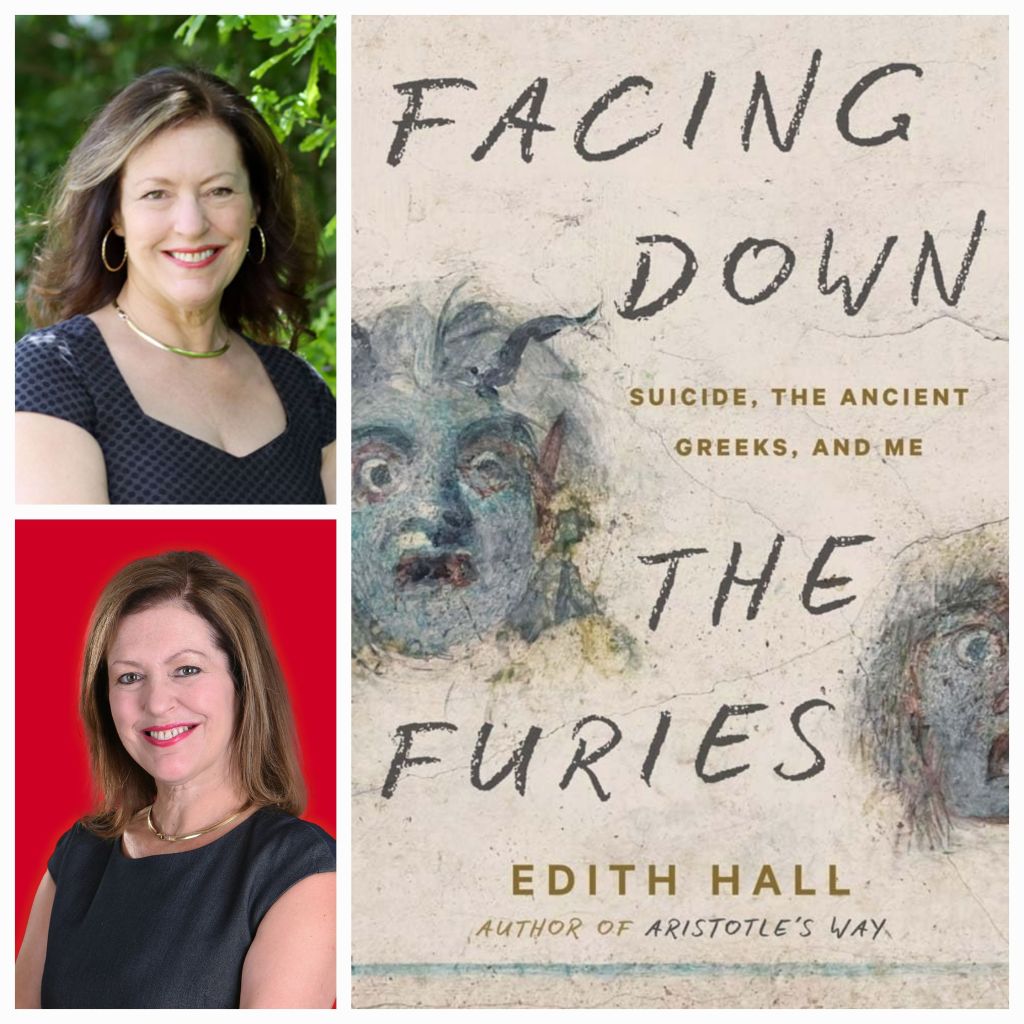
In conclusion, Facing Down the Furies is not just a scholarly text; it is a call to action. It urges readers to reevaluate the roots of their beliefs about autonomy, community, and the value of life through a lens that combines the ancient with the modern, the personal with the communal. Hall’s ability to intertwine classical knowledge with contemporary issues makes her work a crucial addition to ongoing discussions about mental health, societal expectations, and the enduring impact of ancient philosophy on modern life. As debates about physician-assisted suicide and the ethics of suicide continue to evolve, Hall’s reflections provide a vital resource for navigating these complex waters with empathy, respect, and a deeper understanding of the human condition.
#EdithHall #MentalHealthAwareness #SuicidePrevention #GreekTragedy #ClassicalWisdom #Stoicism #EthicalDilemmas #CulturalStigma #BookReview
This post is part of the Bookish League blog hop hosted by Bohemian Bibliophile
I’m participating in the #TBRChallenge by Blogchatter


 Poetry Hub
Leave a reply to Prasanna Raghavan Cancel reply