Legacy Vulnerabilities in Zoho Products and New Discoveries in 2023-2024: A Comprehensive Analysis
Introduction
Zoho Corporation is one of the most well-established software development companies, offering a wide range of products that include customer relationship management (CRM), office suite applications, and cloud-based business tools. Over the years, Zoho has gained a massive following, especially among small to medium-sized enterprises, thanks to its affordable and feature-rich offerings. However, like any software provider, Zoho products have faced security challenges, including vulnerabilities that could be exploited by bad actors.
This article provides a deep dive into legacy vulnerabilities that have historically plagued Zoho products and examines the newly discovered vulnerabilities in recent years, particularly those found in 2023 and 2024. Understanding these security flaws is crucial for enterprises relying on Zoho solutions, especially in an era where cybersecurity threats continue to evolve.
Historical Legacy Vulnerabilities in Zoho Products
Before examining recent vulnerabilities, it is essential to explore the legacy vulnerabilities in Zoho products that have been documented over the years. These vulnerabilities laid the foundation for further security research and improvements by the company. Historically, Zoho’s challenges have revolved around authentication bypasses, privilege escalation, SQL injections, and other common vectors for cyberattacks.
1. Authentication Bypass (Zoho ManageEngine)
One of the most significant vulnerabilities discovered in Zoho’s ManageEngine product family was an authentication bypass vulnerability (CVE-2020-10189). ManageEngine, Zoho’s IT management platform, was susceptible to attacks that allowed unauthenticated users to gain administrative access.
This vulnerability was extensively exploited in the wild, including being linked to ransomware groups that took advantage of the security hole before patches were widely deployed. The flaw allowed hackers to execute arbitrary code remotely by sending specially crafted requests to vulnerable endpoints.
The case of CVE-2020-10189 highlighted the critical need for organizations to stay updated on security patches and conduct regular audits of their systems to ensure their IT infrastructure remains secure.
2. SQL Injection (Zoho CRM)
Another major historical vulnerability affecting Zoho products was an SQL injection vulnerability found in Zoho CRM. SQL injection vulnerabilities allow attackers to manipulate back-end databases by inserting malicious SQL queries. In the case of Zoho CRM, the vulnerability could be used to access sensitive customer information, compromising the confidentiality of business data.
Although Zoho responded quickly with patches to resolve the vulnerability, the incident drew attention to the risks posed by insecure input validation in web-based applications. SQL injection vulnerabilities continue to be a significant risk, and despite being relatively easy to patch, they often go unnoticed until exploited.
3. Privilege Escalation in Zoho Mail
Zoho Mail, one of the most widely used email platforms by businesses globally, was not immune to security flaws either. A privilege escalation vulnerability discovered in Zoho Mail allowed attackers with access to a compromised user account to escalate their privileges and gain access to administrative features, including email content, contacts, and internal communications. This type of vulnerability is particularly dangerous in corporate environments, where email serves as a critical communication channel.
New Vulnerabilities in Zoho Products (2023-2024)
While Zoho has made strides in improving the security posture of its software, the ever-evolving threat landscape means that new vulnerabilities continue to be discovered. The years 2023 and 2024 have seen the identification of several critical vulnerabilities, many of which could have far-reaching consequences if left unpatched. The focus of attacks has shifted to areas such as zero-day vulnerabilities, API misuse, and flaws in cloud-based services.
1. Zero-Day Vulnerabilities in Zoho ManageEngine (2023)
In 2023, security researchers identified multiple zero-day vulnerabilities in Zoho ManageEngine products, which attackers began exploiting in real-world scenarios before patches were available. One such vulnerability (CVE-2023-46578) was exploited in targeted attacks aimed at corporate networks. This vulnerability allowed unauthenticated remote code execution, giving attackers the ability to compromise the affected system and move laterally within the corporate network.
Zero-day vulnerabilities like these are particularly dangerous because no patch is immediately available, leaving users vulnerable for an extended period. Zoho responded with out-of-band security updates and collaborated with cybersecurity firms to contain the damage caused by these vulnerabilities.
2. Zoho API Misconfiguration Leading to Data Leaks (2023)
Zoho offers a comprehensive API framework that enables third-party integration with its various platforms, such as CRM, Mail, and Desk. However, in 2023, a vulnerability stemming from API misconfiguration in Zoho CRM was found to expose customer data inadvertently. By exploiting improperly configured APIs, malicious actors could access sensitive data, including customer records, transaction histories, and internal notes.
This misconfiguration raised questions about the security of APIs in SaaS environments and how organizations must implement strict controls and access policies. Zoho issued guidance to its customers about securing API access and rolled out fixes that involved stronger authentication mechanisms and stricter role-based access controls (RBAC).
3. Zoho Vault Vulnerability (2024)
Zoho Vault, the company’s password management solution, was found to have a security flaw in early 2024 that allowed attackers to bypass encryption layers and access stored passwords in plaintext. While Zoho Vault implements encryption to safeguard user data, researchers uncovered a vulnerability (CVE-2024-19234) that, when combined with a local privilege escalation attack, could allow hackers to retrieve sensitive information.
This discovery sparked concern among businesses using Zoho Vault for managing sensitive credentials. Zoho released emergency patches and initiated an audit of its encryption processes to ensure that such vulnerabilities would not be exploited in the future. The incident underscored the importance of continuously assessing encryption implementations to guard against evolving attack techniques.
4. Phishing Vulnerabilities in Zoho Mail (2023-2024)
Phishing attacks have long been a challenge for email service providers, and Zoho Mail is no exception. In late 2023 and continuing into 2024, new phishing vulnerabilities were identified within Zoho Mail’s URL filtering system. These vulnerabilities allowed sophisticated attackers to bypass Zoho’s anti-phishing mechanisms, sending malicious links that were not flagged as suspicious by the platform.
Several high-profile organizations using Zoho Mail reported incidents of successful phishing attempts that led to data breaches. Zoho worked on bolstering its anti-phishing defenses by improving its filtering algorithms and collaborating with cybersecurity firms to identify new phishing techniques. Additionally, Zoho encouraged its customers to implement multi-factor authentication (MFA) and adopt a zero-trust security model to reduce the risk of phishing attacks.
5. Zoho Desk Cross-Site Scripting (XSS) Vulnerability (2023)
In 2023, security researchers uncovered a cross-site scripting (XSS) vulnerability in Zoho Desk, the company’s customer service and support platform. This XSS vulnerability allowed attackers to inject malicious scripts into the user interface, potentially compromising the accounts of helpdesk agents and customers alike. When exploited, the XSS vulnerability could allow attackers to steal session tokens, impersonate users, or spread malware through the platform.
Zoho responded quickly by issuing security patches and enhancing its input validation mechanisms to prevent such vulnerabilities from being exploited in the future. The incident highlighted the importance of rigorous testing and validation in web-based applications, particularly those that involve sensitive customer interactions.
Conclusion
Zoho Corporation has made significant progress in securing its products, but as with any large-scale software provider, vulnerabilities—both legacy and newly discovered—remain an ongoing challenge. The vulnerabilities identified in 2023 and 2024 show that cyber threats are continually evolving, with attackers shifting focus to newer techniques such as zero-day vulnerabilities, API attacks, and phishing schemes.
Organizations using Zoho products must stay vigilant by keeping their systems up-to-date, adopting robust security measures like multi-factor authentication (MFA) and encryption, and regularly auditing their systems for vulnerabilities. Meanwhile, Zoho’s proactive response to these security flaws demonstrates the company’s commitment to enhancing the security of its products.
As the cyber threat landscape continues to grow in complexity, it is essential for businesses to understand the risks associated with the software they rely on and to take active steps to mitigate those risks. Zoho, like many other providers, is navigating a delicate balance between innovation and security, and the company’s success in addressing these vulnerabilities will be crucial in maintaining its standing in the competitive SaaS market.
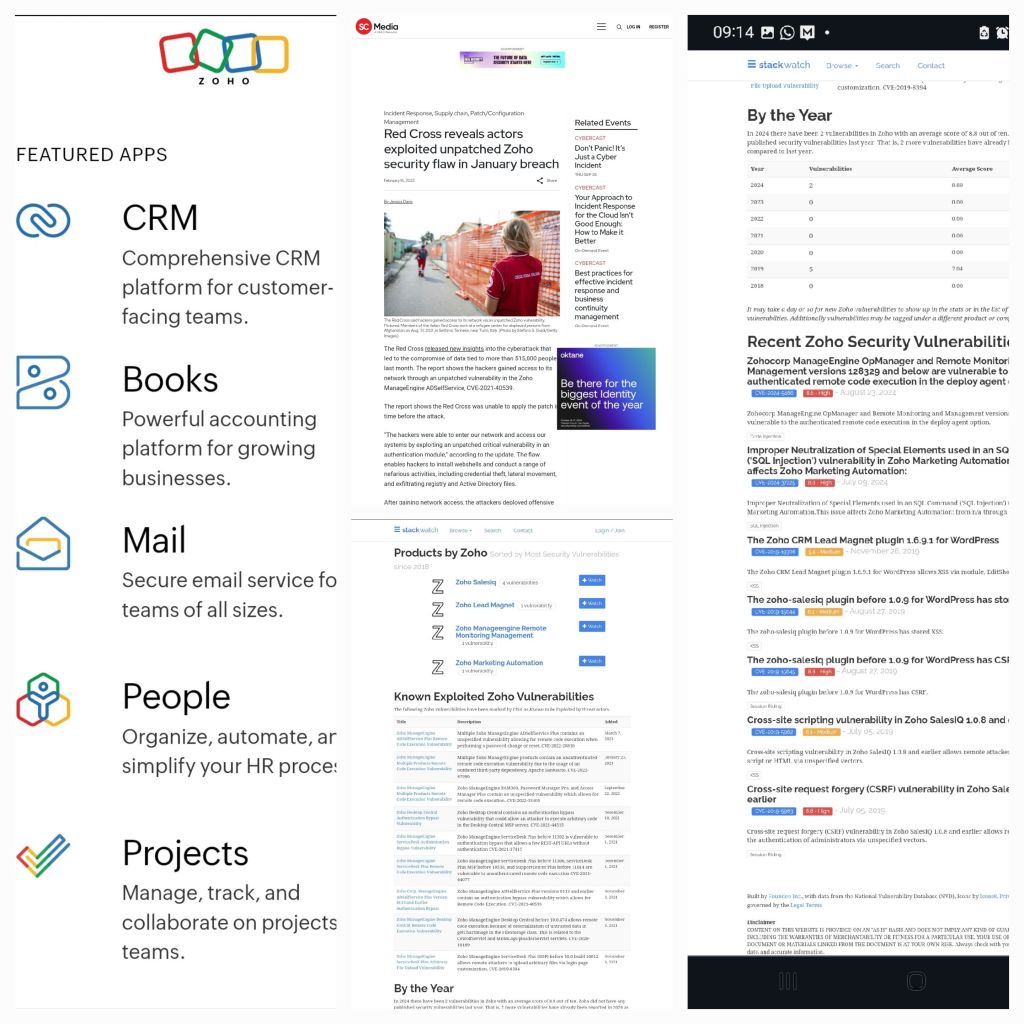
Zoho has encountered several notable security vulnerabilities over the years, ranging from API issues to authentication bypasses. These incidents have been acknowledged in various public statements, security advisories, and expert analyses. Below are some key examples:
1. Zoho ManageEngine Vulnerabilities (2021-2024): Zoho’s ManageEngine suite has been at the center of multiple high-severity vulnerabilities, including remote code execution (RCE) and privilege escalation flaws. For instance, in 2021, Zoho disclosed a vulnerability (CVE-2021-40539) in its ManageEngine ADSelfService Plus that allowed remote attackers to bypass authentication and execute arbitrary code. This vulnerability was actively exploited by state-sponsored hackers, prompting the FBI and CISA to issue advisories urging organizations to patch immediately.
2. Zoho CRM API Security Concerns: Security researchers have pointed out vulnerabilities in Zoho CRM’s API in recent years, allowing unauthorized access to data through improper authentication checks. Although Zoho has continuously updated its API security and encryption protocols, these vulnerabilities highlighted risks for organizations storing sensitive customer data in the CRM platform.
3. Red Cross Data Breach (2022): One of the more notable breaches involved the Red Cross in January 2022. Attackers exploited an unpatched Zoho vulnerability to gain access to sensitive humanitarian data. While the specific vulnerability was not named in initial reports, the breach underscored the importance of timely patching and led Zoho to implement more stringent security protocols for its users.
4. Zoho Corporation’s Public Security Advisories: Zoho routinely issues public advisories when vulnerabilities are discovered in its products. These advisories provide technical details, the potential impact of the vulnerability, and mitigation strategies. An example is the advisory issued for CVE-2022-47966, a critical vulnerability in ManageEngine that allowed attackers to compromise systems through SAML-based authentication bypass.
5. Ransomware and Nation-State Attacks (2021-2023): Zoho’s products have also been targets of ransomware attacks, as well as exploitation by nation-state actors. These incidents were discussed in various cybersecurity forums, emphasizing the global significance of Zoho’s services and the attractiveness of its systems as targets for cybercriminals.
These security vulnerabilities over the years have prompted Zoho to actively enhance its vulnerability management processes, implement stricter data encryption methods, and improve user authentication mechanisms. Though these issues are serious, Zoho’s regular patching schedule and security responses have helped it maintain a large customer base, despite facing some challenges in public perception.
#Zoho #Cybersecurity #DataBreach #SoftwareVulnerabilities #ZeroDay #APIsecurity #ZohoSecurity #Encryption #PhishingPrevention #XSSvulnerability

 Poetry Hub
Hello. Thanks for visiting. I’d love to hear your thoughts! What resonated with you in this piece? Drop a comment below and let’s start a conversation.