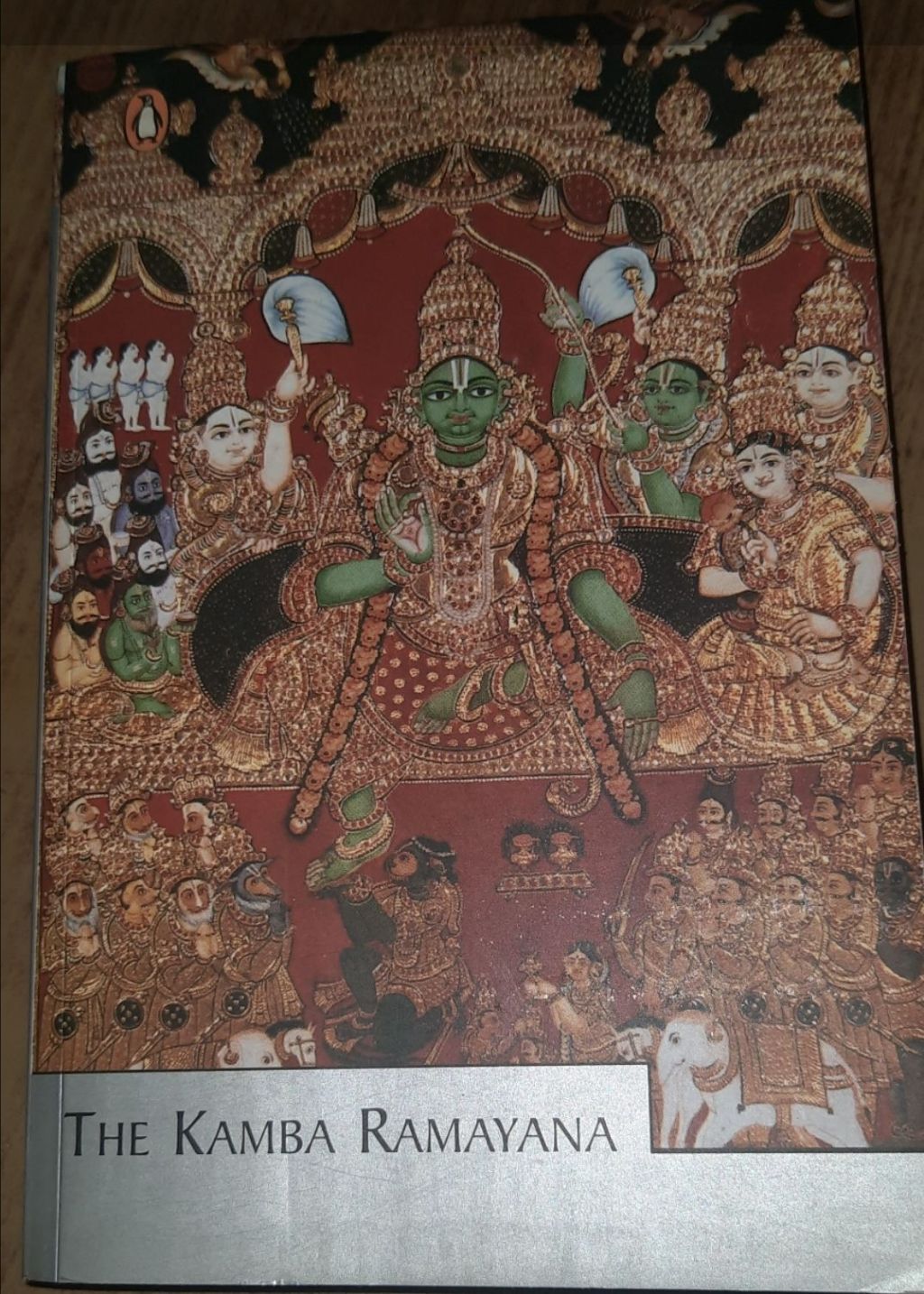
Exploring The Kamba Ramayana: A Journey into Tamil Devotion, Art, and Divine Storytelling @PenguinBooks @PenguinIndia #BookishLeague @BohoBibliophile #TBRChallenge #bookchatter

Book Review: The Kamba Ramayana โ€“ A Journey Through Time, Devotion, and Splendor

As I turn each page of The Kamba Ramayana, I feel as though I am embarking on an intimate pilgrimageโ€”a journey across epochs, languages, and divine poetry, where I meet not only Lord Rama but an entire cultural cosmos brought to life by a remarkable poet, Kamban, in the Tamil heartland of the 12th century. Here, under the brush of P.S. Sundaramโ€™s eloquent translation and N.S. Jagganathanโ€™s meticulous editing, the epic unfurls like an ancient tapestry rethreaded for modern eyes, yet deeply loyal to its roots, rhythm, and resonance. This is more than just a translation; it is a careful transference of spirit and soul from one language, one worldview, to another.

Kamban, a poet born to the son of a temple drummer, seemed destined to become the bard who would give the South Indian world its own Ramayana. His mastery of both Tamil and Sanskrit was unusual and formidable. Imagine: a poet of humble origins, with the primal beat of temple drums in his blood, crafting an epic that would live on for centuries, rivaling Valmikiโ€™s Sanskrit version. But The Kamba Ramayana is not just an adaptation; it is a reinvention. And in these pages, Lord Rama is elevatedโ€”not as the mortal prince we meet in Valmikiโ€™s version, a man wrestling with human emotions and weaknessesโ€”but as a divine being whose godhood shines throughout his journey. Kambanโ€™s Rama is a beacon of dharma, a manifestation of cosmic truth.

When I first encountered the premise of the Kamba Ramayana, I was hesitant. What new light could it shine on a story so ingrained in the consciousness of every Indian heart? But as I read Sundaramโ€™s English translation, I realized this was not just a โ€œRamayanaโ€โ€”it was Kambanโ€™s Ramayana. There are moments here that feel like whispers from another realm, as though Kamban himself is guiding us through his spiritual visions, beckoning us closer to the essence of his devotion.

Sundaramโ€™s translation is brilliant in its ability to capture Kambanโ€™s divine languageโ€”its lyrical cadence and reverent tone. Reading this feels akin to watching a beautiful Tamil painting gain color and depth before my eyes, translated with care but always faithful to the essence. Penguin has performed a great service by bringing this work to the fore, liberating it from the confines of linguistic inaccessibility and granting us all an invitation to explore one of Tamil literatureโ€™s hidden gems. It is not simply the language that Sundaram carries over, but the whole experience of standing in awe before this monumental work.

As I dive deeper into Kambanโ€™s interpretation, I find differences that are bold, deliberate, and profound. In Valmikiโ€™s Ramayana, we witness a mortal prince, an archetype of human perfection but bound by the fragility of human emotion. Kamban, however, reinterprets Rama as a divinity walking among men. He is an ideal not because he is human but precisely because he is godly, an embodiment of divine principles that mortal minds strive to understand. Kambanโ€™s Rama transcends; he is both dharma and deity, the absolute moral compass guiding the cosmos. There is no doubt, no hesitation, no human flaw to ground himโ€”only the strength and wisdom that emanate from the divine.

The beauty of The Kamba Ramayana lies in its small, almost sacred momentsโ€”each scene a heartbeat in a vast, timeless epic. Where Valmikiโ€™s narrative is stripped to a lean, majestic simplicity, Kambanโ€™s world brims with sensory richness. Take, for instance, the vivid landscapes, the lush backdrops that Kamban paints in poetic hues: rivers shimmering like molten silver, forests alive with gods and whispers, and palaces radiant with celestial splendor. The imagery is a feast, a visceral delight, and a devotion-filled offering to the reader. Each description becomes a mantra, invoking the landscape not just as a setting but as a participant in the story.

Through Sundaramโ€™s translation, every syllable feels like a bridgeโ€”a way to cross into Kambanโ€™s heart, to grasp the echoes of drums he once heard, the rhythms that pulsed in his poetry. The linguistic beauty of Tamil, its richness and complexity, is echoed even in Englishโ€”a feat that only an adept translator can achieve. The translation maintains that unique cadence, a melody that, though foreign, feels familiar as it echoes across cultures and languages. It allows us to glimpse the pulse of a Tamil world, immersing us in Kambanโ€™s spiritual vision.

And then there are the deviationsโ€”those exquisite departures from Valmikiโ€™s text that make this version uniquely Kambanโ€™s. For instance, while Valmiki focuses on the human virtues and struggles of Rama, Kamban revels in Ramaโ€™s godhood. He becomes a deity in every way, an omnipotent figure whose presence is like the sun piercing the clouds. The dilemmas and doubts that define Valmikiโ€™s Rama are softened in Kambanโ€™s vision, replaced by a divinity that holds Rama above the tides of human frailty. He becomes an ideal for reverence rather than emulation, a figure to worship, rather than one to imitate.

The Kamba Ramayana is not merely a book; it is a voyage into a poetic landscape where devotion transforms into art. Reading it feels akin to a pilgrimageโ€”a chance to journey through a piece of Indian cultural history that transcends the boundaries of language, class, and era. Each page demands patience and reverence; each verse whispers secrets that invite me to linger, to absorb, to lose myself in a spiritual current that has flowed for centuries.

What Penguin, Sundaram, and Jagganathan have created is more than a translation; it is a portal to another world. The drumbeat of Kambanโ€™s Tamil, echoing through Sundaramโ€™s English, resonates deeply within me, inviting reflection and reverence. As I close the book, I feel changed, as though I have caught a glimpse of a world that once was, and that forever will be, in the currents of devotion that flow through Indian thought and literature.
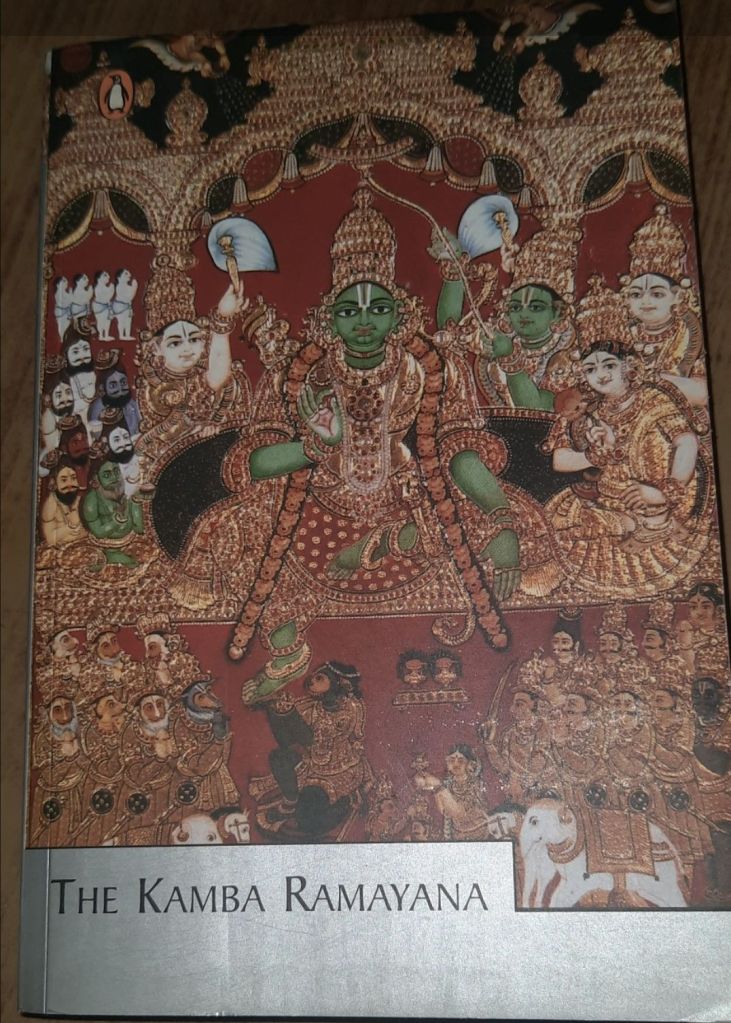
Exploring The Kamba Ramayana: A Journey into Tamil Devotion, Art, and Divine Storytelling @PenguinBooks @PenguinIndia #BookishLeague @BohoBibliophile #TBRChallenge #bookchatter

For anyone interested in not just the story of Rama but in the cultural and spiritual essence of the Tamil world, The Kamba Ramayana is a must-read. It is a grand treat for the eyes, heart, and mindโ€”a text that redefines what it means to journey through an epic. This is more than a retelling; it is an invitation to witness a divine narrative, where devotion, art, and storytelling blend seamlessly into a singular, luminous experience.

#KambaRamayana #BookReview #IndianEpics #TamilLiterature #TranslatedWorks #IndianCulture #Ramayana #HinduMythology #TranslatedLiterature #PSundaram #PenguinBooks #LordRama #SpiritualJourney #DivineStorytelling #Kamban #MustRead #IndianClassics #TimelessLiterature

This post is part of the Bookish League blog hop hosted byย Bohemian Bibliophile.

Iโ€™m participating in the #TBRChallengeย by Blogchatter

Comments

27 responses to “Exploring The Kamba Ramayana: A Journey into Tamil Devotion, Art, and Divine Storytelling @PenguinBooks @PenguinIndia #BookishLeague @BohoBibliophile #TBRChallenge #bookchatter”

  1. Swarnali Nath Avatar

    So nice to know about Kamba Ramayana! I have always believed that Indian Mythology has its own interpretation of the origin of our existence. and that’s why we are inclined to know the mythological characters more and more. Loved how you have researched on this topic. Glad to have read about Kamba Ramayana from your poest.

    Liked by 1 person

    1. PebbleGalaxy Avatar

      Ah, the Kamba Ramayanaโ€”a timeless weave of poetic rhythm and human longing! Your belief resonates deeply, doesnโ€™t it? Indian mythology, after all, isnโ€™t just a collection of tales; itโ€™s a prism through which we glimpse the eternal and the ephemeral, the cosmic and the personal. Each character, each verse, seems to echo the pulse of existence itself, doesn’t it?

      And yet, isnโ€™t it fascinating how mythology doesnโ€™t just interpret our originsโ€”it reinvents them with every reading, every whisper of belief? We lean closer, drawn to the allure of its truths that arenโ€™t truths but reflections, interpretations, dialogues across the ages.

      Your words are like a mirror held up to my intentโ€”thank you for seeing not just the research but the reverence behind it. Kambaโ€™s verses, his Rama, his Sitaโ€”they live beyond the page, shaping and reshaping our narratives of love, dharma, and destiny. Iโ€™m so glad this piece found resonance with you. Mythology, after all, is not just what we read; itโ€™s what we live.

      Like

  2. Anuradha Sowmyanarayanan Avatar

    The Kambaramayanam is a retelling of the original Valmiki Ramayana, written in the 12th century by the Tamil poet Kamban.

    Many scholars say, ” Kamban has not just translated Valmiki’s Ramayanam, he has constructed his epic on the blueprint created by Valmiki.”

    Liked by 1 person

    1. PebbleGalaxy Avatar

      The Kambaramayanam, composed by the legendary Tamil poet Kamban in the 12th century, is indeed a remarkable reimagining of the original Valmiki Ramayana. Far from being a mere translation, Kambanโ€™s work is a creative and poetic reconstruction that enriches the narrative with Tamil cultural nuances, linguistic elegance, and philosophical depth.

      As many scholars aptly observe, โ€œKamban has not just translated Valmikiโ€™s Ramayana; he has constructed his epic on the blueprint created by Valmiki.โ€ This emphasizes Kambanโ€™s creative liberty in portraying characters, themes, and events while retaining the essence of the original. His mastery in blending devotion, aesthetics, and ethics makes the Kambaramayanam not only a retelling but a timeless masterpiece in its own right.

      Like

  3. A Rustic Mind Avatar

    I’m not into much of spiritual reading but this seems really interesting especially if one wants to learn more about Lord Ram. Will check it out.

    Like

  4. Modern Gypsy Avatar

    I hadn’t heard of the Kamba Ramayana, so this was illuminating! It’s also interesting that instead of portraying Ram as a mortal, Kamba portrays him as a God walking this earth. That small distinction would make a lot of difference in how the tale is portrayed and perceived, I would imagine.

    Liked by 1 person

    1. PebbleGalaxy Avatar

      Iโ€™m glad you found the Kamba Ramayana enlightening! You’re absolutely right about that distinctionโ€”portraying Ram as a divine being rather than a mortal changes the entire tone and message of the story. It adds a layer of reverence and awe, and shifts the focus from his human struggles to the spiritual significance of his actions. Itโ€™s fascinating how such subtle differences in portrayal can shape the way we perceive characters and their journeys.

      Like

  5. sinhatarang Avatar

    Wow! I have read a few things about this version of Ramayan. Especially that Sita in this version is extremely powerful (is that so?).

    It sounds fascinating. And you have expressed your views so beautifully. I would like to read it just for its lyrical and luminous prose.

    Liked by 1 person

    1. PebbleGalaxy Avatar

      Yes, you’re rightโ€”Sita in Kamba Ramayana is portrayed as a very powerful and dignified figure. She is not just a passive character but is shown as wise, strong, and resolute in her own right, often standing up for what she believes in. This portrayal adds depth to her character and makes her more than just a supportive figure to Ram.

      The lyrical and luminous prose you mentioned is truly one of the highlights of the Kamba Ramayana. It’s known for its poetic beauty and rich imagery, which makes it a pleasure to read.

      Liked by 1 person

  6. Preeti Chauhan Avatar
    Preeti Chauhan

    It is nice to revisit Kamba Ramayana through your exquisite review of this translated version.The south has SuperGods and Superstars , I do not know what appeals to me more – a humane Rama or a divine Rama.

    Liked by 1 person

    1. PebbleGalaxy Avatar

      It’s fascinating how the portrayal of Ramaโ€”whether as a divine being or a more humanized figureโ€”can evoke such different feelings. The South indeed has its share of SuperGods and Superstars, and perhaps itโ€™s this blend of the divine and the relatable that makes these stories so compelling. For me, both versions have their own appeal. A divine Rama can inspire awe and reverence, while a more humanized Rama allows us to connect with his struggles and triumphs on a personal level.

      Like

  7. Ambica Gulati Avatar

    I wasn’t aware of this Ramayana. Though, I am not into devotional or mythological reading, but your post makes it a soul-stirring experience. It’s good to have an English version that does open our thoughts to something deeper.

    Liked by 1 person

    1. PebbleGalaxy Avatar

      Sometimes, the beauty of these stories transcends the specific genre, and they can stir something deeper within us. The English version does make the wisdom and lyrical depth of the Kamba Ramayana more accessible, offering a fresh perspective on universal themes. Itโ€™s always refreshing to discover something that connects with us on a deeper level, no matter our usual preferences.

      Liked by 1 person

  8. Suchita Avatar

    I love that such epics have interpretations in so many languages and cultures. It shows how great stories are timeless, universal and yet unique in their own way. This was one of the reasons I had enjoyed reading Sita by Devdutt Pattanaik. He too delves into Ramayan in different cultures.

    Liked by 1 person

    1. PebbleGalaxy Avatar

      Absolutely! The fact that epics like the Ramayana have been interpreted in so many languages and cultures really speaks to their timeless and universal appeal. Each version brings something unique, reflecting the values and nuances of the culture it’s rooted in, while still staying connected to the core themes that resonate with people across the world.

      Liked by 1 person

  9. Cindy D'Silva Avatar

    Wow reading it feels like a pilgrimage. That’s a new feeling. I’m sure my friend will love this book. She loves reading about Ramayan in different versions.

    Liked by 1 person

    1. PebbleGalaxy Avatar

      Thank you for such a beautiful comment! I’m so glad the post resonated with you in such a meaningful way. If your friend enjoys exploring different versions of the Ramayan, I think this book will truly captivate her. It’s always wonderful to connect with stories that feel like a spiritual journey.

      Like

  10. kanchansingh1989 Avatar

    This review captures the soul of The Kamba Ramayana so beautifullyโ€”it feels like an invitation to embark on a divine journey. I love how the poetic richness and spiritual essence of Kambanโ€™s work are emphasized. Your reflections on Sundaramโ€™s translation truly highlight its timeless significance. Now I must read it!

    Liked by 1 person

    1. PebbleGalaxy Avatar

      Thank you so much for your thoughtful words! Iโ€™m deeply touched that you feel this way. The Kamba Ramayana truly is a treasure, and Sundaramโ€™s translation brings its poetic beauty and spiritual depth to life so vividly. Itโ€™s more than just a textโ€”itโ€™s an experience, a divine journey, as you so beautifully put it. Iโ€™m thrilled that my reflections resonated with you, and I canโ€™t wait for you to dive into it. Do let me know your thoughts once you doโ€”it would be wonderful to hear your perspective!

      Liked by 1 person

  11. Ninu Nair Avatar

    I have heard so much about the Kamba Ramayana and I am so glad that there is this English translation and you seem to appreciate their efforts in genuinely portraying the true spirit of the original work. Taking a note and adding this to my TBR!

    Liked by 1 person

    1. PebbleGalaxy Avatar

      I’m so glad to hear that you’re adding The Kamba Ramayana to your TBR! It truly is a masterpiece, and Sundaram’s translation does a wonderful job of capturing the depth and beauty of Kambanโ€™s original work. The poetic richness and spiritual essence shine through, making it an unforgettable read. Iโ€™d love to hear your thoughts once you dive into itโ€”I’m sure you’ll find it as captivating and profound as I did!

      Liked by 1 person

  12. nooranandchawla Avatar

    I’m not familiar with this version of the Ramayana – sounds very interesting!

    Liked by 1 person

    1. PebbleGalaxy Avatar

      Thank you! This version of the Ramayana offers a unique perspective that adds depth to the timeless epic. It’s always fascinating to explore how different retellings bring new insights to the story. I hope you get a chance to dive into it!

      Liked by 1 person

  13. Shalini Avatar

    Thank you for introducing us to Kamba Ramayana. It’s truly mesmerizing!

    Liked by 1 person

    1. PebbleGalaxy Avatar

      Thank you for your appreciation! The Kamba Ramayana is indeed a captivating work, filled with poetic beauty and profound insights. I’m glad you found it mesmerizing!

      Like

  14. Ritu Bindra Avatar

    I haven’t read much about Kamba Ramayan. I remember watching an interview of Chitra Banerjee Divakaruni just before The Forest of Enchantments came out. Each region has a different version of Ramayan that I wasn’t aware of earlier. After reading your review, I am quite interested to check out this version.

    Liked by 1 person

    1. PebbleGalaxy Avatar

      Thank you for your thoughtful comment! Itโ€™s fascinating how the Ramayana has so many regional variations, each offering a unique perspective. Chitra Banerjee Divakaruniโ€™s insights are always enriching, and The Forest of Enchantments is such a beautiful retelling. Iโ€™m glad my review piqued your interest in the Kamba Ramayanโ€”it truly offers a poetic and distinctive take on the epic. Iโ€™d love to hear your thoughts if you decide to explore it!

      Like

Hello. Thanks for visiting. I’d love to hear your thoughts! What resonated with you in this piece? Drop a comment below and let’s start a conversation.