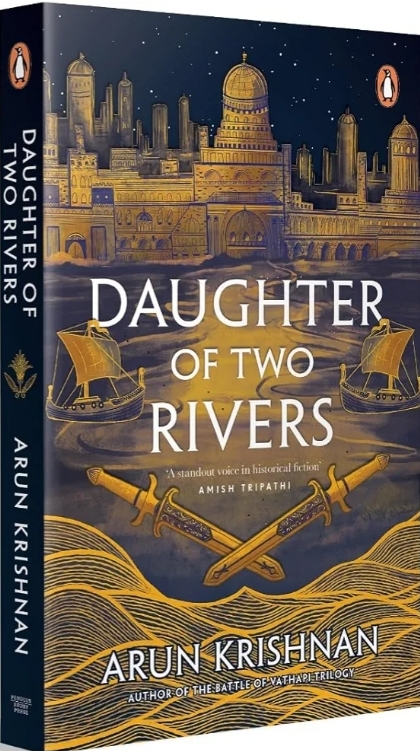
Dr. Arun Krishnan’s “Daughter of Two Rivers” emerges as a remarkable achievement in historical fiction, weaving together archaeological intrigue, epic adventure, and profound emotional resonance into a narrative that transcends the boundaries of time and geography. This ambitious novel, inspired by the actual twentieth-century discovery of a Sumerian tablet off the coast of Mumbai, represents not merely a work of entertainment but a thoughtful exploration of identity, belonging, and the invisible threads that connect civilizations across millennia.
The Archaeological Frame: A Masterful Opening Gambit
The novel’s structural brilliance becomes apparent from its opening pages. The novel opens with a tantalizing prologue set in 1921 Bombay, where an ASI archaeologist unearths a Sumerian tablet in India—a discovery that hints at ancient connections between Bharatvarsha and Mesopotamia. This archaeological framing device serves multiple purposes: it grounds the fantastical elements of the story in historical possibility, establishes the novel’s central preoccupation with cross-cultural connections, and creates an immediate sense of mystery that propels the reader forward.
Krishnan’s decision to anchor his narrative in this real archaeological phenomenon demonstrates both scholarly rigor and narrative sophistication. The discovery of Mesopotamian artifacts in the Indian subcontinent has long fascinated historians and archaeologists, and Krishnan leverages this genuine historical puzzle to create a plausible foundation for his tale of ancient diplomacy and cultural exchange.
Character Development: The Heart of the Epic
At the center of the novel stands Prince Arjuna, whose journey from the drought-stricken settlement of Rohitaka to the opulent courts of Babylon serves as both literal and metaphorical voyage of discovery. When a request from Babylon to trade weapons arrives as a blessing in disguise, a trade delegation, headed by prince Arjuna, and the grizzled veteran, Shrutasena, sets off for the faraway kingdom. Arjuna’s character arc represents one of the novel’s greatest strengths—his evolution from provincial prince to worldly diplomat mirrors the broader themes of cultural understanding and personal growth that permeate the work.
The introduction of Lilith, described as a fierce bodyguard to the Queen, adds layers of complexity to the narrative. Her antagonistic relationship with Arjuna creates dramatic tension while simultaneously exploring themes of cultural misunderstanding and prejudice. The dynamic between these two characters—one representing the Indian subcontinent’s emerging civilization, the other embodying the established power of Mesopotamian culture—becomes a microcosm for the larger civilizational encounter that forms the novel’s backbone.
Shrutasena, the grizzled veteran, provides necessary gravitas and wisdom to the narrative. His presence serves as a stabilizing force, offering both military expertise and cultural perspective that enriches the story’s exploration of warfare, diplomacy, and honor.
Historical Authenticity and World-Building
Arun Krishnan’s “Daughter of Two Rivers” is a captivating historical epic that transports readers to a pivotal moment in ancient India: approximately 3800 years ago, a time when the very first whispers of iron began to reshape the subcontinent. Krishnan’s attention to historical detail creates an immersive experience that feels both authentic and accessible. The author’s scholarly background becomes evident in his careful reconstruction of ancient societies, from the political structures of early Indian settlements to the sophisticated court culture of Babylon.
The novel’s depiction of the transition from Bronze Age to Iron Age technology adds another layer of historical authenticity. This technological shift, occurring around 1800 BCE, represents a crucial turning point in human civilization, and Krishnan uses this backdrop to explore themes of progress, adaptation, and cultural evolution.
The geographical scope of the novel—spanning from the Indian subcontinent to Mesopotamia—requires considerable research and imagination to render convincingly. Krishnan succeeds in creating distinct cultural landscapes that feel historically grounded while remaining engaging to contemporary readers.
Thematic Depth: Beyond Adventure
While “Daughter of Two Rivers” delivers on its promise of adventure and romance, its true strength lies in its thematic sophistication. Inspired by the twentieth century discovery of a Sumerian tablet off the coast of Mumbai, Daughter of Two Rivers is a homecoming story. And like all good homecoming stories, it’s a story of learning what home means—across countries, and across time.
The concept of “home” emerges as the novel’s central preoccupation. For Arjuna, the journey to Babylon becomes a process of understanding his own identity and place in the world. For Lilith, whose connection to the Indian subcontinent becomes increasingly apparent, the narrative explores questions of origin, belonging, and cultural identity that resonate with contemporary discussions of diaspora and cultural connection.
The novel’s treatment of cross-cultural encounter avoids simple exoticism or cultural superiority. Instead, Krishnan presents a nuanced view of civilizational interaction, showing how different cultures can learn from each other while maintaining their distinct identities. This sophisticated approach to cultural exchange feels particularly relevant in our interconnected world.
Narrative Craft and Pacing
Krishnan demonstrates considerable skill in balancing multiple narrative demands. The novel must function as historical fiction, adventure story, romance, and philosophical meditation on identity and belonging. That it succeeds on all these levels speaks to the author’s narrative sophistication.
The pacing moves effectively between intimate character moments and sweeping historical events. As Prince Arjuna and the fierce Lilith navigate treacherous plots and emotional reckonings, the story becomes more than historical fiction—it becomes a journey of belonging, identity, and the universal search for home. The political intrigue of ancient courts provides tension and conflict, while the developing relationship between Arjuna and Lilith offers emotional depth and personal stakes.

Minor Criticisms
While “Daughter of Two Rivers” succeeds admirably in most respects, it occasionally struggles with the weight of its own ambitions. The novel’s attempt to address large historical and philosophical questions sometimes results in moments where the narrative feels slightly overstuffed. Additionally, some readers might find the romantic elements predictable, though this critique applies to many works in the historical fiction genre.
The archaeological framing, while conceptually brilliant, could have been developed more fully. The connection between the 1921 discovery and the ancient narrative could be strengthened to create even stronger thematic resonance.
Conclusion: A Triumphant Achievement
Ultimately, “Daughter of Two Rivers” is a triumph of historical fiction: a novel that entertains with its adventure and romance while provoking reflection on the enduring ties between past and present. Dr. Arun Krishnan has crafted a work that honors both scholarly research and narrative imagination, creating a story that feels both historically grounded and emotionally immediate.
The novel’s exploration of cultural connection, identity, and belonging resonates beyond its ancient setting, offering insights into the universal human experience of finding one’s place in the world. For readers seeking historical fiction that combines rigorous research with compelling storytelling, “Daughter of Two Rivers” represents a significant achievement.
Krishnan has created more than an entertaining adventure story; he has written a meditation on the connections that bind humanity across time and space. In an era of increasing globalization and cultural interaction, this ancient tale of cross-cultural encounter feels both timeless and timely, reminding us that the search for understanding and belonging transcends the boundaries of civilization and epoch.
The novel stands as a testament to the power of historical fiction to illuminate both past and present, creating bridges of understanding that span millennia. “Daughter of Two Rivers” is recommended not only for enthusiasts of historical fiction but for any reader interested in stories that explore the fundamental questions of human identity and connection.


Leave a Reply