
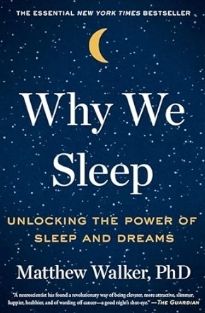
In an age where sleep has become the casualty of our hyperconnected existence, Matthew Walker’s “Why We Sleep: Unlocking the Power of Sleep and Dreams” arrives as both revelation and indictment. Walker, a professor of neuroscience and psychology at UC Berkeley and former Harvard Medical School faculty member, has crafted what may be the most important book about human health published in recent memory—a work that transforms our understanding of that mysterious third of our lives we spend unconscious.
The book’s central thesis is deceptively simple yet profoundly unsettling: sleep is not the enemy of productivity, but its greatest ally, and our systematic neglect of it constitutes nothing less than a public health crisis. Walker marshals decades of research to demonstrate that sleep deprivation doesn’t merely leave us groggy—it fundamentally compromises every aspect of human functioning, from immune response to emotional regulation, from memory consolidation to cellular repair.
Walker’s prose strikes an effective balance between scientific rigor and accessibility. He possesses the rare gift of translating complex neurological processes into language that resonates with general readers without sacrificing accuracy. His explanation of sleep’s architecture—the intricate dance between REM and non-REM phases—unfolds like a well-orchestrated symphony, each movement serving a distinct biological purpose. The description of how memories migrate from short-term to long-term storage during sleep reads with the elegance of poetry, yet remains anchored in hard science.
The book’s structure follows a logical progression that mirrors the sleep cycle itself. Walker begins with the evolutionary foundations of sleep, asking why natural selection would preserve a state that seemingly renders organisms vulnerable to predation. His answer—that sleep’s benefits are so fundamental they outweigh its risks—sets the stage for increasingly alarming revelations about what happens when we shortchange this biological imperative.
Perhaps the most compelling chapters examine sleep’s role in learning and memory. Walker demonstrates how sleep doesn’t merely consolidate the day’s experiences but actively enhances them, finding patterns and connections that escape our waking consciousness. Students who sleep after learning retain information 40% better than those who remain awake—a finding that should revolutionize educational practices. The implications extend beyond academia: Walker argues that many breakthrough discoveries throughout history may have emerged from the creative insights that sleep provides.
The author’s examination of sleep’s relationship with physical health proves equally revelatory. The immune system, he explains, depends on sleep to function effectively. A single night of reduced sleep can decrease immune cell activity by 70%, making us dramatically more susceptible to infection. The links between sleep deprivation and cardiovascular disease, diabetes, and even cancer are not merely correlational but causational—a distinction that transforms these findings from interesting observations into urgent warnings.
Walker’s treatment of mental health deserves particular attention. His exploration of sleep’s role in emotional regulation reads like a psychological thriller, revealing how REM sleep acts as a form of overnight therapy, processing emotional experiences and preventing them from becoming traumatic memories. The connection between sleep loss and depression, anxiety, and even suicide becomes not just plausible but inevitable under Walker’s analysis.
The book’s most disturbing chapters address the societal forces that have declared war on sleep. Walker traces how the invention of electric lighting, the demands of industrial capitalism, and the rise of digital technology have systematically eroded our relationship with natural circadian rhythms. His critique of “sleep macho”—the cultural belief that sleep is for the weak—feels particularly urgent in our era of hustle culture and 24/7 connectivity.
Walker’s discussion of artificial light’s impact on sleep patterns reads like science fiction made manifest. The blue light emitted by screens disrupts melatonin production, effectively tricking our brains into thinking it’s daytime. The irony is stark: the very technologies designed to enhance our lives are literally robbing us of the sleep necessary to enjoy them.
The pharmaceutical industry receives similarly withering treatment. Walker demonstrates how sleeping pills don’t actually produce natural sleep but rather a form of sedation that lacks sleep’s restorative benefits. This revelation transforms the multi-billion-dollar sleep aid industry from solution to symptom of a deeper problem.
Yet “Why We Sleep” is not merely a catalog of horrors but a call to action. Walker’s recommendations for improving sleep hygiene are both practical and transformative. His advocacy for later school start times, recognition of individual chronotypes, and redesign of work schedules around circadian rhythms offer hope for systemic change. The book concludes with a vision of a society that prioritizes sleep as a fundamental human right rather than a luxury.
The work is not without limitations. Walker occasionally overstates his case, presenting correlations as definitive proof of causation. Some critics have questioned whether the evidence supporting certain claims is as robust as he suggests. Additionally, his focus on Western, industrialized societies limits the book’s global applicability, though this perhaps reflects the available research rather than authorial oversight.
More problematically, Walker’s evangelical tone occasionally undermines his scientific credibility. His warnings about sleep deprivation can feel alarmist, potentially creating anxiety that itself interferes with sleep—a cruel irony given the book’s mission. Readers seeking nuanced discussion of competing theories or acknowledgment of research limitations may find Walker’s certainty frustrating.
Despite these concerns, “Why We Sleep” succeeds as both scientific exposition and cultural intervention. Walker has produced a book that fundamentally changes how we think about consciousness, health, and human potential. His central insight—that sleep is not time lost but time invested—challenges core assumptions about productivity and success that have shaped modern life.
The book’s true achievement lies not in its individual revelations but in its cumulative impact. Walker doesn’t merely present sleep as important; he demonstrates that it’s the foundation upon which all other aspects of human flourishing depend. Memory, creativity, emotional stability, physical health, immune function—all rest upon the quality of our sleep. This recognition transforms sleep from a private concern into a public imperative.
“Why We Sleep” demands to be read not just by individuals seeking better rest but by policymakers, educators, and business leaders whose decisions shape the sleep landscape for millions. Walker has written a book that could literally save lives—if we’re wise enough to heed its lessons. In our sleepless age, no message could be more urgent or more necessary.
Rating: ★★★★☆
A groundbreaking work that transforms our understanding of sleep’s crucial role in human health and performance, though occasionally undermined by overstated claims and evangelical tone.
#WhyWeSleep #SleepScience #BookReview #MatthewWalker #HealthBooks #Neuroscience #SleepDeprivation #Wellness #PublicHealth #ScienceBooks #CircadianRhythms #SleepResearch

 Poetry Hub
Hello. Thanks for visiting. I’d love to hear your thoughts! What resonated with you in this piece? Drop a comment below and let’s start a conversation.