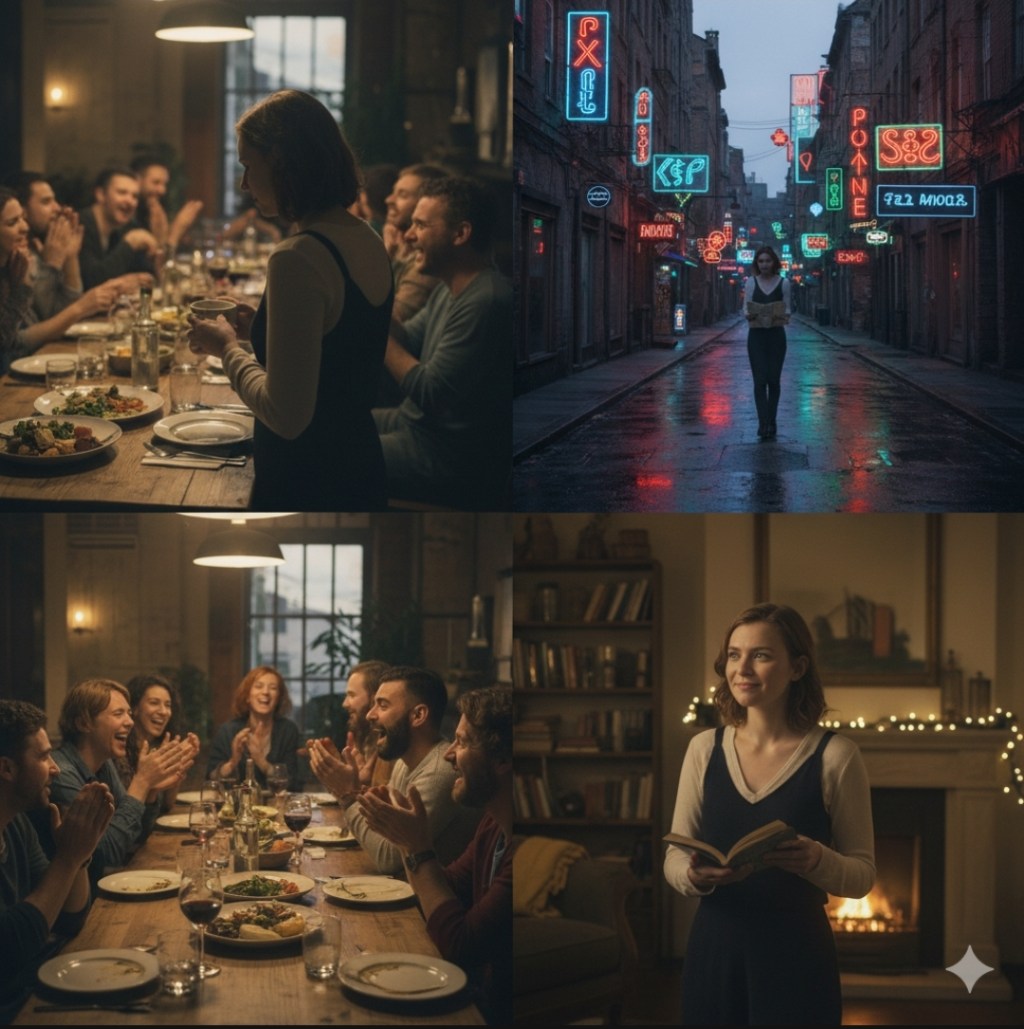
Tell us about a time when you felt out of place.
I remember,
not a single instance,
but a thousand layered echoes
that stitched themselves into the fabric of my becoming—
moments where the air felt too tight around my shoulders,
where my presence seemed uninvited,
even if no one said it aloud.

Once,
it was a room full of pinstripe certainty and crystal laughter,
executives tossing words like coins into a wishing fountain:
"synergy," "pipeline," "valuation,"
each syllable chiming as if it belonged to everyone but me.
I gripped a slim glass of water,
not wine, not champagne,
just water—
as though modesty itself had manifested in my hand.
I rehearsed greetings silently,
ready to trade nods like currency,
but the moment dissolved
and my lines remained caged
within the prison of my throat.

I stood at the edge of polished marble conversations,
a ghost in a world of glittering confidence.
My smile felt rehearsed,
my shoes too loud on the floor,
my presence—
a question mark
in a sentence that had already ended.

And in that pause,
that half-frozen breath of invisibility,
I realized—
I wasn’t simply out of place;
I was out of rhythm.
The room moved like a river,
swift currents of belonging,
and I was a stone lodged in the bank,
watching as all the familiar faces
flowed effortlessly downstream.

But it wasn’t only the boardrooms—
I remembered school corridors
painted with laughter that never included me.
Lunch tables arranged with invisible borders,
friendships sealed by secrets
I was never allowed to hear.
I would sit with my tray,
picking at bread,
while conversations leapt like fireworks
just two chairs away,
each spark reminding me that silence was my only companion.

Later in life,
I carried that same electricity of not-belonging
into family gatherings,
where cousins shared coded jokes about shared summers,
tales of pranks and adventures
I was never part of.
I laughed late,
always half a beat behind,
as though translation was required
between them and me—
a dialect of belonging
for which I never found the dictionary.

Out of place.
It is not just being alone,
for solitude can be warm,
like a book in the lap
or the steady hum of rain at midnight.
Out of place is sharper,
like standing barefoot on gravel,
where every moment you shift,
you hurt.
It is silence not sought
but imposed by circumstance;
it is the feeling of being unshaped
in a world that already knows its patterns.

I recall once,
on a busy train in a foreign city,
maps written in a language
my eyes struggled to summon meaning from.
Everyone else moved instinctively,
disembarking at stops
as though the rails whispered secrets in confidence.
I stood clutching the cold bar,
hesitant,
heart pounding at every station name
I could not pronounce.
A stranger once turned to me and asked something—
I smiled nervously,
words faltering on my lips like raindrops that never fell.
In that instant,
I was completely other:
visible, yet unreachable,
a body misplaced among coordinates I didn’t understand.

And yet,
within these spaces,
hidden truths whispered softly,
lessons disguised in discomfort.
To be out of place
is to observe—
to listen with heightened clarity,
to train the eyes not on what's said,
but on what's unsaid.
It is a kind of apprenticeship
in invisibility.

For from the corner of rooms,
edges of laughter,
you learn
that every circle once began with one line,
that belonging is not inherited
but practiced,
grown slowly like moss on stone.
Sometimes,
you must be the uninvited guest of yourself
before you discover the doorway
built in your own name.

I remember walking home that night
after the corporate gala,
streetlamps bending halos
into the dark air.
I felt silly,
ashamed—
but also alive with the question:
“Why did I feel insignificant?”
The answer came slowly,
like dawn through stubborn curtains:
because I had tried to measure myself
against the cadence of others,
as if their rhythm
was the only song that mattered.

Since then,
I’ve carried my "out of place" moments
like matches in a pocket.
Every time I feel the sharp sting
of dissonance between myself and the room,
I strike one quietly inside my chest.
It flickers,
small at first,
but it reminds me—
flame belongs everywhere,
whether in hearth or lantern,
whether in banquet hall
or solitary cave.

I am not made to dissolve
into backgrounds I do not claim.
I am made to notice them,
to stand apart,
to craft a voice unafraid of silence.
And even when belonging feels like a foreign country,
I realize I carry my own passport
etched in memory,
in resilience,
in the quiet certainty that I am both guest and host
of my own journey.

And so—
the next time someone asks me,
“Tell us about a time when you felt out of place,”
I will not offer a single room,
a single table,
a single train.
I will tell them
about the thread running through all those hours—
the thread of learning what it means to stand
as both witness and wanderer,
to accept dissonance
as a verse in my unfinished poem.

Because sometimes,
being out of place
is simply the first rehearsal
for creating your own space.

And I—
I am still rehearsing,
still crafting rooms within words,
still tuning my step to a rhythm
that feels like mine.

So yes,
I have felt out of place,
often,
deeply,
too humanly so.
But each moment,
each dissonance,
has bent me closer
to the truth:
that belonging is not granted—
it is chosen.

And I—
I choose now,
always,
to belong first
to myself.

#Poetry #OutOfPlace #Belonging #PersonalGrowth #PoeticJourney #Identity #Resilience #SelfDiscovery #PoetryCommunity


 Poetry Hub
Leave a reply to PebbleGalaxy Cancel reply