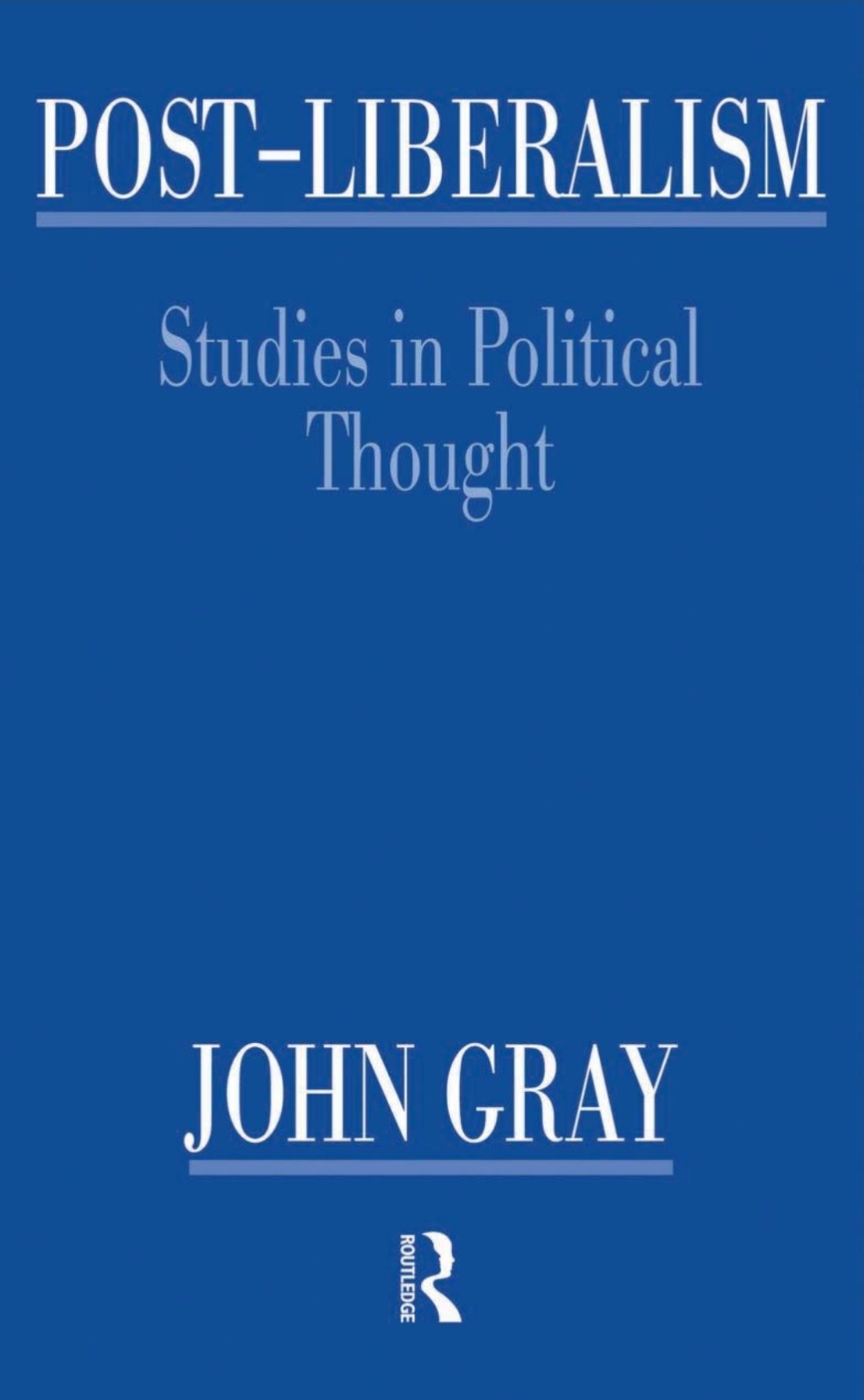
Post-Liberalism: Studies in Political Thought by John Gray—A Critical and Analytical Review
Published in 1993 as a companion volume to his earlier work Liberalisms: Essays in Political Philosophy (1989), John Gray’s Post-Liberalism: Studies in Political Thought represents a pivotal moment in contemporary political philosophy—a transitional work that captures one of the most original thinkers of our age wrestling with the foundations of liberal political theory in the wake of communism’s collapse. This collection of essays marks Gray’s intellectual journey from a critic of foundationalist liberalism to an architect of what he terms “post-modern liberal conservatism,” a position that would eventually give way to a more radical pluralism in his subsequent writings.
Intellectual Context and Historical Significance
The book’s publication coincided with a moment of triumphalism in Western political thought following the dissolution of the Soviet Union. While Francis Fukuyama proclaimed “the end of history” and the final victory of liberal democracy, Gray offered a counterintuitive and deeply skeptical assessment. Rather than celebrating liberalism’s supposed universal vindication, Gray argued that the Enlightenment project of grounding liberal values in universally compelling reason had reached bankruptcy. This intellectual courage to question liberal orthodoxy at the very moment of its apparent triumph demonstrates Gray’s characteristic independence of mind and prescience about liberalism’s future challenges.
The work comprises three distinct sections that systematically dismantle foundationalist liberalism while attempting to salvage liberal practice through radical historicism. Part I examines key thinkers in the Western political tradition—Hobbes, Santayana, Hayek, Oakeshott, Buchanan, and Berlin—reinterpreting their contributions through a post-liberal lens. Part II delivers sustained critiques of Marxism, totalitarianism, and post-Communist transitions, revealing Gray’s deep engagement with the practical failures of ideological politics. Part III confronts fundamental questions about cultural diversity, conservatism, and the living legacy of liberalism.
Core Arguments and Theoretical Framework
Gray’s central thesis rests on a dialectical relationship with liberalism itself—accepting the failures of foundationalist liberal philosophy as final while defending liberal institutions as a historical inheritance meeting human needs in late modernity. Drawing inspiration from Richard Rorty’s pragmatic historicism, Gray attempts what he calls a “radically historicist reformulation of liberal theory” that preserves the near-universal authority of liberal institutions while rejecting their metaphysical justifications.
The book’s most compelling contribution lies in its deployment of Isaiah Berlin’s value pluralism—the recognition that ultimate human values are irreducibly plural and rationally incommensurable. Gray argues that the fundamental problem of political life arises from the need to establish a sustainable modus vivendi among people holding divergent worldviews whose differences cannot be settled through rational arbitration. This insight drives his critique of both liberal and conservative political philosophy, which he sees as trapped within the Enlightenment’s universalist ambitions.
Gray’s reinterpretation of Hobbes exemplifies his approach. He presents Hobbes not as a proto-totalitarian but as offering profound insights into the modern state’s pathologies. The Hobbesian state, Gray argues, possesses unlimited authority but minimal duty—maintaining civil peace and the institutional framework for coexistence. By contrast, the modern democratic state has become “weak because it aims too high and has grown too large,” transforming itself into an arena for redistributional conflicts and doctrinal battles that recreate a political “war of all against all.” This Hobbesian critique of contemporary statism represents one of the book’s most original contributions, offering a perspective that transcends conventional left-right categorizations.
Similarly, Gray’s engagement with George Santayana reveals an underappreciated critic of liberal progressivism. Santayana’s naturalism and skepticism toward the liberal faith in progress provide Gray with resources for questioning modernity’s temporal orientation—its investment in an idealized future rather than acceptance of human nature’s constancy and limits. This anti-progressivism becomes a recurring theme throughout the volume, challenging the meliorism that Gray identifies as central to liberal thought.
Methodological Innovations and Limitations
Gray’s methodology combines historical reinterpretation, immanent critique, and philosophical reconstruction. His readings of canonical thinkers are deliberately heterodox, seeking to recover neglected dimensions of their thought that challenge contemporary orthodoxies. This approach yields genuine insights—his interpretation of Oakeshott as harboring liberal elements and Hayek as essentially conservative disrupts conventional categorizations and reveals deeper tensions within these thinkers’ projects.
However, this same eclecticism creates coherence problems. The book reads more as a collection of discrete essays than a unified theoretical statement, with argumentative threads left underdeveloped and tensions unresolved. Gray’s attempt to synthesize conservative emphasis on tradition, liberal commitment to individual liberty, and pluralist recognition of value diversity produces what some critics have identified as an unstable compound. The question of how these elements cohere—or whether they can—remains inadequately addressed.
Moreover, Gray’s historicism, while offering liberation from foundationalist pretensions, risks sliding into the very relativism he seeks to avoid. If liberal institutions are defended merely as historical inheritances suited to late modernity rather than as expressions of universal moral truths, what grounds exist for criticizing illiberal arrangements in different cultural contexts? Gray acknowledges this tension but does not fully resolve it within this volume.
Critical Engagement with Value Pluralism
The book’s deployment of Berlin’s value pluralism warrants careful scrutiny. Gray argues that value incommensurability—the impossibility of rationally ranking competing ultimate values—undermines all four core elements of liberal doctrine: universalism, egalitarianism, meliorism, and individualism. If forms of life requiring hierarchy or collective identification embody genuine human values, then liberal egalitarianism and individualism cannot claim universal validity.
This argument contains important insights but overstates its conclusions. Value pluralism establishes that reasonable people can disagree about ultimate goods without one side being irrational, but it does not follow that all ways of life are equally legitimate or that liberal arrangements lack advantages in accommodating value diversity. Critics have noted that Gray’s own commitment to minimizing cruelty and violence—central to his defense of modus vivendi—itself represents a universal moral stance that transcends mere historical contingency.
Furthermore, Gray’s conception of modus vivendi as a pragmatic accommodation among incommensurable perspectives faces the “stability problem” that haunts all such arrangements. If participants view peaceful coexistence as merely instrumental to their own ends rather than as embodying intrinsic value, what prevents defection when circumstances favor it? Rawls’s critique that modus vivendi represents a precarious “balance of forces” rather than a principled commitment retains force against Gray’s position. Gray needs but does not provide an account of why parties with deeply conflicting values would sustain their commitment to peaceful coexistence beyond prudential calculation.
The Post-Communist Dimension
Part II’s engagement with Marxism, totalitarianism, and post-Communist transitions reveals Gray’s practical political judgment at its sharpest. His essays on “The Delusion of Glasnost,” “Totalitarianism, Reform and Civil Society,” and “Post-totalitarianism, Civil Society and the Limits of the Western Model” offered prescient warnings against triumphalist assumptions about exporting liberal democratic institutions to post-Soviet societies.
Gray argued that the assumption shared across the Western political spectrum—that former Communist societies could successfully adopt Western institutional models—represented dangerous hubris rooted in Enlightenment universalism. The historical, cultural, and institutional prerequisites for liberal civil society could not be conjured by constitutional engineering or market reforms. This skepticism, controversial when published, appears vindicated by subsequent developments in Russia and much of the former Soviet space.
Yet Gray’s pessimism about post-Communist transitions arguably underestimated liberalism’s genuine appeal and adaptability in Central Europe. Poland, the Czech Republic, and the Baltic states successfully developed robust liberal democratic institutions, suggesting that the “limits of the Western model” are more permeable than Gray allowed. His analysis, while illuminating dangers of mechanical universalism, may have overcorrected toward cultural determinism.
The Paradox of Post-Liberal Liberalism
The book’s central paradox—defending liberal institutions while rejecting liberal philosophy—generates productive tensions but also conceptual difficulties. Gray claims we “need not regret the failure of foundationalist liberalism, since we have all we need in the historic inheritance of the institutions of civil society.” But if liberal institutions cannot be philosophically justified, how can they be critically evaluated, reformed, or defended against challenges?
Gray’s answer—that liberal institutions best facilitate modus vivendi in late modern conditions—itself constitutes a philosophical claim requiring justification. His position resembles Rorty’s attempt to separate the questions “Is it true?” from “Is it useful?” but faces similar objections about the coherence of defending practices whose self-understanding one rejects. Liberal institutions developed historically alongside and were shaped by the very universalist, individualist, and egalitarian commitments Gray dismisses as philosophical errors.
This internal tension would drive Gray’s subsequent intellectual evolution. In Enlightenment’s Wake (1995), he abandoned even the qualified defense of liberal institutions offered in Post-Liberalism, moving toward a more radical pluralism that accorded no universal privilege to liberal arrangements. The terms of peaceful coexistence, he came to argue, must be “worked out locally and in practice” and will “only sometimes encompass the construction of liberal institutions.” This trajectory suggests that Post-Liberalism‘s attempt to have it both ways—rejecting liberal universalism while affirming liberal institutions’ near-universal applicability—could not be sustained.
Contributions to Conservative and Communitarian Thought
Gray’s critique of abstract individualism, emphasis on historical embeddedness, and recognition of communal identity’s constitutive role in personal identity align him with conservative and communitarian traditions. His Hobbesian analysis of the modern state’s overreach resonates with conservative critiques of redistributional politics and interest-group liberalism. Yet his value pluralism cuts against conservative celebration of tradition and established practices, which often rest on claims about objective goods or natural hierarchies that pluralism calls into question.
This ambivalent relationship with conservatism reflects genuine philosophical tensions. Traditional conservatism’s defense of established institutions and practices requires believing they embody genuine goods or wisdom, but Gray’s pluralism denies any transcendent standpoint from which to validate such claims. His “post-modern liberal conservatism” thus represents an unstable synthesis, as he would later acknowledge.
Influence and Legacy
Post-Liberalism‘s influence extends beyond academic political philosophy to broader debates about liberalism’s future. Gray’s critique of universalism, progressivism, and foundationalism anticipated the “post-liberal” discourse that has gained prominence in recent years across the political spectrum. His warnings about liberal hubris in international affairs presaged the failures of democracy promotion and humanitarian intervention.
The book’s greatest lasting contribution may be its demonstration that serious critique of liberal orthodoxy need not proceed from reactionary nostalgia or utopian radicalism. Gray models a form of skeptical political thought that accepts modernity’s irreversibility while rejecting its self-congratulatory narratives. His insistence on the local, particular, and contingent character of political arrangements offers resources for thinking beyond both universalist liberalism and identitarian nationalism.
However, the book’s weaknesses—conceptual instability, incomplete arguments, and unresolved tensions—limit its success as a systematic alternative to liberal theory. It functions better as a critical intervention, exposing fault lines in liberal thought, than as a constructive political philosophy. The modus vivendi framework, while suggestive, requires substantial development to constitute a viable alternative to the liberal theories Gray critiques.
Conclusion: A Transitional Masterwork
Post-Liberalism: Studies in Political Thought occupies a crucial position in John Gray’s intellectual trajectory and late twentieth-century political philosophy more broadly. It captures a distinctive moment when the Cold War’s end invited both triumphalist celebration and critical reassessment of liberal democratic theory. Gray chose the latter path, producing a work of formidable erudition, philosophical depth, and political insight that challenged the era’s complacencies.
The book succeeds brilliantly as an immanent critique of foundationalist liberalism, demonstrating the bankruptcy of attempts to ground liberal institutions in universal reason or natural rights. Its deployment of value pluralism to expose the contingency and particularity of liberal arrangements represents a genuine theoretical advance. Its Hobbesian analysis of the modern state’s pathologies offers resources for diagnosing contemporary political dysfunctions.
Yet as a positive political philosophy, Post-Liberalism remains incomplete and internally conflicted. The attempt to defend liberal institutions through radical historicism while denying them philosophical foundations produces paradoxes Gray cannot fully resolve within this framework. The modus vivendi conception, while promising, requires more robust development to answer questions about stability, justice, and legitimacy.
These limitations do not diminish the book’s importance but rather illuminate the difficulty of Gray’s philosophical project—the attempt to think beyond liberal universalism without succumbing to relativism or reaction. That Gray himself found the position articulated here ultimately untenable, moving toward the more radical pluralism of his later work, testifies to his philosophical honesty and the genuine difficulties he confronted.
Post-Liberalism endures as essential reading for anyone grappling with liberalism’s contemporary crisis. It demonstrates that serious alternatives to liberal orthodoxy require engaging liberalism’s strongest arguments, not dismissing them. It shows that critique of universalism need not abandon commitments to peace, toleration, and human dignity, though it must reconceive their grounds. And it exemplifies the kind of restless, probing, intellectually fearless political philosophy our age requires—thought that refuses easy answers and comfortable certainties in favor of deeper understanding of our political predicaments.
Three decades after publication, as liberalism faces challenges Gray anticipated—populist backlashes, cultural fragmentation, geopolitical disorder, and internal loss of confidence—Post-Liberalism rewards renewed attention. It offers no simple solutions but provides conceptual resources for thinking through our dilemmas with clarity, historical awareness, and philosophical sophistication. That is no small achievement for any work of political philosophy, and it ensures Gray’s volume will remain a landmark in the ongoing debate about liberalism’s past, present, and uncertain future.


 Poetry Hub
Leave a reply to Swamigalkodi Astrology Cancel reply