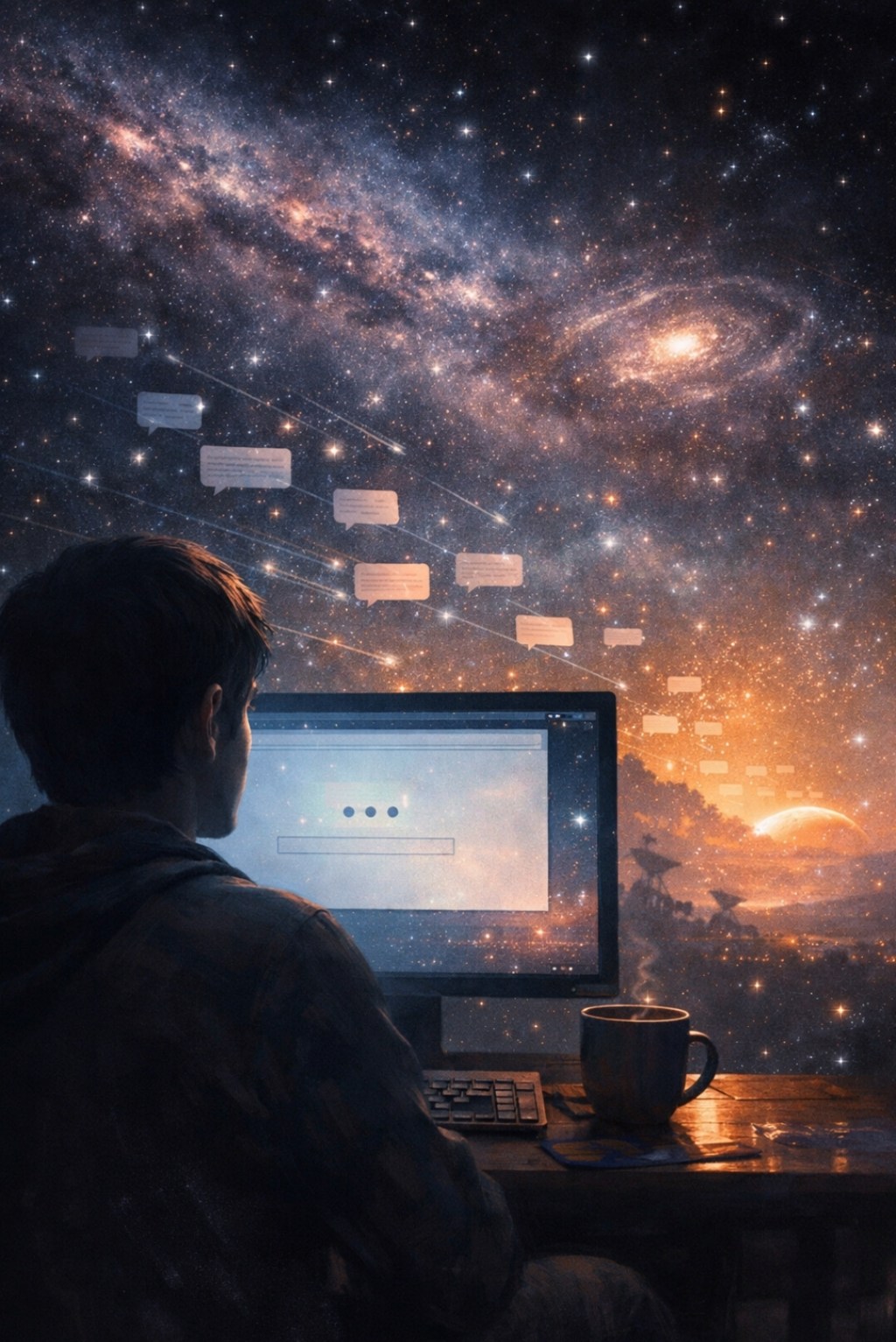
In what ways do you communicate online?
I begin with the smallest motion:
a finger hovering,
a breath held above glass,
the quiet decision to be seen
or to remain a constellation unobserved.
Online, I speak first in pauses.
In the ellipses I leave behind
like shells along a tidal line,
in the draft I save and never send,
in the blinking cursor—
that lighthouse eye
asking whether I am coming home
or sailing past again.
I communicate in fragments,
because fragments feel honest.
A thought rarely arrives whole.
It comes like weather,
like a cloud breaking itself apart
to become rain,
like rain forgetting it was ever a cloud
the moment it touches ground.
I type as if I am whispering into a cave,
uncertain what will echo back.
Some words return enlarged,
their meanings stretched by strangers’ hands.
Some fall flat,
absorbed by the moss of endless scrolling.
Online, I send messages
the way ancient people sent smoke—
hoping someone on a distant hill
would understand the shape of it
before the wind changed its mind.
There are days I speak in lowercase,
making myself small
so I do not startle anyone.
There are days I capitalize whole sentences,
trying to be heard over the thunder
of everyone else’s urgency.
I communicate with restraint,
with the soft discipline of deleting adjectives,
paring sentences down to bone.
I have learned that tone is a fragile animal here—
it bruises easily,
misreads shadows as threats,
runs at the first unfamiliar sound.
And yet,
I also communicate in excess.
In paragraphs that spill like monsoon rivers,
carrying silt and memory and half-forgotten songs.
I send voice notes when typing feels dishonest,
when breath is the only punctuation
that can carry what I mean.
Sometimes I post photographs instead of explanations:
a tree bent by coastal wind,
a cup of tea cooling beside a window,
the moon caught mid-thought
between cloud and clarity.
These are my hieroglyphs.
Read them slowly.
Online, I speak through timing.
Through the decision to reply immediately
or to wait until night settles its weight
on the day.
Silence here is not empty—
it is a language with sharp edges.
It can mean I am listening.
It can mean I am tired.
It can mean I have stepped away
to remember my own name.
I communicate in reactions—
a heart, a star, a folded pair of hands—
tiny constellations of approval or empathy.
They feel inadequate,
but sometimes they are all I have,
like waving from a passing train,
knowing the gesture must stand in
for a conversation that could have been.
There are arguments I enter
like storms I cannot turn back from.
I choose words as if choosing stones
to cross a river in flood.
One misstep
and the current will carry me
far from what I meant to say.
There are also conversations
that feel like walking through snow at dawn,
each sentence a careful footprint,
each reply a shared hush.
In those moments,
the internet stops feeling like a machine
and becomes a clearing in the woods
where two fires burn
without trying to outshine each other.
I communicate with edits.
With apologies written and rewritten,
trying to sand down the sharpness
without losing the truth.
I have learned that clarity
is not the same as cruelty,
and honesty does not require blood.
Online, I send links
the way elders once shared stories.
Read this, I say,
because it helped me survive the night.
Watch this,
because it reminded me
that laughter is still possible.
Here—
a map someone else drew
through the dark.
I also communicate through humor,
that fragile bridge made of timing and trust.
A joke can be a doorway
or a wall,
depending on who is listening.
I have learned to laugh gently here,
aware that irony does not always travel well
across oceans and cultures and time zones.
Sometimes I speak in anger,
my words sharp as broken satellites
falling back to earth.
The screen gives courage,
but also distance—
a dangerous combination.
I have watched sentences ignite
faster than they can be contained,
entire constellations of thought
burning out in seconds.
And then there are the nights
when I communicate only with the cosmos.
I stare at the blue glow
as if it were a second sky,
scrolling past lives
the way ancient astronomers traced stars.
Each profile a planet,
each post a flare,
each silence a dark matter
holding everything together.
I realize then
that online communication
is not separate from being human—
it is a new weather system
inside the old climate of longing.
We still want to be known.
We still fear being misunderstood.
We still send signals into the dark
hoping something intelligent
and kind
will answer.
I communicate by choosing what to withhold.
My grief does not always need witnesses.
My joy does not require an audience.
There is power in keeping some rooms locked,
some letters unsent,
some truths resting quietly
inside the body
like seeds waiting for rain.
I have learned to read between lines,
to listen for what is not said.
The sudden change in tone,
the delayed response,
the overuse of politeness—
these are tremors,
small earthquakes beneath the surface
of polite exchange.
Online, I speak across distances
that would have once taken lifetimes to cross.
My words arrive in cities
I will never walk,
on shores I will never touch.
This humbles me.
This frightens me.
This feels like holding a star
and realizing it is already years gone.
Sometimes,
in rare and luminous moments,
communication becomes communion.
A stranger writes something
that mirrors my own unspoken thought,
and for a second
the universe feels smaller,
or perhaps kinder.
As if consciousness itself
leaned in and said,
Yes. I see you too.
I communicate with care now,
aware that every message
is a small act of creation.
Words shape weather inside other people.
They can summon storms
or clear skies.
They can wound or warm.
They can stay longer
than I ever intended.
And so I slow down.
I let sentences breathe.
I imagine the human
on the other side of the signal—
their morning light,
their private fears,
the cup they are holding
as they read what I send.

In the end,
online communication is how I practice
being human at a distance.
How I learn to compress a soul
into characters and pauses,
how I stretch empathy
across fiber and satellite and time.
It is imperfect.
It is often clumsy.
But it is also miraculous—
this ability to send a thought
like a small spacecraft,
hoping it will land gently
on someone else’s inner world.
And when it does,
when meaning arrives intact,
when understanding flickers on
like a star finally named,
I remember:
We have always been doing this.
Carving messages into stone,
singing across valleys,
reading the sky for signs.
The screen is only the latest night sky.
And here I am,
still learning how to speak
with light.


 Poetry Hub
Hello. Thanks for visiting. I’d love to hear your thoughts! What resonated with you in this piece? Drop a comment below and let’s start a conversation.